Uncategorized
Cannabis Cultivation and Growing Tips
Sep
annabis cultivation and growing tips cover much more than simply placing a seed in soil.
Cannabis is a flowering plant whose development is influenced by genetics, environment, plant health, light, water, nutrition and growing conditions.
For U.S. readers, another factor comes before cultivation:
Is home cultivation legal where you live?
Cannabis laws vary considerably by state and sometimes by municipality. Some jurisdictions permit limited adult home cultivation, some restrict cultivation to registered medical patients, and others prohibit personal cultivation.
The same legal differences affect searches such as:
- dispensary near me open;
- weed shop near me;
- weed near me;
- delivery weed;
- weed dispensary.
This guide therefore combines basic cannabis botany and cultivation education with the legal-market context consumers need when researching marijuana in the United States.
For additional U.S.-focused cannabis education, explore Cannabistopgrade.com.
What Is a Marijuana Plant?
The marijuana plant is a form of Cannabis.
Cannabis belongs to the Cannabaceae plant family.
The plant contains numerous naturally occurring compounds, including:
- cannabinoids;
- terpenes;
- flavonoids;
- chlorophyll;
- other plant chemicals.
Two cannabinoids receive particularly significant attention:
THC and CBD.
THC is primarily responsible for marijuana’s intoxicating effects.
CBD does not produce the same characteristic intoxication as THC.
Cannabis Plant at a Glance
| Feature | Basic Explanation |
|---|---|
| Plant | Cannabis |
| Plant family | Cannabaceae |
| Major cannabinoid | THC |
| Another major cannabinoid | CBD |
| Male plants | Produce pollen |
| Female plants | Produce cannabinoid-rich flowers |
| Photoperiod varieties | Flower in response to light-cycle changes |
| Autoflowering varieties | Flower largely according to age/genetics |
| Home cultivation | Depends on state/local law |
| Sativa/indica labels | Do not perfectly predict effects |
Cannabis Plant Anatomy
Understanding cannabis starts with basic plant anatomy.
Roots
Roots anchor the plant and absorb:
- water;
- oxygen;
- mineral nutrients.
Healthy root systems are fundamental to overall plant development.
Stem
The main stem supports the plant and connects roots with leaves and branches.
Water and nutrients move through vascular tissues within the plant.
Branches
Branches support leaves and flowering sites.
Plant structure differs according to genetics and environmental conditions.
Leaves
Cannabis leaves perform photosynthesis.
The recognizable fan leaf has become one of the most familiar symbols associated with marijuana.
Flowers
Female cannabis plants can produce resinous flowers containing cannabinoid- and terpene-producing glandular structures.
These structures are commonly associated with trichomes.
What Are Cannabis Trichomes?
Trichomes are tiny structures found on cannabis flowers and surrounding plant tissue.
They contain compounds including:
- cannabinoids;
- terpenes.
As flowers develop, trichomes can become increasingly visible.
They often give mature cannabis flowers a frosty or crystalline appearance.
Male vs. Female Marijuana Plants
Cannabis plants can produce male or female reproductive structures, although breeding and cultivation practices can involve additional complexity.
Female plants are generally the focus of flower production.
Male plants produce pollen.
When pollen fertilizes female flowers, the female plant can produce seeds.
This distinction matters to cannabis breeding and botany.
Cannabis Seeds
Cannabis genetics begin with seeds or vegetatively propagated plant material.
Seeds can vary in:
- genetic stability;
- vigor;
- sex expression;
- growth characteristics;
- cannabinoid potential;
- flowering behavior.
Genetics establish possibilities, while the environment influences how those traits are expressed.
Cannabis Clones
A clone is a cutting taken from a parent plant and rooted to produce another plant.
Because clones are genetically derived from the parent, cultivators use them to preserve particular genetics.
However, genetically similar plants can still perform differently under different environmental conditions.
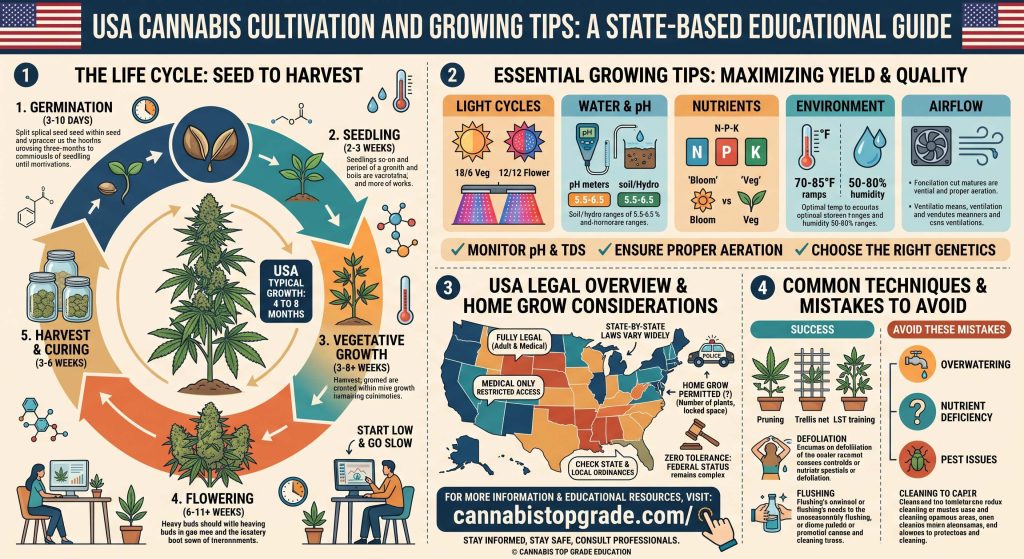
The Cannabis Life Cycle
A marijuana plant moves through several major developmental stages.
These include:
- Germination
- Seedling development
- Vegetative growth
- Pre-flowering
- Flowering
- Maturation
Each stage involves different biological processes.
Germination
Germination begins when a viable seed receives environmental conditions that trigger growth.
The seed eventually develops an initial root and shoot.
Young seedlings are particularly vulnerable to environmental stress.
Seedling Stage
During early development, the plant begins forming its first true leaves.
Seedlings require stable conditions because their root systems remain relatively small.
Problems at this stage can result from:
- excessive moisture;
- insufficient moisture;
- extreme temperature;
- inadequate light;
- disease.
Vegetative Growth
During the vegetative stage, cannabis focuses primarily on:
- roots;
- stems;
- branches;
- leaves.
Photosynthesis supports increasingly rapid plant development.
Plant structure becomes much more obvious during this stage.
Flowering
Flowering is the reproductive stage during which female cannabis plants develop flowers.
Photoperiod-sensitive cannabis responds to changes in day length.
Autoflowering varieties behave differently because flowering is driven more strongly by genetics and plant age.
Marijuana Plant Light
Light powers photosynthesis.
Cannabis grown outdoors depends primarily on sunlight.
Indoor horticulture uses artificial lighting.
Light influences:
- photosynthesis;
- plant structure;
- growth;
- flowering signals.
Too little light can restrict plant development, while excessive light and heat can stress plant tissue.
Water and Cannabis Plants
Water is essential for plant life.
However, more water does not automatically mean healthier cannabis.
Overwatering can reduce oxygen availability around roots and contribute to poor root health.
Underwatering can produce:
- wilting;
- slowed growth;
- plant stress.
Healthy cultivation depends on balancing moisture with adequate root-zone aeration.
Cannabis and Soil
Cannabis can grow in different cultivation media.
Soil-based cultivation relies on a biologically and chemically suitable root environment.
Important soil characteristics can include:
- drainage;
- aeration;
- water retention;
- organic matter;
- nutrient availability.
The ideal balance depends on the cultivation system.
Cannabis Plant Nutrients
Like other plants, cannabis requires mineral nutrients.
Important macronutrients include:
- nitrogen;
- phosphorus;
- potassium.
Plants also require smaller amounts of other elements.
More fertilizer is not necessarily better.
Excessive nutrient concentrations can damage plants and interfere with normal nutrient uptake.
Nitrogen
Nitrogen plays an important role in:
- chlorophyll;
- proteins;
- vegetative development.
Plants require different nutrient balances as they progress through their life cycle.
Phosphorus
Phosphorus participates in important plant processes involving:
- energy transfer;
- roots;
- reproduction.
It is frequently discussed in relation to flowering plants.
Potassium
Potassium contributes to numerous plant processes, including water regulation and cellular function.
Healthy plant nutrition depends on balance rather than maximizing one element.
What Is pH?
pH describes how acidic or alkaline a solution or growing environment is.
Root-zone chemistry influences nutrient availability.
Extremely unsuitable conditions can interfere with the plant’s ability to access essential nutrients even when those nutrients are physically present.
Temperature
Cannabis is sensitive to environmental temperature.
Extreme heat can contribute to:
- wilting;
- excessive water loss;
- reduced growth;
- plant stress.
Cold conditions can also slow biological processes.
Exact environmental requirements depend on genetics and developmental stage.
Humidity
Humidity describes the amount of moisture in the air.
Very humid environments can increase the risk of certain fungal problems, particularly around dense flowers.
Extremely dry environments can also stress plants.
Hereby Air movement and environmental management therefore play important roles in plant health.
Air Circulation
Air movement can help prevent stagnant, excessively humid conditions around foliage.
Poor airflow can contribute to conditions favorable to:
- mold;
- mildew;
- some pests.
Indoor cultivation environments therefore require attention to ventilation as well as light.
Cannabis Pests
Cannabis plants can be affected by pests just like other horticultural crops.
Potential pests can include:
- mites;
- aphids;
- thrips;
- fungus gnats;
- caterpillars.
Prevention and early identification are generally preferable to allowing a severe infestation to develop.
Mold and Mildew
Cannabis flowers can be susceptible to fungal contamination.
Common cultivation concerns include:
- powdery mildew;
- botrytis;
- root diseases.
Moisture, humidity, airflow, sanitation and plant density can influence disease pressure.
Moldy cannabis should not be treated as a normal characteristic of the plant.
Plant Stress
Plants respond to environmental stress.
Potential stressors include:
- excessive heat;
- cold;
- too much water;
- too little water;
- nutrient imbalance;
- pests;
- disease;
- physical damage.
A plant’s appearance can sometimes provide clues about environmental problems, but multiple problems can produce similar symptoms.
Leaf Color Is a Signal, Not a Diagnosis
Cannabis growers sometimes attempt to diagnose every issue solely by leaf color.
Yellowing leaves, for example, can have multiple causes.
Potential explanations include:
- natural aging;
- root problems;
- nutrient availability;
- environmental stress;
- disease.
A single visual symptom does not always establish the cause.
Indoor Cannabis Cultivation
Indoor cultivation gives growers greater control over environmental variables.
These can include:
- light;
- temperature;
- humidity;
- airflow.
However, indoor cultivation also introduces concerns involving:
- electricity;
- heat;
- moisture;
- fire safety;
- equipment;
- local building rules.
Home-grow legality should be confirmed before setting up an indoor cultivation area.
Outdoor Cannabis Cultivation
Outdoor cultivation uses natural sunlight.
Potential advantages can include abundant light and natural environmental conditions.
Challenges can include:
- weather;
- pests;
- animals;
- seasonal changes;
- privacy;
- legal visibility requirements.
Some states that permit home cultivation require plants to remain out of public view or inside secured areas.
Greenhouse Cultivation
Greenhouses combine characteristics of indoor and outdoor growing.
They can provide:
- sunlight;
- environmental protection;
- season extension.
Commercial greenhouse cannabis cultivation remains subject to licensing and regulatory requirements where applicable.
What Is Sativa?
The term sativa is widely used in cannabis.
The user keyword satıva is commonly written in English as sativa.
Traditional cannabis culture associates sativa plants with:
- taller growth;
- narrower leaves;
- longer flowering patterns;
- warmer-climate ancestry.
Modern cannabis breeding has produced extensive hybridization, so these traditional categories are less clear-cut than they once appeared.
Sativa vs. Indica Plant Characteristics
| Characteristic | Traditional Sativa Description | Traditional Indica Description |
|---|---|---|
| General stature | Taller | Shorter/compact |
| Leaflets | Narrower | Broader |
| Branching | Often elongated | Often compact |
| Traditional climate association | Warmer regions | Mountain/continental regions |
| Retail effect stereotype | Energizing | Relaxing |
| Guaranteed effect? | No | No |
The retail terms should not be treated as precise predictions of effects.
Does Sativa Grow Taller?
Traditional sativa-type cannabis is often associated with taller, more elongated growth.
However, modern hybrids can show characteristics inherited from multiple genetic lines.
Environmental conditions also influence plant height.
A strain labeled sativa is therefore not guaranteed to reach a specific size.
Autoflowering Cannabis
Autoflowering cannabis differs from traditional photoperiod-sensitive plants.
Its flowering behavior is strongly influenced by age and genetics rather than depending entirely on seasonal light changes.
Autoflowering traits are associated historically with Cannabis ruderalis genetics.
Modern breeders have incorporated these characteristics into numerous hybrids.
Photoperiod Cannabis
Photoperiod-sensitive cannabis responds strongly to changes in light and darkness.
Outdoors, seasonal changes help trigger flowering.
Indoor environments can reproduce different light conditions.
This biological response is one of the major characteristics distinguishing photoperiod cultivars from autoflowering varieties.
Cannabis Cultivation and Genetics
Genetics can influence:
- plant size;
- structure;
- flowering characteristics;
- cannabinoid potential;
- terpene potential;
- disease susceptibility;
- color.
However, genetics do not operate independently of environment.
This relationship is sometimes summarized as:
genotype + environment = phenotype
Purple Marijuana Plants
Some cannabis varieties develop purple, red or blue coloration.
Plant pigments called anthocyanins contribute to these colors.
Color can be influenced by:
- genetics;
- maturity;
- environmental conditions.
Purple cannabis is not automatically more potent than green cannabis.
Does Bigger Mean More THC?
No.
Plant size does not directly determine THC concentration.
A large marijuana plant can have lower cannabinoid concentrations than a smaller plant.
Potency depends on genetics and numerous cultivation and processing variables.
Cannabis Harvest and Maturity
Cannabis flowers change as the plant matures.
Commercial cultivators use several indicators to evaluate harvest maturity.
However, visual appearance alone cannot establish final THC concentration.
Laboratory testing is required for reliable cannabinoid measurement.
Drying and Curing
After harvest, cannabis flower undergoes post-harvest handling.
Drying reduces moisture.
Curing involves controlled storage intended to stabilize flower characteristics.
Poor post-harvest handling can contribute to:
- excessive dryness;
- aroma loss;
- microbial problems;
- degraded quality.
Commercial cannabis must follow applicable state regulations.
Home-Grow Laws in the United States
This is where cultivation information becomes legally important.
There is no single U.S. home-grow rule.
Depending on jurisdiction, home cultivation may be:
- permitted for adults;
- limited to medical patients;
- restricted by plant number;
- subject to household limits;
- required to remain secured;
- required to stay out of public view;
- prohibited.
Readers should verify current state and local law before cultivating cannabis.
Plant Counts Can Be Complicated
A state that permits home cultivation may impose limits involving:
- plants per adult;
- plants per household;
- mature plants;
- immature plants;
- seedlings.
Do not assume another state’s limit applies where you live.
Landlords and Cannabis Cultivation
State home-grow authorization does not necessarily override every housing restriction.
Renters may face:
- lease provisions;
- building rules;
- smoking restrictions;
- property requirements.
Housing rules should therefore be considered separately from general state legalization.
Federal Property
State cannabis legalization does not make marijuana universally legal under federal law.
This distinction can be particularly important on federal property.
State home-cultivation rules should not be generalized to federal jurisdiction.
Dispensary Near Me Open
People searching for a dispensary near me open are usually looking for current local retail availability.
Cannabis businesses are regulated at state and sometimes local levels.
Before relying on an “open” search result, check:
- state license;
- current operating hours;
- adult-use or medical status;
- local rules.
Third-party map hours can occasionally be outdated.
Weed Shop Near Me
A weed shop near me search can return businesses that are not equivalent.
Results may include:
- licensed marijuana dispensaries;
- hemp stores;
- CBD shops;
- smoke shops;
- unlicensed sellers.
A smoke shop is not automatically authorized to sell state-regulated marijuana.
Weed Near Me
The phrase weed near me is even broader.
The safest legal interpretation is:
Where does my state authorize licensed cannabis retail, if it does at all?
State cannabis regulators frequently maintain license databases or retailer locators.
These should be prioritized over unverified seller advertisements.
Weed Dispensary
A legal weed dispensary operates under the applicable regulatory framework.
Depending on the state, businesses may be licensed for:
- medical cannabis;
- adult-use cannabis;
- or both.
Licensing can involve requirements for:
- inventory;
- product testing;
- packaging;
- security;
- tracking;
- business operations.
Delivery Weed
Searches for delivery weed require particular legal caution.
Some state-regulated cannabis markets permit licensed local delivery.
Others restrict or prohibit it.
Delivery rules may also involve:
- customer eligibility;
- geographic boundaries;
- age verification;
- delivery hours;
- transaction procedures.
A website advertising delivery does not automatically mean the service is legal.
Local Delivery Is Not Interstate Shipping
A licensed local cannabis delivery service should not be confused with interstate marijuana shipping.
State authorization for local delivery does not create general authorization to mail or ship marijuana across state lines.
Consumers should be cautious about websites advertising unrestricted nationwide marijuana shipping.
Marijuana Dispensary vs. Hemp Store
State-regulated marijuana and hemp-derived products can operate under different legal frameworks.
A hemp retailer should not automatically be described as a marijuana dispensary.
Product regulation, testing and THC rules can differ.
Cultivation vs. Buying From a Dispensary
Where both are legal, home cultivation and licensed retail represent different approaches.
| Factor | Home Cultivation | Licensed Dispensary |
|---|---|---|
| Legality | State/local rules | Requires applicable license |
| Time required | Months of plant development | Product already available |
| Plant knowledge | Required | Not required |
| Environmental management | Grower responsibility | Commercial producer responsibility |
| Testing | Usually unavailable to home grower | Regulated products may require testing |
| Plant limits | Often applicable | Purchase/possession limits may apply |
| Local restrictions | Possible | Possible |
Neither option should be assumed legal without checking jurisdiction-specific rules.
Cannabis Cultivation and Environmental Impact
Commercial cannabis cultivation can have environmental effects involving:
- electricity;
- water;
- waste;
- land use;
- fertilizer;
- packaging.
Environmental requirements differ among regulated markets.
Responsible cannabis policy increasingly considers cultivation alongside retail regulation.
Safe Storage After Harvest
Cannabis should be stored securely away from:
- children;
- pets;
- unauthorized users.
This is particularly important in households where cannabis cultivation is legal.
Legal home cultivation does not eliminate the responsibility to prevent unintended access.
Cannabis and Driving
Homegrown cannabis and dispensary cannabis can both cause impairment when they contain THC.
Cannabis can affect:
- reaction time;
- coordination;
- attention;
- judgment;
- perception.
Do not drive while impaired.
Educational Resources
For additional U.S.-focused cannabis cultivation, strain and legal-market education, explore Cannabistopgrade.com.
For current state cannabis legislation and differences in medical, adult-use and home-cultivation policies, consult the NCSL State Cannabis Policy Enactment Database.
Regarding federal information concerning cannabis and public-health effects, explore the CDC Cannabis and Public Health resource.
For scientific cannabis research, readers can search the peer-reviewed literature through PubMed.
Readers can continue exploring marijuana plants, cannabinoids, cannabis laws and U.S. legal-market terminology through Cannabistopgrade.com.
Frequently Asked Questions
1. Is it legal to grow a marijuana plant at home?
It depends on state and local law. Some U.S. jurisdictions allow limited adult home cultivation, some limit growing to registered medical patients, and others prohibit personal cultivation. Check current local rules before growing.
2. What does a marijuana plant need to grow?
Like other plants, cannabis requires suitable light, water, air, root conditions, nutrients and environmental conditions. Genetics and plant health also influence development.
3. What is sativa cannabis?
Sativa is a traditional cannabis classification associated with taller plants and narrower leaves. Modern cannabis is heavily hybridized, and a sativa label does not reliably predict a particular psychological effect.
4. How can I find a licensed weed shop near me?
Where marijuana retail is legal, use the applicable state cannabis regulator’s official license search or retailer directory. This helps distinguish licensed marijuana dispensaries from hemp shops, smoke shops and unlicensed sellers.
5. How do I check whether a dispensary near me is open?
First verify that the retailer is licensed, then check its current posted operating hours. Third-party “open now” information can occasionally be outdated.
6. Is weed delivery legal?
Licensed local marijuana delivery is permitted in some jurisdictions but restricted or prohibited in others. Local delivery authorization does not mean marijuana can legally be shipped across state lines.
