
Uncategorized
Terpenes in Cannabis and Weed
Sep
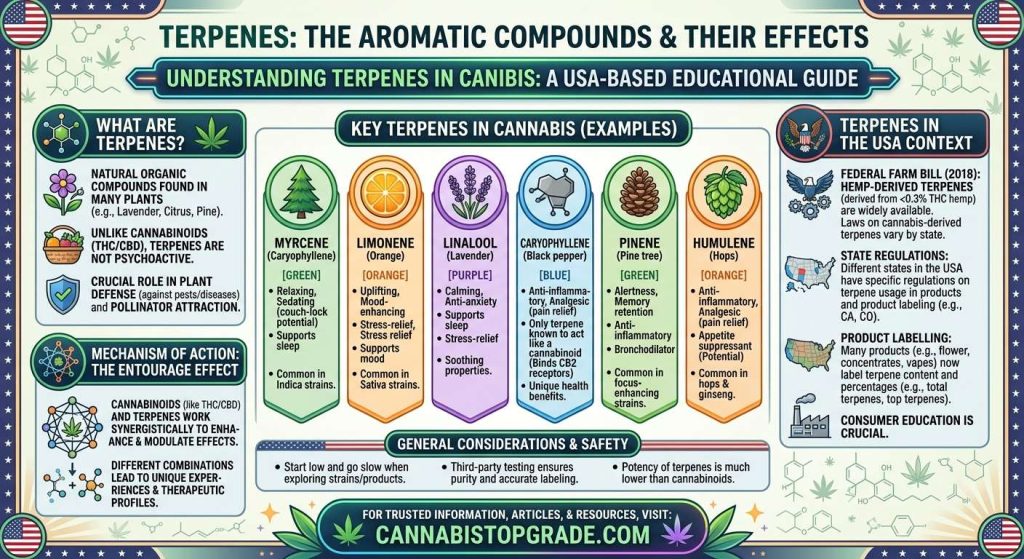
Terpenes in Cannabis and Weed are aromatic compounds that contribute to the distinctive smells and flavors associated with different cannabis products.
The pine aroma of one cultivar, citrus character of another, and earthy or floral scent of another can all be influenced partly by its terpene profile.
Common cannabis terpenes include:
- myrcene;
- limonene;
- beta-caryophyllene;
- pinene;
- linalool;
- terpinolene;
- humulene;
- ocimene.
Cannabis contains hundreds of chemical compounds, including cannabinoids, terpenes, flavonoids and other phytochemicals.
THC and CBD receive much of the public attention, but terpenes are important because they help create the plant’s sensory identity.
They should not, however, be treated as a reliable shortcut for predicting exactly how a cannabis product will affect every person.
This is particularly relevant when researching phrases such as pre rolls near me, cannabis indica, and THC lube.
A pre-roll can contain flower with a measurable terpene profile.
An indica-labeled flower may contain many of the same terpenes found in products labeled sativa.
And a topical or intimate cannabis product marketed with THC may have a completely different formulation from flower.
For additional U.S.-focused cannabis education, explore Cannabistopgrade.com.
Terpenes in Cannabis and Weed Quick Guide
| Topic | Key Point |
|---|---|
| What are terpenes? | Aromatic plant compounds |
| Do terpenes occur only in cannabis? | No |
| Do terpenes affect aroma? | Yes |
| Do terpenes affect flavor? | Yes |
| Do terpenes determine THC potency? | No |
| Is myrcene common in cannabis? | Yes |
| Is limonene found in cannabis? | Yes |
| Does “indica” guarantee one terpene profile? | No |
| Can pre-rolls contain terpenes? | Yes |
| Does a strain name guarantee chemistry? | No |
| Are terpene medical effects settled science? | No |
| Can THC products differ greatly by formulation? | Yes |
What Are Cannabis Terpenes?
Terpenes are naturally occurring aromatic compounds produced by many plants.
They are found in:
- citrus fruits;
- lavender;
- pine;
- hops;
- rosemary;
- black pepper;
- cannabis.
In cannabis, terpenes are produced primarily in glandular trichomes along with cannabinoids.
They contribute to the plant’s:
- smell;
- flavor;
- chemical complexity.
Are Terpenes Cannabinoids?
No.
Terpenes and cannabinoids are different chemical groups.
Examples of cannabinoids include:
- THC;
- CBD;
- CBG;
- CBC;
- CBN.
Examples of terpenes include:
- myrcene;
- limonene;
- caryophyllene;
- pinene;
- linalool.
A cannabis product can contain both.
What Does THC Do?
THC, or delta-9-tetrahydrocannabinol, is the primary intoxicating cannabinoid associated with cannabis.
THC can affect:
- memory;
- attention;
- coordination;
- judgment;
- reaction time.
The CDC notes that THC-containing cannabis products carry health risks regardless of how they are used.
What Do Terpenes Do?
The clearest established role of cannabis terpenes is sensory.
They contribute to:
- aroma;
- flavor;
- plant chemistry.
Scientists are also investigating possible biological activity.
A 2026 systematic review found promising preclinical evidence involving non-cannabinoid cannabis compounds, including terpenes, but also emphasized limited clinical translation and the need for better standardization and research.
The Cannabis Entourage Effect
The term entourage effect describes the hypothesis that cannabinoids and other cannabis compounds may interact in ways that differ from isolated compounds.
This is an active research area.
A 2026 laboratory study reported additive and synergistic interactions between several terpenes and THC at CB1 and CB2 cannabinoid receptors.
That is scientifically interesting, but receptor-level findings should not be translated into claims that a particular terpene will reliably create a specific effect in people.
Are Terpenes Psychoactive?
Most common cannabis terpenes are not intoxicating in the same way THC is.
They can have biological activity, but smelling limonene or myrcene is not equivalent to consuming THC.
This distinction is important.
Myrcene
Myrcene is one of the most frequently discussed cannabis terpenes.
Its aroma is often described as:
- earthy;
- herbal;
- musky;
- slightly fruity.
Myrcene also occurs naturally in:
- hops;
- mango;
- thyme.
Does Myrcene Make Cannabis “Indica”?
Not necessarily.
Myrcene often appears in cannabis products marketed as indica, but it is not exclusive to indica-labeled flower.
Cannabis chemistry does not follow the simple rule:
myrcene = indica.
Limonene
Limonene is associated with citrus-like aromas.
It is naturally abundant in:
- lemons;
- oranges;
- other citrus peels.
Cannabis products rich in limonene may smell:
- lemony;
- orange-like;
- fresh;
- sweet.
Caryophyllene
Beta-caryophyllene is associated with:
- pepper;
- spice;
- wood;
- earth.
It is also naturally found in:
- black pepper;
- cloves;
- hops.
Caryophyllene is unusual among common terpenes because it has documented interaction with cannabinoid CB2 receptors.
That does not make every caryophyllene-rich cannabis strain a medical treatment.
Pinene
Pinene produces a pine-like aroma.
It is found naturally in:
- pine trees;
- rosemary;
- basil;
- cannabis.
Two common forms are:
- alpha-pinene;
- beta-pinene.
Linalool
Linalool is associated with:
- floral;
- lavender-like;
- sweet;
- herbal;
aromas.
It occurs naturally in lavender and other aromatic plants.
Terpinolene
Terpinolene can smell:
- floral;
- herbal;
- piney;
- citrus-like.
It appears as a dominant terpene in some well-known cannabis cultivars.
Humulene
Humulene contributes:
- earthy;
- woody;
- hop-like;
aromas.
It occurs naturally in hops and is closely associated chemically with beta-caryophyllene.
Ocimene
Ocimene can contribute:
- sweet;
- tropical;
- herbal;
- floral;
notes.
It appears in smaller concentrations in many cannabis chemovars.
Cannabis Terpene Comparison
| Terpene | Common Aroma Associations | Also Found In |
|---|---|---|
| Myrcene | Earthy, herbal, musky | Hops, mango |
| Limonene | Lemon, citrus | Citrus peel |
| Caryophyllene | Pepper, spice, wood | Black pepper, cloves |
| Pinene | Pine, fresh herbs | Pine, rosemary |
| Linalool | Floral, lavender | Lavender |
| Terpinolene | Floral, pine, citrus | Nutmeg, tea tree |
| Humulene | Earthy, woody, hops | Hops |
| Ocimene | Sweet, floral, tropical | Mint, basil |
Cannabis Indica
A Cannabis indica is a traditional botanical and commercial classification commonly used in the cannabis market.
Consumers often associate indica with:
- relaxation;
- heavier body sensations;
- evening use.
However, those expectations should not be treated as guarantees.
Indica vs. Sativa
The commercial labels:
indica
and:
sativa
do not reliably describe the full cannabinoid and terpene chemistry of a product.
Modern cannabis has undergone extensive hybridization.
Two products both labeled indica can have significantly different:
- THC levels;
- CBD levels;
- terpene profiles;
- minor cannabinoid concentrations.
Is Indica Always Relaxing?
No.
People often describe indica products as relaxing, but individual responses depend on much more than a label.
Factors include:
- THC concentration;
- CBD concentration;
- terpene composition;
- dose;
- tolerance;
- individual physiology.
Is Sativa Always Energizing?
No.
“Sativa = energetic” and “indica = sleepy” are useful retail shorthand, but they are not precise scientific predictions.
A chemical profile provides more useful information.
Cannabis Chemovars
Researchers increasingly use the concept of a chemovar or chemical variety.
A chemovar can be characterized by measurable compounds such as:
- THC;
- CBD;
- CBG;
- myrcene;
- limonene;
- caryophyllene.
This approach is generally more informative than relying solely on indica or sativa terminology.
Why Strain Names Can Be Misleading
A strain name does not guarantee identical chemistry.
Two products sold under the same name can differ because of:
- genetics;
- phenotype;
- growing environment;
- harvest timing;
- curing;
- storage;
- producer practices.
Laboratory testing provides stronger evidence.
Terpenes and Cannabis Aroma
Terpenes are major contributors to cannabis aroma.
However, cannabis odor is more complicated than terpenes alone.
Other volatile compounds also contribute.
That means a strain’s aroma cannot always be explained by its top three terpenes.
Why Cannabis Can Smell Skunky
Cannabis can produce strong skunk-like aromas.
Research suggests sulfur-containing volatile compounds also contribute to certain characteristic cannabis odors.
Therefore, “skunky” cannabis should not automatically be attributed to one terpene.
Terpenes and Flavor
Flavor perception involves both:
- taste;
- aroma.
When people describe cannabis as:
- lemon;
- berry;
- pine;
- fuel;
- floral;
- peppery;
much of that experience is influenced by volatile aromatic compounds.
Do Terpenes Determine Potency?
No.
THC concentration and terpene concentration are different measurements.
A flower with:
3% total terpenes
does not automatically have more THC than flower with:
1.5% terpenes.
Both should be measured separately.
Total Terpenes
Cannabis laboratory reports may list:
total terpenes.
This represents the measured amount of specified terpene compounds in a sample.
Exact methodology varies among laboratories.
Terpene Percentage
Some regulated cannabis products display terpene percentages.
For example, a product might identify:
- myrcene;
- limonene;
- caryophyllene;
as its three largest measured terpenes.
Those results apply to the tested batch.
Batch Variation
Even cannabis produced by the same grower can vary from batch to batch.
Factors include:
- temperature;
- lighting;
- harvest timing;
- curing;
- storage.
That is why the same strain name may smell different on two occasions.
Terpene Preservation
Terpenes are volatile.
Exposure to:
- excessive heat;
- oxygen;
- light;
- prolonged storage;
can change aroma and chemical composition.
Freshness therefore matters.
Pre Rolls Near Me
The phrase pre rolls near me usually refers to pre-rolled cannabis products available from local retailers.
Where marijuana is legal, pre-rolls should be obtained only through appropriately licensed cannabis businesses.
Cannabis regulations vary by state.
What Is a Pre-Roll?
A cannabis pre-roll is cannabis flower that has already been rolled into paper for consumers.
It may contain:
- ground cannabis flower;
- whole-flower material;
- a blend of cultivars.
Some pre-rolls are infused.
Infused Pre-Rolls
An infused pre-roll can contain cannabis flower combined with:
- hash;
- concentrate;
- kief;
- other cannabis extracts.
This can result in substantially higher THC concentration than ordinary flower.
Regular vs. Infused Pre-Rolls
| Feature | Regular Pre-Roll | Infused Pre-Roll |
|---|---|---|
| Flower | Yes | Usually yes |
| Added concentrate | Usually no | Yes |
| THC concentration | Variable | Often higher |
| Terpenes | Naturally occurring | Natural and/or added |
| Product testing | Important | Especially important |
Terpenes in Pre-Rolls
Pre-rolls can retain the terpene profile of the flower used to produce them.
However, terpene levels may decline through:
- storage;
- oxidation;
- heat;
- poor packaging.
Freshness and product handling matter.
Does a Pre-Roll Have the Same Terpenes as Flower?
Not always.
If the pre-roll contains the exact same flower batch, its original terpene profile may be similar.
But grinding and storage increase surface area and may accelerate terpene loss.
Infused pre-rolls can have additional terpene ingredients.
How to Evaluate a Pre-Roll Label
Useful regulated label information can include:
- THC;
- CBD;
- cannabinoid totals;
- batch number;
- testing information;
- ingredients;
- terpene results where provided.
Marketing words alone provide less useful information.
“Pre Rolls Near Me” and Legal Markets
A search result can show:
- licensed marijuana dispensaries;
- hemp retailers;
- smoke shops;
- delivery businesses.
Those categories are not legally identical.
When adult-use marijuana is legal, the relevant state regulator’s license database is the stronger verification source.
Cannabis Indica Pre-Rolls
Indica-labeled pre-rolls are common.
However, the word indica does not tell you the:
- exact THC percentage;
- exact terpene profile;
- precise effect.
Check the product’s chemistry instead.
Indica Terpenes
Common terpenes in products marketed as indica may include:
- myrcene;
- caryophyllene;
- limonene;
- linalool.
But none is exclusive to indica.
THC Lube
THC lube generally refers to an intimate topical product formulated with THC or cannabis-derived ingredients.
It is different from:
- cannabis flower;
- a vape;
- an edible;
- an ordinary personal lubricant.
Exact formulations differ substantially.
Does THC Lube Make You High?
Not necessarily.
Whether THC produces systemic psychoactive effects depends on:
- formulation;
- route of administration;
- absorption;
- concentration;
- product design.
A topical product intended primarily for local application is not automatically equivalent to an edible or inhaled THC product.
Consumers should follow the product label and understand the formulation.
THC Lube vs. Topical Cannabis Products
Cannabis topical products can include:
- creams;
- balms;
- oils;
- intimate lubricants.
Some contain:
- THC;
- CBD;
- both cannabinoids;
- terpenes.
Different products are designed for different areas of the body.
THC Lube and Product Safety
Intimate products require extra care because sensitive tissue can react differently from ordinary skin.
Useful label information includes:
- ingredient list;
- cannabinoid amount;
- allergen information;
- intended application;
- warnings.
A product marketed simply as “THC lube” should not be assumed suitable for every type of intimate use.
THC Lube and Latex Condoms
Oil-based lubricants can damage latex condoms.
This issue depends on the lubricant base rather than THC itself.
A consumer using latex barriers should check whether the product is:
- water-based;
- silicone-based;
- oil-based;
and review manufacturer compatibility instructions.
THC Lube and Terpenes
Some cannabis lubricants may contain aromatic terpenes.
Terpenes used in products for sensitive skin or mucosal areas should not be assumed harmless solely because they occur naturally.
Concentration and formulation matter.
Natural Does Not Mean Risk-Free
Terpenes occur naturally in many plants, but “natural” does not automatically mean non-irritating.
Some people can experience:
- skin irritation;
- sensitivity;
- allergic reactions.
This principle applies to cannabis cosmetics and intimate products.
THC Lube and Medical Claims
Products should not automatically be described as treatments for:
- sexual dysfunction;
- chronic pelvic pain;
- endometriosis;
- vaginal pain;
- erectile dysfunction.
Evidence for specific THC intimate products remains limited.
Medical symptoms should be evaluated appropriately rather than relying solely on product marketing.
Does THC Lube Increase Arousal?
Some products are marketed with claims related to intimacy or sensation.
However, marketing claims are not the same as established clinical evidence.
Individual experiences can vary widely.
Cannabis Terpenes and Sexual Wellness
Terpenes are sometimes marketed within sexual-wellness cannabis products.
There is not enough evidence to say that a specific terpene profile reliably improves sexual performance or arousal.
Claims should therefore remain cautious.
Terpenes and Relaxation
Consumers often associate terpenes such as:
- myrcene;
- linalool;
with relaxation.
Laboratory and preclinical research has explored possible biological effects.
But a product’s terpene profile cannot guarantee relaxation in humans.
Terpenes and Energy
Limonene, pinene and terpinolene are sometimes marketed as “energizing.”
These labels are largely based on:
- aroma;
- consumer experiences;
- preclinical research.
They should not be treated as predictable clinical effects.
Terpenes and Focus
Pinene is sometimes marketed as a “focus terpene.”
Current evidence does not justify claiming that pinene-rich cannabis reliably improves attention or treats ADHD.
THC can impair attention and memory.
Terpenes and Sleep
Myrcene and linalool are frequently promoted as sleep-related terpenes.
However, terpene content alone cannot determine whether a cannabis product will improve sleep.
Cannabis sleep evidence remains mixed.
Terpenes and Pain
Cannabis terpenes are being researched for possible biological activity related to inflammation and pain pathways.
But evidence remains insufficient to claim that a terpene-rich recreational cannabis product is a proven pain treatment.
Terpenes and Anxiety
Some terpenes have shown promising effects in laboratory or animal research.
Human effects are less certain.
THC itself can increase anxiety in some individuals.
The Importance of THC Concentration
When trying to predict a cannabis product’s effects, THC concentration remains an important factor.
High-THC cannabis may increase the likelihood of:
- anxiety;
- dizziness;
- impairment;
- rapid heart rate;
- unpleasant psychological effects.
Terpenes do not cancel THC-related risks.
Cannabis Use Disorder
Some cannabis users develop cannabis use disorder.
The CDC notes that stronger THC concentrations can be associated with greater risk or more severe symptoms in some users.
Possible signs include:
- craving;
- increasing tolerance;
- difficulty reducing use;
- continued use despite problems.
Terpenes Do Not Make High-THC Cannabis Risk-Free
A product advertised as:
- terpene-rich;
- full-spectrum;
- live resin;
- natural;
can still contain a high concentration of THC.
Those marketing terms should not obscure potency.
Terpenes in Live Resin
Live resin products are often marketed for strong terpene preservation.
They are generally produced from cannabis material preserved soon after harvest.
That can help retain volatile aromatic compounds.
Live Resin vs. Distillate
Live resin generally emphasizes preservation of a broader aromatic profile.
Distillate generally emphasizes refined cannabinoid concentration.
Manufacturers can also add terpenes to distillate formulations.
Cannabis Vape Terpenes
Cannabis vape products frequently contain terpene blends.
These may be:
- cannabis-derived;
- botanically derived;
- formulated to imitate particular strains.
A strain name on a vape does not guarantee the chemistry matches the flower version.
Terpenes in Edibles
Edibles can contain terpenes, but the sensory experience differs greatly from inhaled cannabis.
Many edibles rely primarily on:
- cannabinoid extracts;
- food flavors;
- sweeteners.
Their effects are driven largely by cannabinoid dose rather than cannabis aroma.
Terpenes in Concentrates
Concentrates can preserve or contain significant amounts of terpenes.
Examples include:
- live resin;
- rosin;
- sauce;
- certain waxes.
Terpene percentages vary widely.
High-Terpene Cannabis
Higher terpene concentration can produce stronger aroma.
It does not automatically mean:
- better quality;
- stronger intoxication;
- stronger medical benefit.
Quality is multidimensional.
Cannabinoid-to-Terpene Ratios
Some laboratories and brands discuss cannabinoid-to-terpene ratios.
These may help describe a chemical profile.
There is no universal ratio that guarantees a specific subjective effect.
Why Laboratory Testing Matters
Cannabis laboratory results can provide:
- THC concentration;
- CBD concentration;
- minor cannabinoids;
- terpene measurements;
- contaminant screening.
This provides more useful information than relying solely on cultivar names.
Certificate of Analysis
A Certificate of Analysis, or COA, provides laboratory findings for a particular batch.
Useful COA information can include:
- cannabinoids;
- terpenes;
- pesticides;
- residual solvents;
- microbial testing.
Requirements depend on jurisdiction.
Terpene Labels and Marketing
Common marketing terms include:
- uplifting;
- calming;
- relaxing;
- creative;
- focused.
Consumers should understand that these are not equivalent to clinical guarantees.
Cannabis Indica and Terpenes
The most accurate way to describe indica today is:
a broad cannabis classification with cultural and commercial meaning, but limited ability to predict exact chemistry or effects.
Terpene and cannabinoid testing provides more specific information.
Pre-Rolls and Terpene Freshness
Because cannabis is ground before being rolled, pre-roll material may lose volatile aromatic compounds faster than intact buds.
Packaging matters.
Air-tight containers can help preserve aroma better than poorly sealed packaging.
Cannabis Storage and Terpenes
Excessive exposure to:
- heat;
- oxygen;
- light;
can degrade cannabis compounds.
Cool, dark, controlled storage helps preserve quality.
Cannabis should also be stored securely away from children and pets.
Cannabis and Driving
Terpenes do not prevent THC impairment.
People should not drive while impaired by cannabis.
THC can affect reaction time, judgment and coordination.
Educational Resources
For additional U.S.-focused cannabis strain, cannabinoid and terpene education, explore Cannabistopgrade.com.
Regarding current public-health information about cannabis, review the CDC Cannabis and Public Health.
For a recent scientific review of cannabis non-cannabinoid phytochemicals, including terpenes, see PubMed – The Pharmacological Activity of Non-Cannabinoid Phytochemicals in Cannabis sativa.
Regarding recent research examining terpene and THC receptor interactions, see PubMed – Synergistic and Additive Terpene-THC Interactions.
For further U.S. cannabis education, continue exploring Cannabistopgrade.com.
Frequently Asked Questions
1. What are terpenes in cannabis and weed?
Terpenes are aromatic compounds found in cannabis and many other plants. They contribute significantly to cannabis aroma and flavor. Common cannabis terpenes include myrcene, limonene, caryophyllene, pinene, linalool and terpinolene.
2. Do terpenes make cannabis indica or sativa?
Not by themselves. Products marketed as indica and sativa can share many of the same terpenes. Modern cannabis is heavily hybridized, and cannabinoid and terpene testing provides more specific chemical information than the indica-sativa label alone.
3. Do pre-rolls contain terpenes?
Yes. Cannabis pre-rolls contain terpenes naturally present in the flower used to make them. Terpene levels can change through grinding, storage, heat and oxidation. Infused pre-rolls may also contain concentrate or added terpene formulations.
4. What does “pre rolls near me” mean?
The phrase generally refers to nearby retailers offering pre-rolled cannabis products. In states with legal marijuana markets, consumers should distinguish licensed cannabis dispensaries from smoke shops or hemp retailers and follow the applicable state laws.
5. What is THC lube?
THC lube is an intimate topical product formulated with THC or cannabis-derived ingredients. Formulations differ, and these products should not be assumed to produce the same effects as inhaled or edible THC. Ingredients, intended application and compatibility with barrier products should be checked carefully.
6. Do cannabis terpenes determine the effects of weed?
Not by themselves. Terpenes contribute to cannabis chemistry and are being studied for biological activity, but THC, CBD, minor cannabinoids, terpene concentrations, dose, individual biology and tolerance can all influence the experience. Current research does not support predicting a person’s exact response from terpene content alone.
