Uncategorized
THC and Cannabis Beverages: Effects, Dispensary Deals and Legal Discount Cannabis Guide
Sep
THC and cannabis beverages are an expanding category of infused products that combine cannabinoids with drinks such as sparkling water, sodas, teas, juices and other nonalcoholic beverages. At the same time, consumers searching for these products often use commercial phrases such as dispensary promos, cheapest dispensary near me, dispensary deals today near me, deals weed, and discount dispensary.
Those price-focused searches deserve careful context.
A cheap cannabis product is not automatically a good product, and a promotional dispensary advertisement does not prove that the retailer is licensed.
Cannabis laws remain different across U.S. states. Where adult-use or medical marijuana retail is legal, consumers should prioritize licensed businesses, regulated products and clear cannabinoid labels before focusing on discounts.
THC beverages also require particular attention because they behave more like edible cannabis than smoked cannabis. Their effects can be delayed, may last longer than expected and can be difficult to judge if a person consumes additional servings too quickly.
For more U.S.-focused cannabis education, visit Cannabistopgrade.com.
What Are THC and Cannabis Beverages?
Cannabis beverages are drinks infused with cannabinoids.
They can contain:
- THC;
- CBD;
- THC and CBD together;
- other cannabinoids;
- or hemp-derived cannabinoid formulations.
Common formats include:
- sparkling water;
- sodas;
- flavored waters;
- teas;
- juices;
- mocktails;
- drink powders;
- shots;
- and other infused beverages.
Not every cannabis beverage is intoxicating.
The cannabinoid content determines much of the expected effect.
THC vs. CBD Beverages
THC and CBD drinks should not be treated as interchangeable.
| Beverage Type | Main Cannabinoid | Intoxicating? | General Consideration |
|---|---|---|---|
| THC beverage | THC | Yes | Can impair judgment and coordination |
| CBD beverage | CBD | Generally no | Effects vary and claims should be evaluated carefully |
| THC + CBD beverage | Both | Usually yes | Ratio influences overall cannabinoid profile |
| Hemp beverage | Varies | Depends on formulation | State laws may apply |
| Cannabis mocktail | Often THC | Usually yes | Not equivalent to an alcohol-free ordinary drink |
A product labeled “cannabis beverage” should always be checked for the actual cannabinoids present.
How THC Beverages Work
THC drinks are consumed orally.
That means their effects can differ from inhaled marijuana.
When THC is swallowed, it passes through the digestive system and liver before reaching the bloodstream.
This process can delay intoxication compared with smoking or vaping.
The CDC notes that edible cannabis products, including infused foods and drinks, may take 30 minutes to two hours to produce intoxicating effects.
This delay is one of the most important safety considerations.
Why THC Drinks Can Be Misleading
A person may drink a cannabis beverage and feel little effect immediately.
That can create the mistaken impression that the product is weak.
Consuming more before the first serving has taken effect can lead to unexpectedly intense intoxication later.
Factors affecting onset include:
- amount consumed;
- THC concentration;
- whether food was eaten recently;
- individual metabolism;
- previous cannabis experience;
- other medications;
- and alcohol use.
THC Beverage Effects
Possible effects can include:
- relaxation;
- euphoria;
- altered perception;
- increased appetite;
- sleepiness;
- laughter;
- or changes in mood.
Unwanted effects can include:
- anxiety;
- dizziness;
- confusion;
- nausea;
- paranoia;
- impaired coordination;
- and excessive sedation.
The experience varies substantially from person to person.
How Long Do Cannabis Beverages Last?
Oral THC can last longer than inhaled cannabis.
There is no universal duration because effects depend on:
- cannabinoid concentration;
- serving size;
- metabolism;
- tolerance;
- food intake;
- product formulation;
- and other substances.
The important point is that consumers should not assume a THC drink will behave like a normal soda or energy drink.
Cannabis Beverages vs. Smoking
| Feature | THC Beverage | Smoked Cannabis |
|---|---|---|
| Route | Oral | Inhaled |
| Onset | Slower | Usually faster |
| Duration | Can be longer | Often shorter |
| Dose recognition | Can be difficult | Effects felt sooner |
| Lung exposure | No smoke inhalation | Smoke exposure |
| Overconsumption risk | Important due to delay | Different pattern |
Neither format should be considered risk-free.
THC Beverage vs. Cannabis Gummies
Both are orally consumed cannabis products.
Their pharmacological characteristics can therefore overlap.
The main difference is format.
THC beverages are liquid, while gummies are solid edible products.
Both can involve:
- delayed onset;
- long-lasting effects;
- serving-size confusion;
- and accidental overconsumption.
Are Cannabis Drinks Safer Than Smoking?
Avoiding smoke can reduce exposure to combustion products.
However, this does not mean THC beverages are harmless.
They still can cause:
- intoxication;
- impaired judgment;
- anxiety;
- dizziness;
- and accidental overconsumption.
Different consumption methods involve different risk profiles.
Cannabis Drinks and Alcohol
Consumers should be particularly cautious about combining THC with alcohol.
Using both can increase impairment.
Possible effects may include:
- dizziness;
- nausea;
- poor coordination;
- confusion;
- and reduced judgment.
A THC beverage should not be treated like an ordinary nonintoxicating soft drink.
THC Mocktails
Cannabis mocktails have become increasingly visible in markets where cannabinoid beverages are sold.
The word mocktail usually means a drink without alcohol.
However, a THC mocktail can still be intoxicating.
“Alcohol-free” does not mean “impairment-free.”
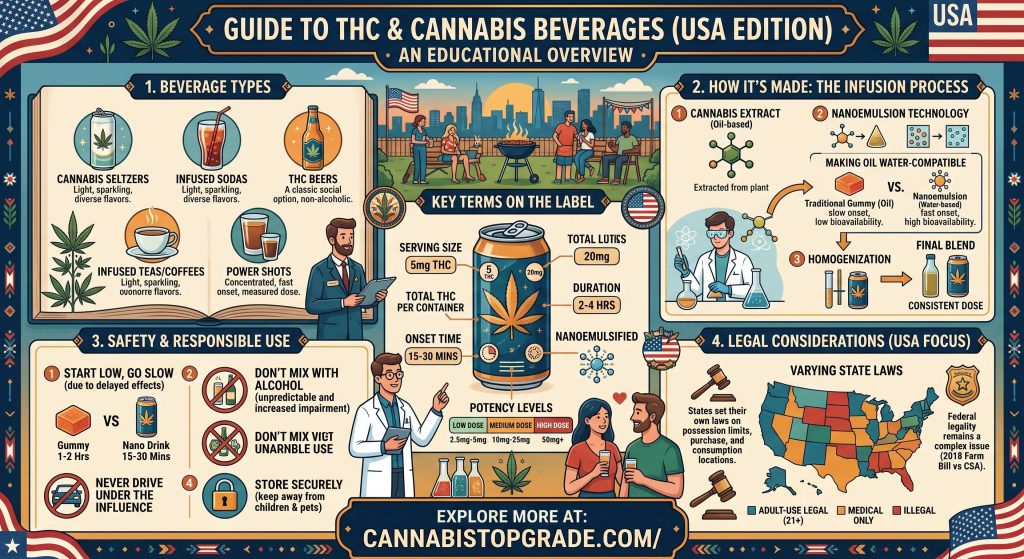
Reading a THC Beverage Label
A useful cannabis beverage label should make cannabinoid information clear.
Look for:
THC per serving
This indicates the amount associated with one defined serving.
THC per container
A bottle or can may contain more than one serving.
CBD content
Some beverages combine THC and CBD.
Serving size
This is especially important if the package contains multiple servings.
Ingredients
Check the full formulation.
Required warnings
Regulated products may carry state-specific warning statements.
Serving Size vs. Container Size
One of the easiest mistakes is confusing a whole container with a single serving.
For example, a package could theoretically contain several cannabinoid servings even though it looks like an ordinary single drink.
Consumers should therefore check:
THC per serving and total THC per package separately.
THC Potency Is Not the Same as Quality
A beverage containing more THC is not automatically better.
Quality can also involve:
- accurate labeling;
- formulation consistency;
- flavor;
- packaging;
- regulatory testing;
- manufacturing quality;
- cannabinoid balance;
- and freshness.
Maximum potency should not be the only buying criterion.
Dispensary Promos
The phrase dispensary promos refers to promotional offers from cannabis retailers.
Depending on state and local rules, promotions may include:
- percentage discounts;
- loyalty rewards;
- reduced-price products;
- patient discounts;
- clearance products;
- or scheduled promotional events.
Cannabis advertising and promotional rules differ by jurisdiction.
A promotion should not be assumed lawful simply because it appears online.
Dispensary Deals Today Near Me
Someone searching dispensary deals today near me is usually looking for current cannabis pricing.
Because discounts change quickly, static articles cannot reliably identify today’s cheapest retailer.
A better process is to:
- first confirm that recreational or medical cannabis retail is legal;
- verify the retailer’s active license;
- review its current menu;
- compare the same product size and category;
- and check whether taxes or other charges are included.
Price comparison should come after license verification.
Cheapest Dispensary Near Me
The phrase cheapest dispensary near me sounds straightforward, but cannabis prices can be difficult to compare.
Two retailers may advertise different prices because their products differ in:
- weight;
- potency;
- brand;
- quality;
- age;
- cultivation method;
- testing;
- or taxes.
The lowest advertised number may not represent the lowest comparable price.
How to Compare Dispensary Prices Properly
For flower, compare:
- price per gram;
- package size;
- cannabinoid information;
- cultivator;
- harvest or package date;
- and applicable taxes.
For cannabis beverages, compare:
- container size;
- THC per serving;
- total cannabinoid content;
- number of servings;
- and total price.
This provides more meaningful information than comparing package price alone.
Deals Weed
The phrase deals weed is usually shorthand for cannabis discounts.
Discounted products may include:
- older inventory;
- small flower buds;
- house brands;
- larger package sizes;
- limited promotions;
- or products nearing a retailer’s inventory rotation deadline.
A discount does not automatically indicate poor quality.
Likewise, a high price does not automatically guarantee superior cannabis.
Discount Dispensary
A discount dispensary typically emphasizes lower-priced cannabis products.
That business model can exist legally within regulated markets.
Consumers should still evaluate:
- license status;
- product testing;
- labels;
- storage;
- freshness;
- retailer reputation;
- and transparency.
Low pricing should never replace basic regulatory verification.
Licensed vs. Unlicensed Discounts
A large discount can attract attention.
But offers from an unlicensed seller do not have the same regulatory framework as deals from a licensed cannabis dispensary.
Licensed-market products may be subject to requirements involving:
- laboratory testing;
- contaminant screening;
- labeling;
- packaging;
- inventory tracking;
- security;
- age verification;
- and recalls.
Exact requirements differ among states.
Cannabis Taxes and Dispensary Prices
Taxes can make cannabis pricing confusing.
Depending on jurisdiction, legal cannabis may be subject to:
- sales tax;
- cannabis excise taxes;
- local taxes;
- or other fees.
A menu price may therefore not equal the final amount charged.
When comparing “cheap” dispensaries, consumers should consider the final transaction price where possible.
Medical Patient Discounts
Some regulated cannabis retailers provide discounts for medical patients.
Programs vary.
Possible benefits can include:
- lower prices;
- medical-only products;
- different tax treatment;
- or patient loyalty programs.
Whether these benefits exist depends on state law and retailer policy.
Veteran and Senior Discounts
Some dispensaries advertise promotional discounts for veterans or older adults.
Such programs are retailer-specific and subject to local regulations.
Consumers should verify current terms directly with licensed businesses.
Cannabis Loyalty Programs
Some regulated retailers use loyalty systems.
These can involve:
- points;
- member pricing;
- periodic discounts;
- or promotional notices.
Cannabis marketing regulations can restrict how promotions operate, especially concerning youth exposure or excessive consumption.
Are Dispensary Deals Always Better Value?
No.
A discounted product may be good value, but consumers should still check:
- product age;
- THC;
- CBD;
- batch details;
- package condition;
- testing information;
- serving quantity;
- and producer.
For THC beverages, accurate dosing information is particularly important.
Clearance Cannabis
Cannabis retailers may discount inventory as it ages.
Cannabis does not necessarily become dangerous simply because it is older, but quality can decline.
Potential changes can include:
- reduced aroma;
- drying;
- terpene loss;
- flavor changes;
- and cannabinoid degradation.
Packaging dates can therefore matter when evaluating a sale.
Dispensary Promotions and High THC
Promotional advertising sometimes emphasizes very high THC percentages.
Consumers should avoid assuming:
high THC + low price = best deal.
Potency is only one product characteristic.
For beverages especially, predictable labeling and serving information may be more useful than maximizing cannabinoid content.
THC Beverages and Driving
THC beverages can impair abilities necessary for safe driving.
These include:
- reaction time;
- judgment;
- coordination;
- attention;
- and decision-making.
The delayed onset of oral THC can make impairment especially unpredictable.
Someone should not assume they are safe to drive simply because they do not feel intoxicated immediately after drinking a THC beverage.
Cannabis Beverages and Work
THC beverages can also affect workplace performance.
Possible impairment can involve:
- attention;
- judgment;
- memory;
- reaction speed;
- and coordination.
State cannabis legalization does not necessarily prevent employers from maintaining workplace impairment or drug policies.
Cannabis Use Disorder
Repeated cannabis use can become problematic for some individuals.
Warning signs can include:
- increasing tolerance;
- using more than intended;
- difficulty cutting down;
- craving;
- withdrawal;
- and continued use despite negative consequences.
The convenience or pleasant flavor of a cannabis beverage does not eliminate these risks.
Keeping THC Drinks Away From Children
Cannabis beverages can resemble ordinary sodas, juices or flavored waters.
This creates a risk of accidental ingestion.
Products should be stored securely away from:
- children;
- teenagers;
- pets;
- and anyone who could mistake them for ordinary drinks.
Original packaging should be retained when possible.
Accidental Cannabis Poisoning
The CDC notes that orally consumed cannabis products carry a greater risk of poisoning than smoked cannabis partly because effects are delayed.
Accidental ingestion or consuming too much can produce severe intoxication.
Symptoms can warrant medical attention, especially in children.
Cannabis Beverages and Older Adults
Older adults may respond differently to THC because of:
- medication use;
- cardiovascular conditions;
- balance concerns;
- metabolism;
- and increased sensitivity to dizziness.
Drug interactions can also matter.
Anyone using multiple medications should consider discussing cannabinoid use with a qualified healthcare professional.
Cannabis Beverages and Pregnancy
THC products should not be assumed safe during pregnancy.
Cannabis exposure can present health concerns during pregnancy and breastfeeding.
Consumers should seek appropriate medical guidance rather than treating beverages as a safer alternative simply because no smoking is involved.
Legal THC Beverages
Legal status can depend on whether a beverage comes from:
- state-regulated marijuana;
- hemp-derived cannabinoids;
- or another cannabinoid category.
State laws may regulate these differently.
A THC beverage being sold in one state does not mean the same product is legal under identical rules nationwide.
Hemp-Derived THC Drinks
Some beverages are marketed as hemp-derived THC products.
These can exist under a different legal framework from state-regulated marijuana beverages.
States increasingly regulate areas such as:
- intoxicating hemp cannabinoids;
- age limits;
- serving sizes;
- manufacturing;
- retail locations;
- and product testing.
Consumers should check current state rules.
Current U.S. Cannabis Laws
Cannabis regulation remains highly state-specific.
Policies can cover:
- adult-use cannabis;
- medical programs;
- THC beverages;
- product regulations;
- business licensing;
- advertising;
- promotions;
- taxation;
- public health;
- and local control.
The NCSL State Cannabis Policy Enactment Database was updated August 31, 2026 and tracks enacted cannabis legislation across the states, territories and Washington, D.C.
Why “Near Me” Deals Need Current Verification
Cannabis retailers can:
- open;
- close;
- change hours;
- change promotions;
- lose or renew licenses;
- and change inventory.
This means a static article should not permanently claim that one dispensary is the cheapest.
Consumers should use current regulated-market information when comparing same-day promotions.
Educational Resources
For more U.S.-focused cannabis, THC and dispensary education, explore Cannabistopgrade.com.
For public-health information about THC-infused foods and beverages, see CDC Cannabis and Poisoning.
Concerning broader information on cannabis consumption methods and health effects, see CDC About Cannabis.
For current state cannabis laws covering product regulation, licensing and business practices, consult the NCSL State Cannabis Policy Enactment Database.
Readers can continue exploring THC products, cannabis beverages, dispensary terminology and state marijuana regulations through Cannabistopgrade.com.
Frequently Asked Questions
1. What are THC and cannabis beverages?
THC beverages are drinks infused with tetrahydrocannabinol or other cannabis-derived cannabinoids. They can include sparkling waters, sodas, teas, juices and mocktail-style beverages. THC-containing versions are intoxicating.
2. How quickly do THC beverages work?
Because THC beverages are consumed orally, their effects can be delayed. The CDC states that edible cannabis products can take approximately 30 minutes to two hours to produce intoxicating effects, and the effects may last longer than expected.
3. How can I find legitimate dispensary promos near me?
First verify that the retailer is licensed through the appropriate state cannabis regulator. Then check its current menu or official business information for promotions. Deals can change daily, so static search results may become outdated.
4. How do I find the cheapest dispensary near me?
Compare licensed retailers using equivalent package sizes and product categories. Consider final price, taxes, freshness, testing, cannabinoid content and quality rather than relying solely on the lowest advertised price.
5. Are discount dispensaries safe?
A low-price business can operate legally, but price does not establish safety. Verify the retailer’s cannabis license and look for regulated products with appropriate testing and labeling.
6. Can THC beverages be mixed with alcohol?
Combining THC with alcohol can increase impairment and make effects less predictable. A cannabis beverage should not be assumed safe to combine with alcohol simply because it is sold in a legal market.
