
Uncategorized
Cannabis Edibles and Gummies: THC Gummies for Sleep, Delta-9, Effects and U.S. Safety Guide
Sep
Cannabis edibles and gummies have become one of the most recognizable categories in modern U.S. cannabis markets.
Among the most common searches are:
- best THC gummies for sleep
- THC gummies for sleep
- best delta 9 gummies for sleep
- best THC sleep gummies for adults
- best weed gummies for sleep
These searches reflect growing consumer interest in cannabis and sleep.
However, describing one THC gummy as the “best” sleep product would oversimplify the evidence.
Some adults report feeling relaxed or sleepy after THC, and randomized research suggests certain cannabinoid formulations may improve subjective sleep measures in some people. At the same time, newer systematic reviews show that cannabis does not consistently improve objective sleep measures, and recreational cannabis use has been associated with poorer sleep in several observational studies.
THC gummies are also intoxicating cannabis products.
Their effects can be delayed, long-lasting and less predictable than inhaled cannabis.
For more U.S.-focused cannabis, cannabinoid and edible education, explore Cannabistopgrade.com.
What Are Cannabis Edibles?
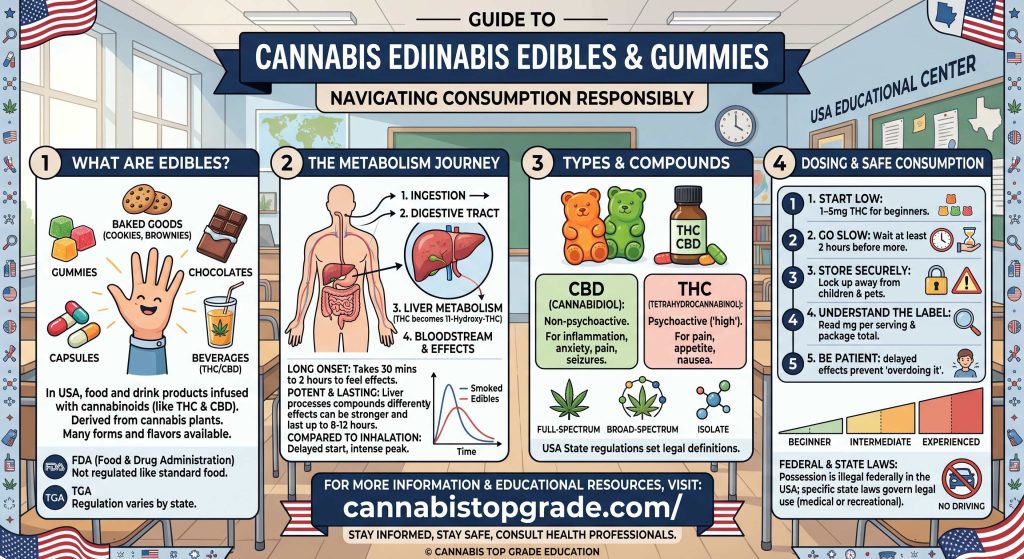
Cannabis edibles are foods or beverages containing cannabis-derived cannabinoids.
Examples include:
- gummies;
- chocolates;
- baked goods;
- candies;
- beverages;
- lozenges;
- and other infused foods.
Edibles may contain:
- delta-9 THC;
- CBD;
- THC and CBD together;
- or additional cannabinoids.
The exact composition depends on the product.
What Are THC Gummies?
THC gummies are edible products containing tetrahydrocannabinol.
In regulated marijuana markets, delta-9 THC is usually the principal intoxicating cannabinoid.
THC can influence:
- mood;
- perception;
- memory;
- coordination;
- reaction time;
- appetite;
- and alertness.
For some people, THC can feel relaxing or sedating.
For others, particularly with higher exposure, it may cause:
- anxiety;
- restlessness;
- racing thoughts;
- dizziness;
- or an unpleasantly intense experience.
That variability is one reason there is no universally best THC sleep gummy.
THC Gummies for Sleep
The popularity of THC gummies for sleep is largely driven by consumer reports that cannabis can make falling asleep feel easier.
Scientific evidence is more complicated.
A 2025 systematic review and meta-analysis of randomized studies found that cannabinoid treatments improved self-reported sleep quality compared with placebo, particularly among participants who already had insomnia or poor sleep.
However, the studies were highly variable.
They used different:
- cannabinoid formulations;
- THC-to-CBD ratios;
- doses;
- populations;
- and study designs.
The findings therefore cannot be translated directly into a recommendation for ordinary retail THC gummies.
What Does Research Say About Cannabis and Sleep?
A separate 2025 systematic review examined objective sleep measurements such as polysomnography.
Researchers found that cannabis did not consistently change:
- total sleep duration;
- time required to fall asleep;
- wake time;
- sleep efficiency;
- or sleep stages.
Earlier research suggested THC might suppress REM sleep, but newer findings are mixed.
This means someone can subjectively feel that cannabis helped them sleep while objective sleep measurements show less clear benefit.
Recreational Cannabis and Sleep Quality
Another 2025 systematic review and meta-analysis examined recreational cannabis use.
Current cannabis use was associated in observational studies with:
- poorer sleep quality;
- more insomnia symptoms;
- unusually short or long sleep duration;
- and later sleep timing.
Experimental studies did not consistently reproduce those associations.
The overall evidence therefore remains mixed.
Cannabis should not be presented as a proven universal sleep aid.
Best THC Gummies for Sleep
When people search for the best THC gummies for sleep, they may really be looking for several things:
- predictable THC labeling;
- regulated testing;
- consistent cannabinoid content;
- appropriate packaging;
- trustworthy ingredient information;
- and a product legally available within their state.
Those characteristics are more meaningful than a marketing claim such as:
“best sleep gummy.”
No particular THC gummy works best for everyone.
Individual response can depend on:
- cannabis tolerance;
- THC sensitivity;
- medications;
- alcohol use;
- underlying sleep disorders;
- age;
- frequency of cannabis use;
- and other health factors.
Best THC Sleep Gummies for Adults
The phrase best THC sleep gummies for adults should also be approached cautiously.
Being an adult does not automatically make THC appropriate for persistent insomnia.
Sleep difficulty can result from:
- stress;
- sleep apnea;
- depression;
- anxiety;
- medication effects;
- chronic pain;
- restless legs syndrome;
- shift work;
- caffeine;
- alcohol;
- or other medical conditions.
Someone experiencing persistent insomnia may benefit from identifying the underlying cause rather than relying exclusively on an intoxicating edible.
Are THC Gummies FDA-Approved for Insomnia?
No ordinary consumer THC gummy is FDA-approved as a treatment for insomnia.
FDA states that it has not approved a cannabis product for treating any disease or condition.
The agency has approved:
- one cannabis-derived prescription medication containing purified CBD;
- and several synthetic cannabis-related prescription medications
for specific medical indications.
These prescription medicines are very different from retail THC gummies.
For FDA information, see FDA and Cannabis: Research and Drug Approval Process.
Delta-9 THC Gummies for Sleep
Delta-9 THC is the primary intoxicating form of THC commonly associated with marijuana.
The phrase best delta 9 gummies for sleep has become popular as hemp and cannabis products have expanded.
However, delta-9 THC is still intoxicating regardless of whether a product is described as:
- hemp-derived;
- cannabis-derived;
- nighttime;
- relaxation;
- or sleep support.
Marketing language does not change THC’s pharmacological effects.
Hemp-Derived Delta-9 vs. Marijuana-Derived Delta-9
Delta-9 THC is the same cannabinoid molecule regardless of source.
The legal classification of the product may differ depending on:
- THC concentration;
- hemp definitions;
- state law;
- product formulation;
- and regulatory interpretation.
This is why consumers should not assume every product marketed as “hemp delta-9” is automatically legal everywhere.
State laws continue to evolve.
Cannabis Gummies vs. Hemp Gummies
These terms are often used loosely.
Cannabis Gummies
May contain THC, CBD or combinations of cannabinoids.
Hemp Gummies
May contain:
- CBD;
- minimal cannabinoids;
- hemp seed ingredients;
- or intoxicating hemp-derived cannabinoids.
A product labeled hemp gummy does not automatically mean it contains CBD.
It also does not automatically mean it is non-intoxicating.
The ingredient and cannabinoid label matters.
Weed Gummies for Sleep
The phrase best weed gummies for sleep usually refers to THC-containing cannabis edibles.
“WEED gummy” is informal language rather than a technical product category.
Products within that category can differ dramatically in:
- THC;
- CBD;
- other cannabinoids;
- ingredients;
- serving size;
- testing;
- and legal status.
No single strain or gummy format guarantees better sleep.
THC vs. CBD for Sleep
THC and CBD should not be treated as equivalent.
A 2025 meta-analysis found that non-CBD cannabinoid interventions showed greater improvement in subjective sleep quality than CBD-only treatments.
CBD-only interventions in that analysis did not show a statistically significant improvement.
However, this does not prove retail THC gummies are effective insomnia treatments.
Research formulations and ordinary commercial products are not necessarily interchangeable.
Cannabis Edibles vs. Inhaled Cannabis
Edibles behave differently from smoked or vaped cannabis.
CDC notes that edible cannabis can take approximately:
30 minutes to 2 hours
before intoxicating effects become apparent.
The effects can also last longer than expected.
This delayed onset increases the risk that someone may consume additional THC before the first serving has fully taken effect.
Why Edibles Can Feel Stronger
When THC is swallowed, it is processed through the digestive system and liver.
This produces metabolites including 11-hydroxy-THC, which contributes to edible cannabis intoxication.
The experience can therefore differ from inhaled cannabis.
Individual effects are influenced by:
- metabolism;
- food intake;
- THC amount;
- tolerance;
- medications;
- and other substances.
Edibles and Accidental Overconsumption
CDC specifically identifies edible cannabis as presenting greater poisoning risks than smoked cannabis.
Because effects can take time to appear, people may mistakenly believe a product is not working.
This can lead to excessive consumption.
Potential signs of excessive THC exposure can include:
- severe anxiety;
- confusion;
- panic;
- paranoia;
- rapid heart rate;
- impaired coordination;
- nausea;
- or extreme sedation.
THC Gummies and Next-Day Effects
Sleep-focused products sometimes imply that their effects end by morning.
That cannot be guaranteed.
Edible THC can produce longer-lasting intoxication than inhaled cannabis.
Factors influencing duration include:
- THC concentration;
- individual metabolism;
- previous cannabis exposure;
- food;
- alcohol;
- medications;
- and other cannabinoids.
Residual effects can potentially affect next-day alertness and performance.
THC Gummies and Driving
A product marketed for nighttime use can still affect driving ability.
THC can impair:
- judgment;
- coordination;
- reaction time;
- attention;
- and decision-making.
Someone should not drive or operate dangerous machinery while impaired.
Feeling sleepy is not the only relevant effect.
THC Gummies and Alcohol
Combining cannabis with alcohol can increase impairment.
CDC notes that cannabis effects depend partly on whether other substances such as alcohol are used at the same time.
For sleep, alcohol itself can also disrupt sleep architecture even though it may initially feel sedating.
Mixing intoxicants is therefore not a reliable strategy for better sleep.
THC Gummies and Medications
Cannabis may interact with medications.
People taking:
- sedatives;
- sleep medications;
- anxiety medicines;
- antidepressants;
- antihistamines;
- or other drugs affecting alertness
may face additional sedation or other interactions.
Persistent sleep difficulty combined with medication use is a good reason to discuss symptoms with a qualified healthcare professional.
THC Tolerance and Sleep
Repeated cannabis exposure may lead to tolerance.
This means some people experience diminishing effects over time.
Increasing THC exposure to recreate earlier sedation can also increase:
- intoxication;
- dependence risk;
- unwanted psychological effects;
- and next-day impairment.
Cannabis Withdrawal and Sleep
Cannabis withdrawal is particularly relevant to sleep.
The 2025 sleep-architecture review found that withdrawal from active cannabis use was consistently associated with:
- reduced total sleep time;
- longer sleep-onset latency;
- and REM rebound.
This can create a cycle in which someone feels they need cannabis to sleep partly because stopping cannabis temporarily disrupts their sleep.
Cannabis Use Disorder
Frequent cannabis use can become problematic for some people.
CDC recognizes cannabis use disorder, which involves continued cannabis use despite significant problems.
Using THC every night specifically because someone feels unable to sleep without it may warrant closer attention.
It does not automatically mean a person has cannabis use disorder, but it can be an important pattern to recognize.
THC Gummies and Anxiety
THC can have different effects depending on the person.
Some people report relaxation.
Others experience:
- anxiety;
- paranoia;
- racing thoughts;
- or panic.
A gummy marketed as a sleep product does not eliminate these possibilities.
Higher THC exposure may make unwanted psychological effects more likely for sensitive individuals.
THC Gummies and Children
Cannabis gummies can resemble ordinary candy.
CDC emphasizes the risk of accidental poisoning, especially among children.
Cannabis edibles should be stored securely and kept away from:
- children;
- teenagers;
- and pets.
Child-resistant packaging reduces risk but does not replace secure storage.
Cannabis Gummies and Pets
THC can also be dangerous for animals.
A gummy’s sweet flavor may make it attractive to pets.
Products should therefore be stored where animals cannot reach them.
Reading a THC Gummy Label
A regulated cannabis edible label may include information such as:
THC per Serving
This describes the amount associated with a defined serving.
THC per Package
The total package may contain multiple servings.
CBD Content
Some products contain both THC and CBD.
Ingredient List
This is particularly important for people with allergies or dietary restrictions.
Batch Information
Batch identification improves traceability.
Testing Information
Regulated markets may require laboratory testing.
Warning Statements
These vary by state.
Serving Size vs. Package Size
One common source of edible confusion is assuming an entire package equals one serving.
A package can contain multiple servings.
Product regulations vary by state.
Consumers should therefore distinguish:
amount per serving
from
amount in the entire package.
Cannabis Edibles Comparison
| Product Type | Intoxicating Potential | Onset | Duration | Major Consideration |
|---|---|---|---|---|
| THC gummy | Yes | Delayed | Often prolonged | Overconsumption risk |
| THC/CBD gummy | Usually yes if meaningful THC | Delayed | Prolonged | Cannabinoid ratio matters |
| CBD-only product | Typically not THC-like intoxication | Variable | Variable | Label accuracy and interactions |
| Smoked cannabis | Yes if THC-rich | Rapid | Generally shorter | Smoke exposure |
| Vaped THC | Yes | Rapid | Variable | Potency and inhalation concerns |
Exact effects depend on the specific product and person.
Is More THC Better for Sleep?
Not necessarily.
Higher THC may increase sedation in some people, but it can also increase:
- anxiety;
- dizziness;
- cognitive impairment;
- paranoia;
- and next-day effects.
The goal of sleep should not be confused with maximum intoxication.
Research has not established that progressively stronger THC produces progressively better sleep.
Sleep Quality vs. Sedation
This distinction is crucial.
Feeling sedated is not necessarily the same as getting high-quality restorative sleep.
Sleep consists of different stages and cycles.
A substance can make someone feel drowsy without consistently improving:
- sleep architecture;
- REM sleep;
- deep sleep;
- total sleep time;
- or next-day functioning.
This helps explain why subjective reports and laboratory sleep studies sometimes disagree.
Alternatives to Relying on THC for Sleep
Persistent sleep problems deserve proper evaluation.
Evidence-based approaches to insomnia can include:
- consistent sleep scheduling;
- managing light exposure;
- reducing late caffeine;
- addressing sleep apnea;
- treating underlying medical conditions;
- and cognitive behavioral therapy for insomnia.
These approaches can address the actual cause rather than simply producing sedation.
When Sleep Problems Need Medical Attention
Sleep problems may warrant professional evaluation when they:
- persist for weeks;
- interfere with work or daily functioning;
- involve loud snoring or breathing pauses;
- cause severe daytime sleepiness;
- occur alongside depression or anxiety;
- or require increasing amounts of substances to manage.
Sleep disturbance can sometimes be a symptom rather than the primary problem.
Legal Status of THC Gummies
THC edible laws vary significantly across the United States.
The NCSL State Cannabis Policy Enactment Database was updated August 31, 2026.
It tracks state legislation involving:
- adult-use cannabis;
- medical cannabis;
- THC;
- hemp and CBD;
- edibles;
- concentrates;
- packaging;
- labeling;
- testing;
- and public health.
A THC gummy legally available under one state’s system may be regulated differently elsewhere.
Delta-9 Gummy Laws Can Be Complicated
Federal hemp law and state cannabis law overlap.
Some states have adopted additional restrictions involving intoxicating hemp-derived cannabinoids.
Therefore, the phrase delta-9 gummy does not provide enough information to determine legality.
Relevant factors can include:
- source material;
- delta-9 concentration;
- package formulation;
- age restrictions;
- state statutes;
- and local regulations.
Regulated Cannabis Edibles vs. Unverified Products
A product being sold online or in a convenience store does not automatically prove that it meets a state’s regulated-marijuana standards.
Regulated cannabis systems may impose:
- laboratory testing;
- licensed manufacturing;
- track-and-trace requirements;
- packaging standards;
- cannabinoid labeling;
- and age verification.
Those protections vary considerably across jurisdictions.
Educational Resources
For additional U.S.-focused cannabis edible, cannabinoid and legal-market education, explore Cannabistopgrade.com.
Regarding public-health information about edible cannabis and delayed intoxication, see the CDC Cannabis and Poisoning resource.
For scientific research on cannabis and objective sleep architecture, see the 2025 PubMed systematic review and meta-analysis.
Concerning randomized evidence concerning cannabinoids and subjective sleep quality, see the 2025 PubMed systematic review.
For current state cannabis laws involving edibles, THC, labeling and product regulation, consult the NCSL State Cannabis Policy Enactment Database.
Readers can continue exploring cannabis edibles, cannabinoids and U.S. cannabis regulations through Cannabistopgrade.com.
Frequently Asked Questions
1. What are the best THC gummies for sleep?
There is no scientifically established single best THC gummy for sleep. Research on cannabinoids and sleep is mixed, and retail THC gummies are not FDA-approved insomnia treatments. Product testing, legal status and individual health factors are more meaningful than “best” marketing claims.
2. Do THC gummies help you sleep?
Some people report that THC makes them feel sleepy, and randomized studies suggest certain cannabinoid formulations may improve subjective sleep quality. However, objective sleep studies have not consistently shown improvements in sleep duration, efficiency or sleep stages.
3. What are the best delta-9 gummies for sleep?
No specific delta-9 gummy has been established as universally best through high-quality clinical evidence. Delta-9 THC is intoxicating, and effects vary significantly between individuals and products.
4. Are THC sleep gummies safe for adults?
THC gummies have risks even for adults, including intoxication, anxiety, delayed effects, overconsumption and impaired driving. Individual medications and health conditions can also affect risk.
5. How long do weed gummies take to work?
CDC states that edible cannabis can take approximately 30 minutes to 2 hours before intoxicating effects appear. Effects can also last longer than expected.
6. Are THC gummies for sleep legal everywhere in the United States?
No. Cannabis and intoxicating hemp-product laws vary by state. Regulations can differ for medical cannabis, adult-use cannabis, hemp-derived THC, packaging, serving sizes and retail sales.
