Uncategorized
Cannabis and Its Effects: Health, THC, Mount Pleasant Dispensaries and Long Island Cannabis Laws
Sep
Cannabis and its effects remain major areas of public-health, medical, and legal interest throughout the United States. People researching cannabis often want to understand how THC affects the body and brain while also looking for local information using searches such as dispensaries in Mount Pleasant, dispensaries Mt Pleasant MI, dispensaries in Mount Pleasant Michigan, recreational dispensary Long Island, and Farmingdale dispensary.
Those searches combine two different topics:
- what cannabis does to the body and brain; and
- how legal cannabis retail works in specific U.S. jurisdictions.
Both require accurate information.
Cannabis can affect memory, attention, reaction time, coordination, emotions, appetite, perception, heart rate, and other body systems. At the same time, legal access depends heavily on state and local law.
Michigan operates a regulated adult-use marijuana market, while New York regulates adult-use cannabis through its Office of Cannabis Management. A dispensary appearing in a search result should still be verified through the appropriate state licensing authority.
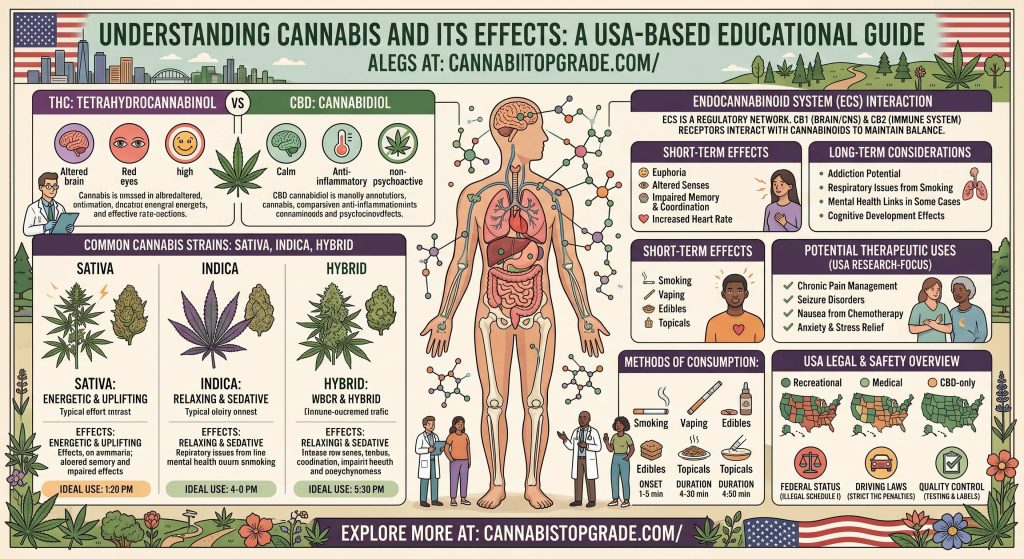
For additional U.S.-focused cannabis education, explore Cannabistopgrade.com.
What Is Cannabis?
Cannabis is a plant that contains numerous naturally occurring chemical compounds.
The best-known are cannabinoids.
Major cannabinoids include:
- THC;
- CBD;
- CBG;
- CBC;
- and others.
Cannabis also contains aromatic compounds known as terpenes.
Together, these chemicals influence:
- aroma;
- flavor;
- physiological effects;
- intoxication;
- and the overall consumer experience.
What Is THC?
THC, or tetrahydrocannabinol, is the principal intoxicating cannabinoid associated with marijuana.
THC interacts with the body’s endocannabinoid system and can influence brain areas involved in:
- memory;
- coordination;
- pleasure;
- attention;
- decision-making;
- movement;
- and sensory perception.
Higher THC exposure can produce stronger intoxication, although effects vary greatly among individuals.
What Is CBD?
CBD stands for cannabidiol.
Unlike THC, CBD is not generally considered intoxicating in the same way.
CBD has been studied for several potential medical uses, but ordinary retail CBD products should not be assumed to treat medical conditions.
The FDA has approved a purified prescription CBD medication for specific seizure disorders, but that is different from general over-the-counter cannabis or hemp products.
Cannabis and Its Effects at a Glance
| Area | Possible Cannabis Effect |
|---|---|
| Memory | Short-term memory may be impaired |
| Attention | Concentration may decrease |
| Reaction time | Can become slower |
| Coordination | May be impaired |
| Mood | Euphoria or anxiety may occur |
| Appetite | May increase |
| Heart rate | May temporarily rise |
| Judgment | Can be impaired |
| Sleep | Some users report sedation, but effects vary |
| Driving | Driving ability can be impaired |
Cannabis effects depend on product strength, frequency of use, individual sensitivity, age, product format, and other substances being used.
How Cannabis Affects the Brain
THC affects brain function through cannabinoid receptors.
According to public-health research, cannabis can influence areas involved in:
- learning;
- memory;
- attention;
- emotions;
- decision-making;
- coordination;
- and reaction time.
These effects can become especially important during driving, work requiring concentration, or activities involving machinery.
Cannabis and Short-Term Memory
One of THC’s most recognizable effects involves short-term memory.
Someone under the influence may have greater difficulty:
- remembering recent information;
- following a sequence of events;
- recalling conversations;
- or completing complex tasks.
Effects depend heavily on potency and individual sensitivity.
Cannabis and Attention
Cannabis can affect concentration.
A consumer may feel relaxed or creatively stimulated while still experiencing measurable impairment in attention.
This distinction matters because subjective feelings do not always reflect objective performance.
Feeling focused does not necessarily mean attention has improved.
Cannabis and Reaction Time
THC can slow reaction time.
That can become particularly dangerous during:
- driving;
- cycling;
- operating machinery;
- or other activities requiring rapid responses.
Legal cannabis use does not make impairment safe.
Cannabis and Coordination
Cannabis can affect motor coordination.
Possible changes include:
- slower movement;
- altered balance;
- impaired hand-eye coordination;
- and reduced precision.
These effects help explain why cannabis-related driving impairment remains an important public-safety concern.
Cannabis and Driving
Cannabis can impair abilities required for driving.
These include:
- judgment;
- attention;
- coordination;
- reaction time;
- and perception.
Consumers should not drive while impaired.
Combining cannabis with alcohol can further increase impairment.
Cannabis and Mood
Cannabis can affect mood in different ways.
Some people report:
- relaxation;
- euphoria;
- laughter;
- sociability;
- or calmness.
Others may experience:
- anxiety;
- paranoia;
- panic;
- confusion;
- or emotional discomfort.
THC responses vary considerably.
Cannabis and Anxiety
Cannabis is sometimes discussed in relation to anxiety.
However, THC can produce both relaxation and anxiety depending on:
- potency;
- dose;
- tolerance;
- frequency of use;
- individual sensitivity;
- and setting.
A cannabis product should not be described as a guaranteed treatment for anxiety.
Persistent anxiety deserves appropriate professional evaluation.
Cannabis and Appetite
THC can increase appetite in some users.
This effect is commonly known as “the munchies.”
Cannabis may influence brain pathways related to:
- hunger;
- smell;
- taste;
- and reward.
Not everyone experiences the same appetite response.
Cannabis and Heart Rate
Cannabis can temporarily increase heart rate.
It may also influence blood pressure shortly after use.
People with cardiovascular concerns should not assume cannabis is risk-free simply because it is legal in their state.
Cannabis and Sleep
Many consumers use cannabis in relation to sleep.
Some report:
- faster sleep onset;
- relaxation;
- sedation;
- or fewer nighttime awakenings.
However, scientific evidence remains mixed.
Cannabis can alter sleep patterns, and withdrawal after frequent use can also interfere with sleep.
“Indica” does not automatically mean clinically proven sleep treatment.
Cannabis and Pain
Cannabinoids have been studied for various forms of pain.
Evidence suggests that some cannabinoid products may provide modest benefit in certain chronic pain conditions.
However:
- effects vary;
- side effects matter;
- evidence quality differs;
- and individual cannabis strains are not standardized medications.
A retail strain name should not be treated as a medical prescription.
Cannabis and Mental Health
Cannabis can affect mental health differently among users.
Higher-potency THC products may increase the likelihood of:
- anxiety;
- panic;
- paranoia;
- and other adverse psychological effects.
People with personal or family histories of serious mental-health conditions may face additional risks.
Cannabis Use Disorder
Cannabis use can become problematic.
The CDC estimates that roughly 3 in 10 people who report cannabis use may develop cannabis use disorder.
Possible warning signs include:
- using more than intended;
- unsuccessful efforts to cut down;
- craving;
- increasing tolerance;
- withdrawal;
- and giving up important activities because of cannabis.
Higher-frequency use and starting during adolescence are associated with greater risk.
THC Potency Matters
Modern cannabis products vary dramatically in THC concentration.
Flower might contain moderate or high THC levels.
Concentrates can be much stronger.
Examples include:
- wax;
- shatter;
- live resin;
- rosin;
- vape oils;
- and other extracts.
The stronger the THC concentration, the greater the potential for intense intoxication and adverse effects.
Flower vs. Concentrates
| Cannabis Product | General Potency |
|---|---|
| Flower | Variable |
| Pre-roll | Similar to source flower |
| Vape cartridge | Often concentrated |
| Live resin | High THC possible |
| Wax | High THC possible |
| Shatter | High THC possible |
| Rosin | Often concentrated |
A product format can matter just as much as the strain name.
Cannabis Edibles
Edibles include:
- gummies;
- chocolates;
- baked products;
- beverages;
- and capsules.
Edibles can produce delayed effects compared with inhaled cannabis.
This delay can make overconsumption more likely when someone takes additional THC before the first serving has fully taken effect.
Why Edibles Can Feel Strong
THC consumed orally is processed differently by the body than inhaled THC.
Effects can:
- take longer to begin;
- last longer;
- and feel more intense.
Product labels and serving sizes therefore matter.
Cannabis and Young People
Cannabis exposure during adolescence raises additional concerns because the brain continues developing into early adulthood.
Regular cannabis use in young people has been associated with risks involving:
- attention;
- memory;
- learning;
- mental health;
- and dependence.
Legal adult-use markets generally impose age restrictions for this reason.
Cannabis During Pregnancy
Cannabis should not be assumed safe during pregnancy.
THC can cross the placenta.
Public-health authorities advise caution because cannabis exposure may affect pregnancy and fetal development.
Anyone considering cannabis during pregnancy should discuss it with a qualified healthcare professional.
Cannabis and Alcohol
Using cannabis and alcohol together can result in greater impairment than using either alone.
Potential problems include:
- reduced coordination;
- nausea;
- dizziness;
- confusion;
- and impaired judgment.
Mixing substances can make individual effects less predictable.
Dispensaries in Mount Pleasant
The phrase dispensaries in Mount Pleasant can refer to several locations in the United States.
For cannabis search intent, Mount Pleasant, Michigan is especially relevant because Michigan has a regulated adult-use cannabis market.
Consumers searching for dispensaries should prioritize licensed businesses.
The Michigan Cannabis Regulatory Agency provides an official tool for verifying:
- adult-use establishments;
- medical marijuana facilities;
- tribal marijuana businesses;
- and hemp processor-handler licenses.
Dispensaries Mt Pleasant MI
Someone searching dispensaries Mt Pleasant MI should distinguish between:
- licensed marijuana retailers;
- medical cannabis facilities;
- hemp stores;
- smoke shops;
- and unlicensed businesses.
The business name alone does not prove regulatory status.
Michigan’s Cannabis Regulatory Agency provides current license verification information.
Dispensaries in Mount Pleasant Michigan
Michigan regulates adult-use cannabis establishments through the Cannabis Regulatory Agency, commonly abbreviated CRA.
The agency regulates:
- adult-use marijuana establishments;
- medical marijuana facilities;
- license applications;
- renewals;
- inspections;
- and compliance.
Consumers can use Michigan’s official license system to confirm whether a retailer is authorized.
Michigan Adult-Use Cannabis
Michigan permits regulated adult-use marijuana sales.
Licensed marijuana retailers can sell cannabis products under state rules.
Retail businesses operate within a regulatory system involving:
- licensing;
- product tracking;
- testing;
- taxes;
- security;
- labeling;
- and business requirements.
Local government rules can also influence where retailers operate.
Medical Cannabis in Michigan
Michigan also maintains medical marijuana facilities.
Medical and recreational cannabis systems are related but legally distinct.
The CRA separately provides information about:
- adult-use licenses;
- medical marijuana facility licenses;
- and current active facilities.
What to Check Before Visiting a Michigan Dispensary
Consumers researching Mount Pleasant dispensaries should verify:
- active state license;
- correct business address;
- whether adult-use or medical sales are offered;
- legal operating status;
- and current business hours.
Search engines are useful for convenience.
State regulators are more authoritative for licensing.
Recreational Dispensary Long Island
The phrase recreational dispensary Long Island refers to legal adult-use cannabis retailers operating within New York’s regulated market.
New York’s Office of Cannabis Management oversees the adult-use system.
The state maintains a Buy Legal retailer finder where consumers can search for:
- adult-use dispensaries;
- medical dispensaries;
- and licensed retail locations.
New York Adult-Use Cannabis Market
New York’s legal cannabis market continues expanding.
The Office of Cannabis Management licenses businesses involved in:
- cultivation;
- processing;
- distribution;
- microbusinesses;
- and retail dispensaries.
Licensing and regulatory requirements are intended to distinguish the legal market from unlicensed sellers.
Long Island Cannabis Retail
Long Island includes Nassau and Suffolk counties.
Cannabis access on Long Island depends not only on New York State law but also on local municipal participation and zoning rules.
Consumers should verify each retailer individually.
A Long Island address alone does not prove that a business is an authorized adult-use dispensary.
Farmingdale Dispensary
The phrase Farmingdale dispensary usually refers to searches for cannabis retailers in or around Farmingdale, New York.
Because businesses can open, close, relocate, or change license status, an article should not permanently declare one specific retailer as the best or closest option.
Instead, consumers should use the New York Office of Cannabis Management’s official retailer finder and search:
Farmingdale, New York
This provides a more current way to locate licensed adult-use or medical dispensaries.
Licensed vs. Unlicensed New York Cannabis Shops
New York has taken significant steps to distinguish the legal cannabis market from unlicensed sellers.
A licensed dispensary operates within the state’s regulatory framework.
Regulated retailers may be subject to rules concerning:
- age verification;
- product testing;
- packaging;
- advertising;
- labeling;
- security;
- and recordkeeping.
Unlicensed cannabis businesses do not necessarily offer equivalent consumer protections.
Age Verification in New York
New York adult-use dispensaries must verify that customers meet the legal age requirement.
Cannabis marketing is also regulated to reduce appeal to people under 21.
Packaging requirements include restrictions intended to reduce youth attraction.
Cannabis Retailer Distance Rules in New York
New York cannabis rules can include spacing requirements involving:
- other adult-use retail dispensaries;
- schools;
- youth facilities;
- and houses of worship.
The exact rule depends on municipality population and the surrounding location.
This helps explain why cannabis retailers may not appear evenly distributed across Long Island.
Why State License Verification Matters
A search result can tell you:
what business is nearby.
It cannot always tell you:
whether that cannabis business is currently licensed.
Official state databases provide stronger regulatory verification.
For Michigan, consumers can use the Cannabis Regulatory Agency.
For New York, consumers can use the Office of Cannabis Management.
Cannabis Quality at a Dispensary
A licensed dispensary may offer hundreds of cannabis products.
Consumers should evaluate:
- THC concentration;
- CBD concentration;
- product format;
- batch testing;
- terpene information;
- producer;
- packaging;
- and freshness.
The strain name alone is not enough to determine quality.
High THC Does Not Mean High Quality
THC has become one of the most visible numbers on cannabis menus.
But higher THC does not automatically mean:
- better cannabis;
- better flavor;
- better effects;
- better medical value;
- or a safer experience.
Other factors matter.
These include:
- genetics;
- freshness;
- terpene preservation;
- curing;
- testing;
- storage;
- and cannabinoid balance.
Cannabis Strains and Effects
Strains are often described as:
- indica;
- sativa;
- or hybrid.
These labels can be useful for cultural and botanical identification, but they do not perfectly predict effects.
Cannabis chemistry can vary greatly even when two products share the same strain name.
Consumers should pay attention to the actual product label.
Terpenes and Cannabis Effects
Terpenes contribute aroma and flavor.
Common cannabis terpenes include:
Myrcene
Earthy, herbal, musky.
Limonene
Citrus-like.
Pinene
Pine-like.
Caryophyllene
Peppery or spicy.
Terpinolene
Floral, citrus, herbal, or woody.
Terpenes may contribute to the overall cannabis experience, but they should not be treated as guaranteed medical effects.
Cannabis and Medical Claims
Cannabis products should not be promoted as guaranteed treatments for:
- anxiety;
- insomnia;
- pain;
- depression;
- ADHD;
- or other medical conditions.
Cannabinoids have been studied medically, but evidence varies by condition and product.
Retail cannabis strains are not standardized prescription medicines.
Cannabis and Workplace Safety
Cannabis laws do not automatically override workplace rules.
Employers may maintain policies involving:
- impairment;
- drug testing;
- safety-sensitive positions;
- commercial driving;
- or federal regulations.
Legal cannabis use outside work does not guarantee protection in every job.
Cannabis and Federal Law
Cannabis regulation involves both state and federal law.
State legalization does not automatically eliminate every federal restriction.
This distinction can matter for:
- federal property;
- federally regulated employment;
- transportation;
- firearms;
- and interstate commerce.
Consumers should avoid assuming that state legality equals universal legality.
Educational Resources
For additional cannabis health, strain, and U.S. regulatory education, explore Cannabistopgrade.com.
For current public-health information about cannabis effects on the brain and body, see CDC Cannabis Health Effects.
Regarding Michigan cannabis retailer and medical-facility verification, use the Michigan Cannabis Regulatory Agency License Verification Tool.
For New York recreational and medical cannabis retailer verification, use the New York Office of Cannabis Management Buy Legal Retailer Finder.
Readers can continue researching cannabis effects, cannabis strains, legal markets, and state marijuana rules through Cannabistopgrade.com.
Frequently Asked Questions
1. What are the main effects of cannabis?
Cannabis can affect memory, attention, reaction time, coordination, mood, appetite, judgment, and perception. THC can also cause intoxication, anxiety, or paranoia in some users.
2. Are there legal dispensaries in Mount Pleasant, Michigan?
Michigan operates a regulated adult-use marijuana market and licensed medical marijuana facilities. Consumers searching Mount Pleasant should verify individual retailers using the Michigan Cannabis Regulatory Agency’s current license database.
3. How do I find dispensaries in Mount Pleasant Michigan?
Use Michigan’s official cannabis license-verification system to identify active adult-use or medical marijuana facilities, then confirm current address and operating hours with the retailer.
4. Are recreational dispensaries legal on Long Island?
New York permits licensed adult-use cannabis retail, including licensed businesses on Long Island where applicable. Availability varies by municipality, so consumers should use New York’s official Buy Legal retailer finder.
5. How can I find a Farmingdale dispensary?
Search Farmingdale, New York, using the New York Office of Cannabis Management’s official retailer finder. This is more reliable than relying on an older article because license status and store openings can change.
6. Does legal cannabis mean cannabis is safe?
No. Legalization creates a regulatory framework, but cannabis can still cause impairment, anxiety, dependence, cardiovascular effects, and other health risks. Legal status and health risk are separate questions.
