
Uncategorized
CBN and Its Effects on Sleep and Wellness
Sep
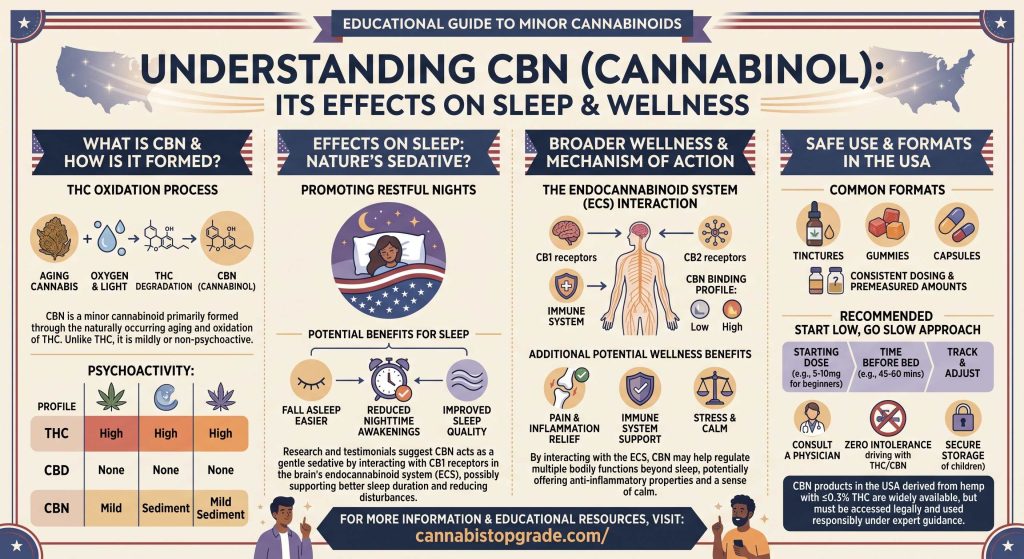
CBN and its effects on sleep and wellness have become increasingly visible topics in the U.S. cannabis market.
Cannabinol, better known as CBN, now appears in products marketed for nighttime use, including gummies, tinctures, capsules and formulations combining CBN with other cannabinoids.
This growing popularity has also connected CBN searches with local cannabis queries such as:
- weed shops near me;
- weed dispensary near me now open;
- marijuana dispensaries near me.
But CBN marketing has moved faster than the scientific evidence.
CBN should not automatically be called a proven natural sleeping pill. Early human research is interesting, but evidence remains limited, formulations vary, and many commercial nighttime products combine CBN with THC, CBD, melatonin or other ingredients.
That makes it difficult to attribute every reported effect specifically to CBN.
For more U.S.-focused cannabinoid and cannabis education, readers can explore Cannabistopgrade.com.
What Is CBN?
CBN stands for cannabinol.
It is one of the many cannabinoids associated with the cannabis plant.
CBN differs from:
- THC;
- CBD;
- CBG;
- CBC.
Although these compounds come from the same broad cannabinoid family, they have different chemical structures and biological activity.
CBN is particularly interesting because it can develop as THC undergoes chemical changes associated with oxidation and aging.
This helps explain why older cannabis has historically been associated with increased CBN.
CBN at a Glance
| Question | Current Understanding |
|---|---|
| Full name | Cannabinol |
| Abbreviation | CBN |
| Cannabinoid? | Yes |
| Same as CBD? | No |
| Same as THC? | No |
| Associated with aging THC? | Yes |
| Commonly marketed for sleep? | Yes |
| Proven insomnia treatment? | No |
| Human sleep research | Emerging but limited |
| Commercial forms | Gummies, tinctures, capsules and cannabinoid blends |
The distinction between marketed for sleep and proven to treat sleep disorders is essential.
How Is CBN Formed?
CBN is closely connected chemically with THC.
As THC is exposed over time to factors such as oxygen, heat and light, chemical degradation can contribute to the formation of CBN.
This process helped create an old cannabis assumption:
Older cannabis makes people sleepier because it contains more CBN.
The biology is not that simple.
Aging cannabis can change multiple compounds simultaneously, and sleepiness cannot automatically be attributed to CBN alone.
CBN vs. THC
THC is the primary cannabinoid responsible for the intoxicating effects commonly associated with marijuana.
CBN is different.
The compounds should not be treated as interchangeable simply because CBN can arise from THC degradation.
Products marketed as CBN formulas can also contain THC, depending on their composition and regulatory category.
Consumers should therefore read cannabinoid labels carefully.
CBN vs. CBD
CBN and CBD are also different cannabinoids.
CBD has received much more scientific and regulatory attention than CBN.
However, even CBD is frequently marketed with wellness claims that go beyond established evidence.
CBN is newer to the mainstream consumer market, and the human evidence base is substantially less developed than its advertising sometimes suggests.
Why Is CBN Associated With Sleep?
CBN has developed a strong reputation as a sleep cannabinoid.
Commercial products are frequently promoted with phrases involving:
- nighttime;
- rest;
- relaxation;
- sleep;
- calm;
- bedtime.
That has encouraged people to refer to CBN as the “sleepy cannabinoid.”
However, a nickname is not clinical evidence.
Early studies and emerging human trials justify continued research, but they do not establish CBN as a universally effective insomnia treatment.
Does CBN Make You Sleepy?
Possibly for some people, but the evidence remains developing.
Some early human research has reported improvements in certain self-reported sleep outcomes with CBN.
That is scientifically interesting.
It is not the same as demonstrating that:
CBN makes everyone sleepy.
Individual responses may differ based on:
- dose;
- formulation;
- other cannabinoids;
- medications;
- underlying sleep problems;
- age;
- individual biology.
What Does Human CBN Research Show?
Recent human research has begun testing CBN more directly rather than relying exclusively on historical assumptions or animal studies.
One randomized, double-blind, placebo-controlled trial examined nightly CBN and combinations of CBN with CBD.
Researchers reported improvements in some sleep outcomes, including nighttime awakenings and overall sleep disturbance at a tested CBN dose.
However, the study did not establish improvement across every sleep measure.
This is an important distinction.
Scientific evidence should be interpreted according to what was actually measured rather than converted into a blanket claim that CBN “cures insomnia.”
CBN and Nighttime Awakenings
One potentially interesting area is nighttime awakening.
Some human data suggest CBN may reduce the number of awakenings or improve certain self-reported aspects of sleep.
More independent research is still necessary to establish:
- reproducibility;
- ideal formulation;
- longer-term outcomes;
- safety;
- which populations might benefit.
CBN and Falling Asleep
People frequently assume that anything marketed as a sleep cannabinoid must make them fall asleep faster.
That has not been established universally for CBN.
Sleep involves several separate measurements, including:
- sleep onset;
- total sleep time;
- nighttime awakenings;
- sleep efficiency;
- sleep stages;
- morning functioning.
Improvement in one measure does not prove improvement in all of them.
CBN and Sleep Quality
“Sleep quality” can also mean different things.
Consumers may use the phrase to describe feeling:
- more rested;
- less restless;
- calmer;
- less awake during the night.
Researchers can use structured questionnaires and objective sleep measurements.
These are not necessarily equivalent.
A person feeling more relaxed does not automatically mean their objective sleep architecture improved.
Cannabis and Objective Sleep Research
The broader cannabis-and-sleep literature remains mixed.
A 2025 systematic review and meta-analysis evaluating objective sleep architecture found that cannabis administration did not consistently improve several major sleep measurements.
These included:
- total sleep time;
- sleep latency;
- wake time;
- sleep efficiency;
- sleep stages.
Effects varied according to cannabinoid composition, dose, previous cannabis exposure and participant characteristics.
This broader evidence is important when interpreting CBN marketing.
CBN Is Not the Same as Cannabis Flower
Another common mistake is treating research on one cannabinoid as evidence about every cannabis product.
CBN isolate is different from:
- high-THC flower;
- CBN + THC gummies;
- CBN + CBD products;
- full-spectrum extracts;
- marijuana edibles.
The ingredients matter.
A nighttime gummy containing CBN, THC and melatonin cannot automatically demonstrate what CBN would do independently.
CBN + CBD
Some products combine CBN and CBD.
The idea is often marketed around relaxation and nighttime wellness.
However, adding CBD does not necessarily make a CBN formulation more effective for sleep.
In one controlled human study, adding CBD to CBN did not clearly enhance the reported effects of CBN on sleep.
That finding is particularly useful because it challenges the assumption that more cannabinoids automatically create a better sleep product.
CBN + THC
CBN products may also contain THC.
THC can cause:
- intoxication;
- impaired coordination;
- altered perception;
- drowsiness;
- anxiety;
- slowed reaction time.
If a CBN product contains meaningful THC, any sleepiness cannot automatically be attributed exclusively to CBN.
CBN and the “Entourage Effect”
Cannabis marketing frequently invokes the entourage effect, suggesting that cannabinoids and terpenes work together in uniquely beneficial ways.
Cannabinoid interactions are a legitimate area of scientific research.
However, the term should not be used as a shortcut for making unproven health claims.
Specific combinations require specific evidence.
Is CBN Psychoactive?
The answer requires nuance.
CBN interacts with the cannabinoid system differently from THC and is generally considered much less intoxicating than THC.
However, commercial CBN products may contain other cannabinoids, including THC.
A consumer should therefore never assume that a package labeled “CBN” is automatically THC-free or incapable of causing impairment.
Read the complete cannabinoid panel.
CBN and Wellness
“Wellness” is an extremely broad term.
CBN products are sometimes marketed around:
- relaxation;
- recovery;
- nighttime routines;
- stress;
- sleep;
- general well-being.
Evidence differs substantially across these proposed uses.
Consumers should be particularly skeptical when a CBN product claims to:
- cure disease;
- treat multiple unrelated medical conditions;
- replace prescription medication;
- guarantee better sleep.
CBN remains an active research area rather than a universal wellness treatment.
CBN and Pain
Cannabinoids are widely discussed in relation to pain.
However, evidence concerning cannabis and pain cannot automatically be transferred to isolated CBN.
Research on one cannabinoid or cannabis formulation does not prove that another formulation provides the same benefit.
More direct clinical research is needed.
CBN and Anxiety
CBN is sometimes marketed for calm or relaxation.
That does not establish it as an anxiety treatment.
People with persistent anxiety should not assume that a commercial cannabinoid product is equivalent to an evidence-based medical treatment.
CBN and Insomnia
Insomnia is more than occasionally having difficulty sleeping.
Persistent insomnia can involve repeated problems:
- falling asleep;
- remaining asleep;
- waking too early;
- obtaining restorative sleep.
CBN has not been established as a universally effective treatment for chronic insomnia.
Persistent sleep problems can warrant medical evaluation.
Why Sleep Problems Matter
Poor sleep can have many underlying causes.
Examples include:
- stress;
- anxiety;
- depression;
- sleep apnea;
- chronic pain;
- medication effects;
- caffeine;
- alcohol;
- irregular schedules;
- shift work.
Simply adding a cannabinoid may not address the underlying cause.
CBN Gummies
CBN gummies have become a common commercial format.
Products can differ substantially in:
- CBN amount;
- CBD;
- THC;
- melatonin;
- other ingredients;
- serving size;
- testing;
- regulatory status.
The words “CBN gummy” therefore do not describe one standardized product.
CBN Tinctures
CBN may also appear in tincture-style products.
Again, formulations differ.
A label should clearly identify:
- cannabinoid content;
- serving information;
- other active ingredients.
Consumers should not assume every tincture marketed for nighttime use has equivalent composition.
CBN and Melatonin
Some nighttime products combine CBN with melatonin.
If someone experiences drowsiness from such a product, it becomes difficult to determine which ingredient produced the effect.
That is why combination-product testimonials are weak evidence for the independent effects of CBN.
Can CBN Cause Side Effects?
Research is still developing, and comprehensive long-term safety information is limited.
Potential concerns can depend on:
- amount;
- formulation;
- other cannabinoids;
- medications;
- individual sensitivity.
Commercial products containing THC create additional intoxication and impairment considerations.
CBN and Medication Interactions
Cannabinoids can interact with medications.
People using prescription medicines should be particularly cautious about adding cannabinoid products when the medicines already cause sedation or have narrow therapeutic ranges.
Relevant categories may include some:
- sleep medications;
- anxiety medications;
- seizure medicines;
- anticoagulants;
- pain medicines;
- other central nervous system depressants.
A pharmacist or healthcare professional can provide individualized interaction guidance.
CBN and Driving
A product marketed for sleep should never be assumed compatible with driving.
This is especially important when the formulation also contains THC.
THC can impair:
- reaction time;
- coordination;
- attention;
- judgment;
- perception.
Do not drive while impaired.
CBN and Alcohol
Combining cannabinoid products with alcohol may increase impairment or drowsiness, particularly when THC is also present.
Alcohol should not be treated as a way to intensify a nighttime cannabinoid product.
CBN and Cannabis Withdrawal
Sleep disturbances are commonly associated with cannabis withdrawal among frequent users.
Research has documented issues such as:
- longer sleep latency;
- reduced sleep duration;
- REM rebound;
- vivid dreams.
This can complicate claims that regular cannabis use simply “fixes” sleep.
Educational Resources
For additional U.S.-focused cannabinoid, cannabis and public-health education, explore Cannabistopgrade.com.
Regarding peer-reviewed human research on CBN and sleep, see the randomized controlled CBN sleep study on PubMed.
For broader peer-reviewed evidence concerning cannabis and objective sleep architecture, see the 2025 systematic review and meta-analysis on PubMed.
For federal consumer information concerning cannabis-derived products, CBD and regulatory considerations, consult the U.S. Food and Drug Administration.
Readers can continue exploring cannabinoids, cannabis research and U.S. marijuana policy through Cannabistopgrade.com.
Weed Shops Near Me
Searches for weed shops near me require legal context because cannabis retail rules differ substantially across the United States.
Depending on location, a search result may represent:
- a licensed adult-use dispensary;
- a medical marijuana facility;
- a hemp store;
- a CBD retailer;
- a smoke shop;
- an unlicensed seller.
These businesses are not interchangeable.
A store appearing prominently in search results does not prove it is licensed to sell marijuana.
Weed Dispensary Near Me Now Open
A search for a weed dispensary near me now open adds another variable: current operating hours.
“Open now” information can change because of:
- holidays;
- local rules;
- temporary closures;
- operating-hour changes;
- business decisions.
The safer research sequence is:
verify license → confirm current hours → confirm product category
rather than relying only on a map listing.
Marijuana Dispensaries Near Me
In states with regulated marijuana retail, consumers can usually identify licensed retailers through the applicable state cannabis agency.
The exact agency differs by state.
Official resources may allow searches using:
- business name;
- address;
- ZIP code;
- license number.
This can help distinguish licensed marijuana dispensaries from stores selling only hemp or CBD products.
Medical vs. Recreational Marijuana Dispensaries
Some states maintain separate medical and adult-use systems.
A medical dispensary may require:
- patient registration;
- medical documentation;
- a recommendation;
- other state-specific eligibility.
An adult-use retailer generally operates under different eligibility and possession rules.
Always check the applicable state requirements.
CBN at Marijuana Dispensaries
Licensed marijuana dispensaries may carry products containing combinations such as:
- CBN + THC;
- CBN + CBD;
- CBN + THC + CBD;
- CBN + melatonin.
That makes label reading particularly important.
Two products carrying the word “CBN” may have completely different cannabinoid profiles.
CBN at Hemp and CBD Stores
CBN products can also appear outside state marijuana dispensaries.
Hemp-derived cannabinoid markets can operate under different regulatory structures from state-licensed marijuana systems.
Consumers should not assume that:
sold online = FDA approved
or:
sold in a store = clinically proven
Neither conclusion automatically follows.
How to Evaluate a CBN Product
Useful information to examine includes:
- CBN per serving;
- THC per serving;
- CBD per serving;
- complete ingredient list;
- serving size;
- batch information;
- testing information;
- manufacturer identity;
- applicable warnings.
Products making sweeping disease-treatment claims deserve additional skepticism.
CBN Labels Matter More Than the Front of the Package
A package might prominently display:
NIGHTTIME CBN
while the ingredient panel reveals that the product also contains THC, CBD and melatonin.
The front label is marketing.
The detailed cannabinoid and ingredient information provides a better picture of what the consumer is actually evaluating.
CBN and Drug Testing
Consumers should not assume a CBN product is automatically safe from workplace or other drug-testing concerns.
Products can contain:
- THC;
- trace cannabinoids;
- inaccurately represented ingredients.
Drug-testing consequences depend on the product and testing method.
A “CBN” label alone does not guarantee a negative THC test.
CBN Products and Children
Cannabinoid gummies can resemble ordinary candy.
All cannabinoid products should be stored securely away from children and pets.
This becomes especially important when products contain THC.
Cannabis Laws Vary by State
The legal status of marijuana products remains dependent on jurisdiction.
States differ regarding:
- medical cannabis;
- adult-use cannabis;
- retail licensing;
- possession;
- product standards;
- delivery;
- local regulation.
Therefore, a search for marijuana dispensaries near me cannot be answered accurately without considering location and current law.
Licensed Does Not Mean Medically Proven
This distinction is crucial.
A product can be legally sold in a licensed dispensary without being FDA-approved as a treatment for insomnia.
Retail legality and medical efficacy are two separate questions.
The Bottom Line on CBN and Sleep
CBN is an interesting minor cannabinoid with emerging human sleep research.
Early evidence provides legitimate reasons for continued investigation, particularly around certain self-reported sleep outcomes.
But the current evidence does not justify calling CBN:
- a guaranteed sedative;
- a cure for insomnia;
- a replacement for medical care;
- a universally effective sleep supplement.
Consumers should also distinguish isolated CBN research from commercial products containing mixtures of CBN, THC, CBD, melatonin and other ingredients.
For anyone searching weed shops near me, weed dispensary near me now open, or marijuana dispensaries near me, license verification and careful product-label review remain important.
Frequently Asked Questions
1. Does CBN help you sleep?
Early human research suggests CBN may affect certain self-reported sleep outcomes, including nighttime awakenings, but evidence remains limited. CBN has not been established as a universally effective insomnia treatment.
2. Is CBN the same as CBD?
No. CBN and CBD are different cannabinoids with different chemistry and research profiles. Products can contain either cannabinoid separately or combine them.
3. Does CBN make you high?
CBN differs substantially from THC and is generally considered much less intoxicating. However, commercial CBN products can also contain THC, so consumers should read the complete cannabinoid label.
4. Are CBN gummies proven sleep medicines?
No. Commercial CBN gummies are not automatically proven insomnia medicines. Formulations vary considerably and can contain CBD, THC, melatonin or other ingredients.
5. How can I identify legitimate weed shops near me?
Where marijuana retail is legal, use the applicable state cannabis regulator’s official license database to verify a retailer before relying on map listings or advertising.
6. How can I find a weed dispensary near me now open?
Identify licensed retailers through the state regulator, then verify the retailer’s current operating hours. “Open now” information from third-party maps can occasionally be outdated.
