
Uncategorized
Florida Marijuana Laws and Legalization: 2026 Guide With Louisiana Comparison
Sep
Florida marijuana laws and legalization remain major topics for residents, medical cannabis patients, visitors and anyone following changing marijuana policy across the United States.
Florida has an established medical marijuana system, but medical legalization should not be confused with unrestricted recreational cannabis legalization.
This distinction also creates an opportunity to compare Florida with Louisiana, where searches such as medical card Louisiana, cannabis laws in Louisiana, medical marijuana Louisiana, and is weed illegal in Louisiana continue to generate questions.
As of September 2026, both states authorize marijuana under regulated medical frameworks, but neither should be described as having a general statewide recreational marijuana retail market.
Understanding the difference between medical authorization, possession laws, adult-use legalization and decriminalization is essential.
For additional state-by-state marijuana education, explore Cannabistopgrade.com.
Is Marijuana Legal in Florida in 2026?
The accurate answer depends on the type of marijuana use.
Medical Marijuana
Florida permits medical marijuana for qualifying patients under its regulated medical marijuana program.
Florida’s medical framework is established principally through Article X, Section 29 of the Florida Constitution and Florida Statutes §381.986.
Recreational Marijuana
Florida should not currently be treated as a state with general recreational marijuana legalization.
Possession outside legally authorized circumstances can still result in criminal penalties.
Hemp
Hemp and hemp-derived products exist under a separate regulatory framework and should not automatically be treated as equivalent to Florida’s medical marijuana program.
Florida Marijuana Laws at a Glance
| Cannabis Issue | Florida Status |
|---|---|
| Medical marijuana | Legal for qualifying patients |
| Recreational marijuana | Not generally legal |
| Medical marijuana identification | Required within state program |
| Medical Marijuana Treatment Centers | State regulated |
| Recreational dispensaries | No general adult-use system |
| Unauthorized possession | Can remain a criminal offense |
| Driving while impaired | Illegal |
| Interstate marijuana transport | Not authorized by state medical status |
| Home cultivation by ordinary patients | Not generally authorized |
Cannabis laws can change, so current state information should always be checked.
Florida Medical Marijuana
Florida has one of the country’s largest medical marijuana markets.
Qualifying patients can access medical cannabis through the state’s regulated framework after satisfying applicable requirements.
Florida’s system regulates:
- qualified patients;
- caregivers;
- physicians;
- Medical Marijuana Treatment Centers;
- identification;
- product dispensing;
- possession;
- and other program requirements.
Medical authorization does not create unlimited cannabis rights.
Who Qualifies for Medical Marijuana in Florida?
Florida law recognizes qualifying medical conditions.
These include specified serious illnesses and other conditions that meet statutory requirements.
Medical marijuana certification requires an appropriate evaluation by a qualified physician.
A patient should not assume that merely having a medical condition guarantees certification.
The physician must determine whether the patient satisfies Florida’s medical cannabis requirements.
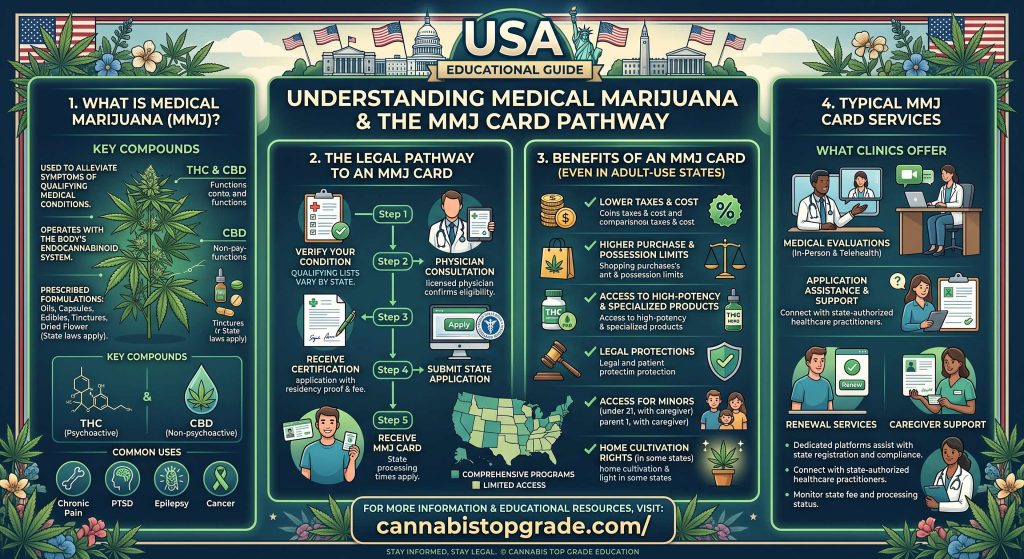
Florida Medical Marijuana Card
Florida’s system differs from Louisiana in an important way.
Florida uses a formal medical marijuana registry and identification-card framework.
Qualified patients and caregivers interact with Florida’s Medical Marijuana Use Registry.
This makes the phrase Florida medical marijuana card more literal than the commonly searched phrase medical card Louisiana.
Medical Marijuana Treatment Centers
Florida’s regulated cannabis businesses are known as Medical Marijuana Treatment Centers, often abbreviated MMTCs.
These businesses operate within Florida’s medical marijuana system.
An MMTC is different from:
- a smoke shop;
- a CBD store;
- a recreational dispensary;
- an unlicensed cannabis seller;
- or an ordinary online marijuana website.
Consumers should verify businesses through Florida’s official medical marijuana resources.
Can Florida Medical Marijuana Patients Buy Recreational Weed?
Medical authorization does not create a separate right to participate in an unregulated recreational market.
Florida medical marijuana must remain within the authorized medical framework.
Patients should use appropriately licensed Medical Marijuana Treatment Centers and follow state program requirements.
Florida Marijuana Possession Laws
Unauthorized cannabis possession can still carry criminal penalties in Florida.
Under Florida’s controlled-substance statute, possession of 20 grams or less of cannabis outside authorized circumstances can constitute a first-degree misdemeanor.
Larger quantities or other conduct can involve more serious consequences.
This is one of the clearest reasons Florida should not be described as a generally legalized recreational marijuana state.
Medical Legalization vs. Recreational Legalization
These terms describe different policies.
Medical legalization
Medical legalization permits qualifying patients to access cannabis under a regulated therapeutic framework.
Recreational legalization
Adult-use legalization generally permits eligible adults to possess and obtain cannabis within statutory limits without needing medical qualification.
Florida currently has the first type of framework, not a general adult-use retail system.
Can You Smoke Medical Marijuana in Florida?
Florida’s medical marijuana framework permits authorized forms of medical cannabis subject to state rules.
However, medical authorization does not permit cannabis consumption everywhere.
Restrictions can apply to locations and circumstances.
Patients should review current state requirements rather than assuming medical marijuana can be consumed anywhere tobacco smoking might otherwise occur.
Florida Cannabis and Driving
Medical authorization never means authorization to drive while impaired.
THC can affect:
- reaction time;
- coordination;
- attention;
- judgment;
- perception;
- and decision-making.
Patients and other consumers should not operate vehicles while impaired.
Can Florida Patients Take Marijuana Across State Lines?
A Florida medical marijuana authorization should not be treated as permission to transport marijuana across state lines.
State medical cannabis programs operate within their respective jurisdictions.
Crossing from Florida into another state creates separate legal considerations even if the destination also has medical or recreational marijuana laws.
Florida Marijuana and Federal Property
State medical authorization does not automatically override federal restrictions.
This distinction can matter on:
- federal property;
- certain federally managed lands;
- and other locations governed by federal law.
State legality and federal legality are not identical concepts.
Florida Marijuana and Employment
Florida medical marijuana authorization should not automatically be interpreted as universal protection against workplace cannabis policies.
Employment issues can involve:
- workplace impairment;
- employer drug policies;
- safety-sensitive positions;
- federal contractors;
- commercial transportation;
- and other federally regulated work.
Employees should review the policies applicable to their particular employment.
Florida Cannabis Products
Florida’s medical cannabis market can include various authorized product categories.
Depending on current rules and individual authorization, these may involve:
- flower;
- concentrates;
- vape products;
- oral formulations;
- tinctures;
- capsules;
- topical products;
- and other permitted forms.
Product availability does not mean every product is appropriate for every patient.
THC Potency
THC concentration can vary dramatically among cannabis products.
Higher THC can increase intoxication and unwanted effects.
Possible effects include:
- anxiety;
- dizziness;
- impaired memory;
- reduced coordination;
- paranoia;
- and excessive sedation.
Higher THC should not automatically be equated with better medical cannabis.
Florida Marijuana Legalization Debate
Florida has experienced significant political and electoral debate surrounding adult-use marijuana legalization.
The important SEO and legal distinction is that proposals, campaigns and ballot initiatives should never be described as existing law simply because they received substantial attention.
Cannabis-law articles should distinguish between:
proposed legalization and legalization that has actually taken effect.
Until the law changes, existing Florida statutes remain the appropriate basis for determining what conduct is authorized.
Florida vs. Louisiana Marijuana Laws
Florida and Louisiana both permit medical cannabis, but their systems differ.
| Issue | Florida | Louisiana |
|---|---|---|
| Medical marijuana | Legal | Legal |
| General recreational retail | No | No |
| Patient system | Registry/card framework | Clinician recommendation-centered |
| Medical clinician involvement | Required | Required |
| Authorized retailers | MMTC system | Therapeutic marijuana retailers |
| Telehealth | Subject to Florida medical rules | Therapeutic recommendation expressly permitted through telehealth |
| Small unauthorized possession | Criminal penalties remain | Reduced penalty for 14g or less |
| Interstate transfer | Not authorized | Not authorized |
This comparison demonstrates why state-specific cannabis information matters.
Medical Card Louisiana
The phrase medical card Louisiana is extremely common, but Louisiana’s system differs from Florida’s.
Louisiana primarily uses a clinician recommendation for therapeutic marijuana rather than structuring patient participation around the same conventional physical state-issued MMJ card model associated with some other states.
Under Louisiana Revised Statutes §40:1046, an authorized clinician can recommend therapeutic cannabis within a bona fide clinician-patient relationship when the clinician determines that it may be helpful for a debilitating medical condition.
Medical Marijuana Louisiana
Louisiana permits marijuana for therapeutic use.
Authorized clinicians can include qualifying:
- physicians;
- nurse practitioners with appropriate prescriptive authority;
- and medical psychologists.
The clinician must be appropriately licensed and in good standing.
Louisiana law also expressly states that authorized clinicians are not prevented from making therapeutic marijuana recommendations through telehealth.
Medical Marijuana Qualifying Conditions In Louisiana
Louisiana law identifies numerous debilitating conditions.
Examples include:
- cancer;
- glaucoma;
- epilepsy;
- seizure disorders;
- Parkinson’s disease;
- multiple sclerosis;
- muscular dystrophy;
- HIV/AIDS;
- Crohn’s disease;
- PTSD;
- traumatic brain injury;
- certain chronic pain conditions;
- hospice conditions;
- and palliative-care conditions.
Louisiana law also provides clinicians with broader discretion for certain other debilitating conditions when statutory requirements are satisfied.
Louisiana Medical Marijuana Purchase Limits
A permitted therapeutic marijuana retailer may not sell an individual patient more than:
2.5 ounces, or 71 grams, every 14 days.
This represents a legal maximum.
It should not be interpreted as a recommended amount for consumption.
Cannabis Laws in Louisiana
Louisiana has made several significant changes to marijuana policy over the years.
The state:
- permits therapeutic marijuana;
- regulates medical cannabis retailers;
- allows qualifying clinician recommendations;
- permits telehealth recommendations;
- recognizes certain visiting qualifying patients;
- and has reduced penalties for possession of small quantities.
However, none of these changes amount to general statewide recreational marijuana legalization.
Is Weed Illegal in Louisiana?
The most accurate answer is:
Recreational marijuana remains unlawful in Louisiana, while qualifying therapeutic marijuana is legal within the state’s regulated medical program.
This distinction is essential.
Someone participating lawfully in Louisiana’s medical program is in a very different legal position from someone possessing marijuana outside authorized circumstances.
Louisiana Marijuana Possession
Louisiana’s possession law contains a notable reduced-penalty provision.
For possession of 14 grams or less, a first or subsequent conviction can result in a fine of no more than $100.
The statute also provides for enforcement by summons rather than custodial arrest in that circumstance.
That does not mean possession has been legalized.
It means the state imposes a comparatively reduced penalty for that particular amount.
More Than 14 Grams in Louisiana
For a first conviction involving more than 14 grams, Louisiana law allows:
- a fine of up to $500;
- imprisonment in parish jail for up to six months;
- or both.
Additional or more serious conduct can carry different penalties.
Consumers should therefore avoid interpreting Louisiana’s small-possession reform as blanket recreational legalization.
Decriminalization vs. Legalization in Louisiana
This distinction deserves emphasis.
Reduced penalties
A state can reduce punishment for possessing a small quantity while keeping the conduct unlawful.
Legalization
A state can affirmatively authorize possession or retail activity within specified limits.
Louisiana’s $100 maximum penalty for possession of 14 grams or less is an example of reduced punishment.
It is not a statewide recreational cannabis retail law.
Louisiana Medical Marijuana Protections
Louisiana law provides protections for patients participating in the state-sponsored medical marijuana program when they possess permitted medical marijuana for qualifying conditions pursuant to a legitimate recommendation.
Those protections apply within the authorized medical framework.
They should not be interpreted as authorization for:
- recreational sales;
- unauthorized distribution;
- unrestricted possession;
- or interstate marijuana transport.
Louisiana Visiting Medical Patients
Louisiana law also recognizes certain visiting qualifying patients.
A person who is not a Louisiana resident, or who has been a Louisiana resident for less than 30 days, can potentially qualify when the individual has appropriate medical marijuana identification or its equivalent from another U.S. jurisdiction and satisfies Louisiana requirements.
This is a limited medical provision, not general recreational reciprocity.
2026 Louisiana Medical Marijuana Development
Louisiana continued modifying its medical cannabis program in 2026.
Act 602 addresses certain terminally ill patients in covered healthcare facilities.
The law requires qualifying healthcare facilities to permit therapeutic marijuana use under specified conditions.
Smoking and vaping are prohibited as methods of use under that provision.
The patient’s current medical marijuana recommendation must also be documented.
The measure demonstrates that Louisiana’s medical program continues evolving even though adult-use marijuana has not been legalized statewide.
Florida vs. Louisiana Small-Possession Rules
The difference between the states is particularly noticeable with unauthorized small amounts.
Florida
Unauthorized possession of 20 grams or less can constitute a first-degree misdemeanor.
Louisiana
Possession of 14 grams or less remains unlawful but generally carries a maximum $100 fine under the specific marijuana-possession provision.
Therefore, neither state should simply be described as recreationally legal based on its medical program.
Medical Marijuana Is Not Recreational Marijuana
Medical marijuana programs generally involve:
- clinician involvement;
- qualifying patients;
- regulated retailers;
- product requirements;
- possession limits;
- and state oversight.
Recreational markets typically operate under a different framework.
A person should never assume that seeing cannabis stores or medical marijuana advertising means recreational possession is automatically lawful.
Marijuana Laws Change by State
The United States does not have one uniform state marijuana policy.
Depending on jurisdiction, cannabis can be:
- medically legal;
- recreationally legal;
- decriminalized for certain possession amounts;
- restricted to limited cannabinoid products;
- or prohibited outside narrow circumstances.
This is why cannabis law research should always identify both the state and the type of activity involved.
What About Cannabis Purchased Legally in Another State?
Buying cannabis lawfully somewhere else does not automatically make possession lawful after crossing into Florida or Louisiana.
State cannabis programs do not create a nationwide marijuana passport.
Travelers should not assume that a package purchased from a licensed dispensary can simply be transported across state lines.
Marijuana and Driving in Both States
Neither a Florida medical authorization nor a Louisiana therapeutic marijuana recommendation authorizes impaired driving.
THC can impair abilities required for safe vehicle operation.
These include:
- reaction time;
- coordination;
- judgment;
- attention;
- and decision-making.
Medical status and driving safety remain separate issues.
Cannabis and Alcohol
Combining cannabis and alcohol can increase impairment.
Possible consequences include:
- dizziness;
- nausea;
- reduced coordination;
- confusion;
- and impaired judgment.
Legal medical access does not eliminate these effects.
Cannabis Use Disorder
Medical legalization also does not make cannabis risk-free.
Some people develop cannabis use disorder.
Warning signs can include:
- using more than intended;
- craving;
- increasing tolerance;
- unsuccessful attempts to reduce use;
- withdrawal;
- and continued use despite negative consequences.
Medical and recreational policy should therefore be discussed separately from health risk.
Why Current Legal Sources Matter
Cannabis laws change rapidly.
Old articles can contain outdated information about:
- legalization;
- possession;
- medical eligibility;
- dispensaries;
- product regulations;
- and patient requirements.
Legal information should therefore be checked against current statutes and official state regulators.
Educational Resources
For additional state-by-state cannabis law and legalization education, explore Cannabistopgrade.com.
Concerning Florida’s medical marijuana statutory framework, consult Florida Statutes §381.986.
Regarding Louisiana’s current therapeutic marijuana framework, consult Louisiana Revised Statutes §40:1046.
For Louisiana’s marijuana possession provisions, consult Louisiana Revised Statutes §40:966.
Readers can continue exploring marijuana legalization, medical cannabis programs and state-specific cannabis policy through Cannabistopgrade.com.
Frequently Asked Questions
1. Is recreational marijuana legal in Florida in 2026?
Florida has a regulated medical marijuana program, but ordinary recreational marijuana possession and sales should not be treated as generally legal. Unauthorized possession can still carry criminal penalties under Florida law.
2. Can you get medical marijuana legally in Florida?
Yes. Qualifying patients can participate in Florida’s medical marijuana program when they satisfy the state’s requirements, including appropriate physician certification and patient-registry requirements.
3. Is weed illegal in Louisiana?
Recreational marijuana remains unlawful in Louisiana. However, therapeutic marijuana is legal for qualifying patients participating within Louisiana’s regulated medical cannabis program.
4. How does a medical card in Louisiana work?
Louisiana primarily operates through a valid medical marijuana recommendation from an authorized clinician rather than relying on the same conventional physical MMJ-card structure used by some states. Authorized recommendations may also be provided through telehealth when Louisiana requirements are satisfied.
5. What happens if someone possesses 14 grams or less of marijuana in Louisiana?
Louisiana law provides that possession of 14 grams or less can result in a maximum fine of $100, with enforcement by summons rather than custodial arrest under that provision. The reduced penalty does not make recreational possession legal.
6. Are Florida and Louisiana marijuana laws the same?
No. Both states authorize medical marijuana, but their patient systems, possession penalties and regulatory structures differ. Florida uses a medical marijuana registry/card framework, while Louisiana centers its therapeutic program on authorized clinician recommendations.
