Uncategorized
Cannabis and Brain Health
Sep
Cannabis and brain health is an important public-health topic as marijuana becomes increasingly available through medical and adult-use markets across the United States.
Cannabis contains numerous biologically active compounds, but tetrahydrocannabinol (THC) is especially important when discussing the brain.
THC can affect functions involving:
- memory;
- attention;
- learning;
- coordination;
- reaction time;
- decision-making;
- emotions.
The magnitude and duration of these effects can vary according to the individual, THC concentration, frequency of use, age, product type and other factors.
At the same time, consumers researching cannabis frequently use commercial and local phrases such as:
- cannabis store near me;
- packs;
- dispensary deals near me;
- dispensaries;
- pot shop near me;
- weed store near me.
This guide combines evidence-based brain-health education with information about identifying legal, licensed cannabis retailers in U.S. markets.
For additional U.S.-focused cannabis and public-health education, explore Cannabistopgrade.com.
How Does Cannabis Affect the Brain?
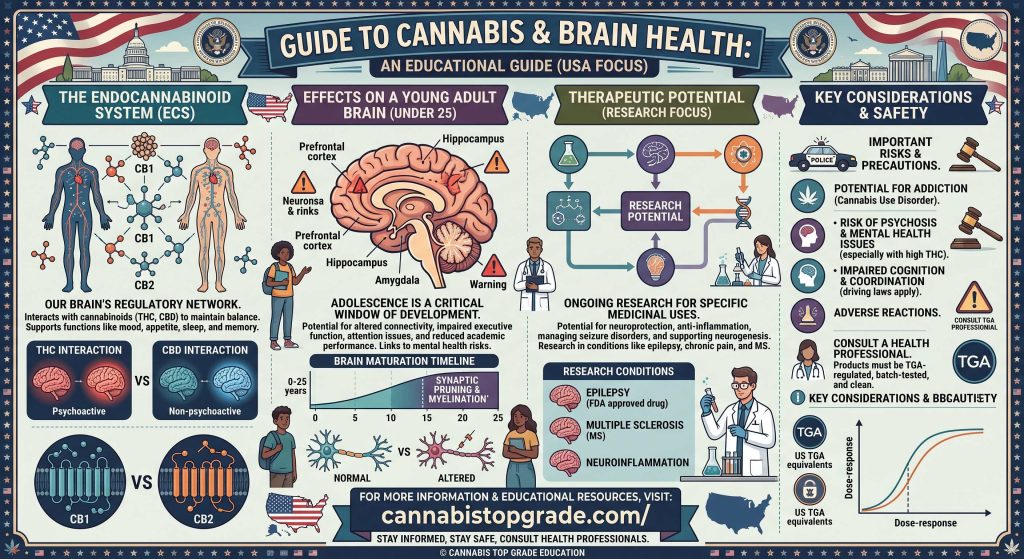
Cannabis interacts with the body’s endocannabinoid system.
This biological signaling system participates in numerous processes, including:
- memory;
- appetite;
- mood;
- pain;
- sleep;
- movement.
Cannabinoids can influence this system.
THC produces many of its characteristic effects by interacting with cannabinoid receptors, particularly CB1 receptors that are abundant in parts of the brain.
Cannabis and the Brain at a Glance
| Brain-Health Topic | What We Know |
|---|---|
| Memory | THC can temporarily impair memory |
| Attention | Cannabis can affect attention and concentration |
| Learning | Recent cannabis use can interfere with learning |
| Reaction time | THC can slow responses |
| Coordination | Cannabis can impair coordination |
| Decision-making | Judgment can be affected |
| Developing brain | Adolescents and young adults deserve particular caution |
| Driving | Cannabis can impair driving-related abilities |
| Long-term effects | Depend on age, frequency, potency and other factors |
| Cannabis use disorder | Can occur in some users |
THC and Brain Function
THC is the principal intoxicating cannabinoid in marijuana.
When THC reaches the brain, it can alter neural signaling.
Short-term effects can include:
- altered perception;
- impaired short-term memory;
- slower reaction time;
- impaired coordination;
- changes in attention;
- altered judgment.
These effects explain why feeling subjectively “normal” does not necessarily mean someone is unimpaired.
Cannabis and Memory
Memory is one of the most extensively discussed cognitive effects of cannabis.
Recent THC exposure can make it more difficult to:
- retain new information;
- remember recent events;
- organize information;
- perform tasks requiring working memory.
These effects are particularly relevant to:
- students;
- workers;
- drivers;
- people operating equipment.
Does Cannabis Kill Brain Cells?
The statement that marijuana simply “kills brain cells” is an oversimplification.
Cannabis research examines much more complicated questions involving:
- neural signaling;
- cognition;
- brain development;
- functional connectivity;
- memory;
- attention.
The evidence does not support reducing all cannabis-brain research to the claim that each exposure directly destroys brain cells.
However, that does not mean cannabis is harmless to cognitive function.
Cannabis and Attention
THC can interfere with attention and concentration.
Tasks requiring sustained focus may become more difficult during intoxication.
The effect can depend on:
- THC exposure;
- tolerance;
- frequency of use;
- individual sensitivity;
- other substances.
This is one reason cannabis should not be treated as a proven productivity enhancer.
Cannabis and Learning
Learning depends heavily on attention and memory.
If cannabis interferes with either function, learning can become more difficult.
This concern is particularly relevant for adolescents and young adults whose brains are still developing.
The Developing Brain
Human brain development continues into young adulthood.
The CDC notes that the brain continues developing until approximately age 25.
This does not mean every person reaches an identical developmental milestone on their 25th birthday.
Rather, brain development is a gradual biological process extending beyond adolescence.
Teen Cannabis Use
Cannabis exposure during adolescence deserves particular public-health attention.
Earlier and more frequent cannabis use has been associated in research with concerns involving:
- learning;
- memory;
- attention;
- educational outcomes;
- cannabis use disorder.
Association does not automatically prove that cannabis alone caused every observed outcome, because environmental and individual factors can also contribute.
Cannabis Potency Has Changed
Modern cannabis products can contain substantial concentrations of THC.
The market also includes concentrated products such as:
- vape oils;
- extracts;
- wax;
- shatter;
- live resin;
- other concentrates.
A high-potency concentrate is not equivalent to lower-THC flower.
This matters when evaluating brain and behavioral effects.
Higher THC and Stronger Effects
Higher THC exposure can increase the likelihood of intense intoxication.
Potential unwanted effects can include:
- anxiety;
- panic;
- confusion;
- paranoia;
- impaired memory;
- impaired coordination.
More THC does not automatically mean a better cannabis experience.
CBD and Brain Effects
CBD, or cannabidiol, differs from THC.
Cannabinoids does not produce the characteristic high associated with THC.
However, CBD should not automatically be described as harmless or as a treatment for every neurological or psychological condition.
CBD can:
- cause side effects;
- interact with medications;
- affect liver function.
Evidence depends on the specific condition and formulation being studied.
THC vs. CBD
| Feature | THC | CBD |
|---|---|---|
| Characteristic cannabis high | Yes | No |
| Can impair driving | Yes | Not typically like THC, but drowsiness/interactions matter |
| Memory impairment during intoxication | Possible | Not characteristic like THC |
| FDA-approved general wellness product | No | No |
| Prescription cannabinoid medicine exists | Yes, specific formulations/uses | Yes, specific seizure disorders |
| Same compound? | No | No |
Cannabis and Reaction Time
Reaction time matters for activities such as driving.
THC can slow responses and interfere with:
- attention;
- coordination;
- judgment;
- perception.
This is why legal cannabis purchase does not mean cannabis-impaired driving is safe.
Cannabis and Driving
Cannabis can impair several abilities needed for driving.
Do not drive while impaired.
This remains true whether cannabis came from:
- a medical dispensary;
- an adult-use dispensary;
- a legal home grow.
Legal possession and safe driving are separate issues.
Cannabis and Alcohol
Combining alcohol and cannabis can increase impairment.
Someone who has used both may have more difficulty with:
- coordination;
- reaction time;
- judgment.
Combining substances should not be treated as a way to create a predictable effect.
Cannabis and Anxiety
Cannabis can feel relaxing to some people.
For others, THC can produce:
- anxiety;
- panic;
- paranoia;
- uncomfortable thoughts.
Response can change with potency and individual sensitivity.
Therefore, marijuana should not be universally described as calming.
Cannabis and Psychosis
Cannabis research has identified an association between cannabis use and psychosis-related outcomes.
Risk appears particularly concerning with:
- frequent use;
- high-THC exposure;
- younger initiation;
- individual vulnerability.
An association does not mean every cannabis user will develop psychosis.
It does mean the relationship deserves serious attention rather than dismissal.
Cannabis and Mental Health
Cannabis and mental health have a complex relationship.
People may use cannabis while experiencing:
- anxiety;
- depression;
- trauma;
- sleep problems;
- stress.
That does not necessarily mean cannabis is treating the underlying condition.
Persistent mental-health symptoms deserve appropriate evaluation.
Cannabis Use Disorder
Some people develop cannabis use disorder (CUD).
Possible signs include:
- craving;
- using more cannabis than intended;
- unsuccessful attempts to cut down;
- increasing tolerance;
- withdrawal;
- continuing despite negative consequences.
The CDC estimates that approximately 3 in 10 people who report cannabis use have cannabis use disorder.
Risk is greater among people who begin using cannabis during youth or adolescence and those who use more frequently.
Cannabis Withdrawal
Regular users can experience withdrawal after reducing or stopping cannabis.
Symptoms may include:
- irritability;
- sleep disturbance;
- reduced appetite;
- restlessness;
- mood changes.
Withdrawal demonstrates that cannabis can produce physiological adaptation in some users.
Cannabis and Sleep
THC can make some people feel sleepy.
However, feeling sedated does not necessarily mean objective sleep quality improves.
Recent research examining cannabis and sleep architecture has produced mixed results.
Cannabis should therefore not automatically be described as a proven sleep treatment.
Long-Term Cannabis and the Brain
Long-term brain effects are harder to summarize than acute intoxication.
Research outcomes can vary according to:
- age when use began;
- frequency;
- duration;
- THC potency;
- other substance use;
- underlying health;
- periods of abstinence.
This is why claims such as “cannabis permanently damages everyone’s brain” or “cannabis has no long-term brain effects” are both too absolute.
Can Brain Effects Improve After Stopping Cannabis?
Some cognitive effects associated with recent cannabis use can improve after intoxication ends or following periods of abstinence.
The exact pattern can differ by:
- individual;
- duration of use;
- frequency;
- age;
- potency.
Research continues to examine how reversible different effects may be.
What Are “Packs” in Cannabis Slang?
The keyword packs can be ambiguous.
In cannabis culture, “pack” or “packs” may refer informally to packaged quantities or products.
It can also appear in branding or slang without representing one standardized weight or product category.
Therefore:
“pack” is not an official cannabis measurement by itself.
Consumers should rely on the actual labeled weight.
Cannabis Package Sizes
Regulated cannabis flower can be labeled using standardized weight information.
The exact quantity should appear on the product label.
A slang expression such as “pack” should not replace:
- grams;
- ounces;
- other legally required measurements.
Cannabis Packaging
Legal cannabis markets often regulate packaging.
Requirements can address:
- cannabinoid labeling;
- warnings;
- child resistance;
- product identity;
- net quantity;
- batch information.
Specific requirements differ by state.
Cannabis Store Near Me
A cannabis store near me search can return several different types of businesses.
Possible results include:
- licensed adult-use dispensaries;
- medical marijuana dispensaries;
- CBD stores;
- hemp shops;
- smoke shops;
- unlicensed sellers.
These categories should not be treated as identical.
Pot Shop Near Me
“Pot” is a common slang term for marijuana.
However, the wording used in a search result does not establish whether a retailer is licensed.
Official state regulatory databases are better sources for verifying legal authorization.
Weed Store Near Me
A weed store near me should likewise be verified.
A nearby business should ideally be checked for:
- license status;
- address;
- current operating status;
- adult-use or medical authorization;
- applicable local permits.
Distance alone does not establish legitimacy.
What Is a Dispensary?
A cannabis dispensary is generally a regulated marijuana retail location.
Depending on state law, it may sell products such as:
- flower;
- pre-rolls;
- concentrates;
- edibles;
- beverages;
- tinctures;
- topicals.
States determine which product categories and sales practices are permitted.
Medical vs. Adult-Use Dispensaries
Medical dispensaries can require:
- patient registration;
- medical certification;
- other state documentation.
Adult-use retailers generally serve adults meeting the state’s age and identification requirements.
Some businesses operate in both markets.
Dispensary Deals Near Me
A search for dispensary deals near me typically has commercial intent.
Licensed retailers may advertise:
- loyalty discounts;
- seasonal promotions;
- product markdowns;
- first-time customer promotions;
- medical-patient discounts where permitted.
But percentage discount alone does not determine value.
How to Compare Dispensary Deals
Consumers researching legal-market prices should consider:
Final price = product price + applicable taxes and fees
They can also compare:
- package size;
- price per gram;
- THC concentration;
- freshness;
- testing;
- product format.
A “40% off” product can still cost more than another comparable product.
High THC Is Not Automatically a Better Deal
Cannabis value should not be reduced to:
most THC for the least money.
Higher THC can also mean stronger intoxication and greater risk of unwanted effects.
Other product characteristics can matter, including:
- freshness;
- cannabinoid balance;
- terpene profile;
- product quality.
Cannabis Deals and Clearance Products
Discounts may sometimes apply to older inventory.
That does not automatically make the product unsafe, but consumers can examine:
- packaging date;
- testing information;
- product condition.
Freshness can affect characteristics such as aroma and moisture.
Dispensary Loyalty Programs
Some licensed cannabis retailers operate loyalty programs where state rules permit them.
Consumers should still compare actual final prices rather than assuming loyalty points always produce the best value.
Verify the Dispensary First
Before comparing deals, determine whether the retailer is legally authorized.
A useful process is:
state cannabis regulator → license verification → retailer information → price comparison
This puts legality before discounts.
Why License Verification Matters
A polished storefront, website or social-media account does not prove cannabis licensing.
Official regulators can provide more authoritative information about:
- active licenses;
- business addresses;
- license categories;
- regulatory status.
Marijuana Laws Vary by State
There is no single nationwide recreational cannabis retail system.
States differ regarding:
- adult-use legalization;
- medical cannabis;
- retail licenses;
- home cultivation;
- delivery;
- possession limits;
- taxes.
The National Conference of State Legislatures tracks cannabis policy developments across U.S. jurisdictions.
Local Cannabis Rules Matter Too
Even within a legal state, municipalities can sometimes impose restrictions involving:
- zoning;
- operating hours;
- retailer locations;
- public consumption;
- delivery.
A legal state can therefore contain cities with very different retail availability.
Online Cannabis Directories
Cannabis directories and map services can help identify potential retailers.
However, third-party directories should not replace state license verification.
Business information can become outdated.
Cannabis Delivery
Some regulated markets permit licensed cannabis delivery.
Rules can vary according to:
- jurisdiction;
- medical/adult-use status;
- service area;
- customer eligibility.
Local delivery authorization should never be confused with unrestricted interstate marijuana shipping.
Interstate Cannabis
State legalization does not create general permission to transport marijuana across state lines.
This remains an important distinction when evaluating websites advertising nationwide cannabis sales.
Brain Health Matters Regardless of Where Cannabis Comes From
Purchasing marijuana from a licensed dispensary improves regulatory accountability, but it does not eliminate THC’s pharmacological effects.
Licensed cannabis can still impair:
- memory;
- attention;
- reaction time;
- coordination.
“Legal” and “risk-free” do not mean the same thing.
Reading Cannabis Labels
Where regulated products are available, consumers can examine:
- THC;
- CBD;
- total cannabinoids;
- serving size;
- package size;
- testing information;
- warnings.
This information can help consumers understand what the product actually contains.
THC Percentage and Brain Effects
A product labeled 30% THC is not simply a “better” version of a product containing less THC.
Higher-potency exposure may increase the intensity of:
- intoxication;
- memory impairment;
- anxiety;
- coordination problems.
Potency deserves attention when discussing brain health.
Edibles and Brain Effects
THC edibles can take longer to produce noticeable effects than inhaled cannabis.
Effects can also last longer.
This delayed onset increases the risk of consuming more before the initial dose has fully taken effect.
Cannabis Concentrates
Concentrates can contain substantially higher THC concentrations than traditional cannabis flower.
This makes product format important when discussing:
- intoxication;
- impairment;
- tolerance;
- brain effects.
Safe Storage
Cannabis should be stored securely away from:
- children;
- pets;
- unauthorized users.
Edibles deserve special attention because they can resemble ordinary candy, baked goods or beverages.
Educational Resources
For additional U.S.-focused cannabis, cannabinoid and public-health education, explore Cannabistopgrade.com.
For evidence-based information concerning marijuana’s effects on memory, learning, attention, decision-making and other brain functions, consult CDC Cannabis and Brain Health.
Regarding information about cannabis use disorder, risk factors and dependence, see CDC Understanding Your Risk for Cannabis Use Disorder.
For current information about differences in U.S. cannabis laws and regulatory policies, consult the NCSL State Cannabis Policy Enactment Database.
Readers can continue exploring cannabis strains, THC, CBD, dispensary terminology and U.S. marijuana policy through Cannabistopgrade.com.
Frequently Asked Questions
1. How does cannabis affect brain health?
THC can temporarily affect memory, learning, attention, decision-making, coordination and reaction time. Longer-term outcomes depend on factors including age, frequency, potency and duration of cannabis exposure.
2. Does marijuana kill brain cells?
Describing marijuana as simply “killing brain cells” is an oversimplification. Cannabis research instead examines effects on cognition, brain development, neural signaling and behavior. THC can nevertheless impair several important brain functions.
3. Is cannabis more concerning for teenagers?
Yes. Adolescence and young adulthood are important periods of brain development. Earlier and more frequent cannabis exposure has been associated with concerns involving memory, learning, attention and cannabis use disorder.
4. How can I find a legitimate cannabis or weed store near me?
Where marijuana retail is legal, identify nearby businesses and verify their licenses using the applicable state cannabis regulator. A map listing alone does not prove that a business is an authorized marijuana retailer.
5. How should I compare dispensary deals near me?
Verify the dispensary first, then compare final prices, package size, price per gram, cannabinoid content, testing and freshness. The largest advertised discount does not necessarily represent the best value.
6. What does “packs” mean in cannabis?
“Packs” is informal and can have different meanings depending on context. It may refer generally to packaged cannabis or quantities, but it is not one standardized legal measurement. Regulated product labels provide the actual weight and cannabinoid information.
