
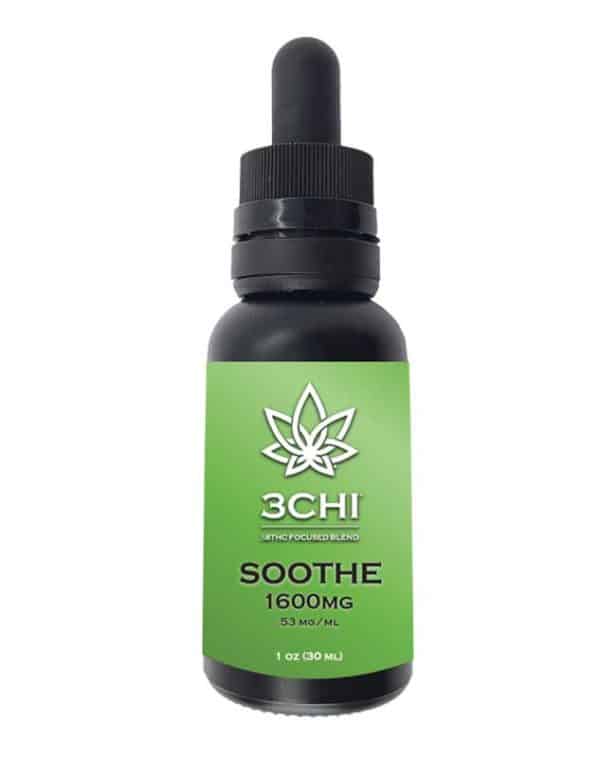
Delta 8 Focused Blends – Soothe Oil Tincture
$40.00
Using a blend of 75% Δ8THC distillate, 25% of a variety of cannabinoids (CBD, CBN, CBC, CBG, CBT, CBDv), this designer Soothe oil tincture gives a more tailored effect than any individual cannabis strain ever could. This 1oz bottle comes with a metered dropper for easy, accurate dosing.
Delta 8 Focused Blends – Soothe Oil Tincture is a hemp-derived cannabinoid tincture currently offered by 3CHI. It is not a conventional marijuana strain. Instead, the manufacturer formulates the oil primarily around delta-8 THC together with several additional cannabinoids.
3CHI currently lists Soothe Oil as a 30 mL broad-spectrum tincture containing about 1,200 mg delta-8 THC, equivalent to roughly 40 mg delta-8 THC per mL, and about 1,600 mg total cannabinoids per bottle. The blend is described as approximately 75% delta-8 THC with the remaining cannabinoid portion containing CBD, CBN, CBC, CBG, CBT and CBDV.
| Product detail | Current information |
|---|---|
| Product | Delta 8 Focused Blends – Soothe Oil Tincture |
| Brand | 3CHI |
| Bottle size | 30 mL / 1 oz |
| Delta-8 THC | Approximately 1,200 mg total |
| Delta-8 concentration | Approximately 40 mg/mL |
| Total cannabinoids | Approximately 1,600 mg |
| Other cannabinoids | CBD, CBN, CBC, CBG, CBT, CBDV |
| Carrier | MCT oil |
| Delta-9 THC | Manufacturer states under 0.3% |
| Intoxicating? | Potentially yes |
| Utah availability | Manufacturer currently excludes Utah shipping |
An especially important point for this page is that 3CHI currently lists Utah among the states to which it does not ship this Delta 8 Soothe Oil Tincture because of state-law concerns.
Utah’s own medical-cannabis program also takes a cautious position on concentrated or synthesized delta-8 THC. Utah DHHS states that delta-8 is psychoactive, is often synthesized from CBD, and that evidence has not established a therapeutic benefit for derived or synthesized cannabinoids such as delta-8 THC.
For broader cannabis education, readers can explore Cannabistopgrade Cannabis Education, Cannabistopgrade Hash and Concentrates and Cannabis Concentrates and Dabbing.
Is Soothe Oil a Weed Strain?
No. Delta 8 Focused Blends – Soothe Oil Tincture is a formulated cannabinoid product rather than a named cannabis cultivar.
A cannabis strain develops its chemistry from genetics, phenotype, cultivation conditions and harvest. A formulated tincture allows a manufacturer to combine selected cannabinoids in predetermined proportions.
That means terms such as OG Kush, Blue Dream or Sour Diesel describe commercial cannabis cultivars, whereas Soothe Oil describes a cannabinoid formulation.
| Soothe Oil | Cannabis strain |
|---|---|
| Formulated liquid extract | Cultivated cannabis plant |
| Delta-8 dominant | Commonly THCA/THC dominant |
| Cannabinoid blend selected by manufacturer | Chemistry emerges from genetics and cultivation |
| No cannabis-strain lineage | Named cultivar genetics |
| Concentration measured in mg/mL | Flower often measured as cannabinoid % |
The manufacturer’s term Soothe is product positioning. It should not be interpreted as proof that the tincture treats pain, anxiety, insomnia or another health condition.
Bud Strain Identifier
A bud strain identifier is usually a strain database, app or reference tool designed to help identify cannabis flower.
However, identifying a cannabis strain from appearance alone is unreliable.
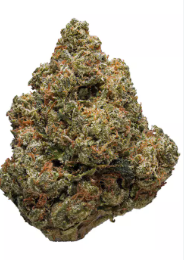
A photograph may reveal characteristics such as flower structure, coloration, trichome coverage and pistils, but many unrelated cultivars can look nearly identical.
A more reliable bud strain identifier combines several kinds of information:
| Identifier | What it can tell you |
|---|---|
| Strain name | Commercial identity |
| Breeder/grower | Source |
| Parent strains | Claimed genetic lineage |
| THC/THCA results | Current potency |
| CBD/CBDA | CBD-related chemistry |
| Terpenes | Aroma-related chemical profile |
| Batch number | Links product to COA |
| Laboratory report | Current measured chemistry |
For an unknown cannabis bud, laboratory testing can identify cannabinoid and terpene chemistry, but even that does not necessarily prove a proprietary commercial strain name.
This is why a picture of a bud cannot reliably answer:
“What exact strain is this?”
Famous Weed Names
Certain famous weed names have become deeply embedded in cannabis culture.
Classic examples include OG Kush, Blue Dream, Sour Diesel, Northern Lights, White Widow, Granddaddy Purple, Jack Herer, Durban Poison, GSC, Gelato, Wedding Cake and Runtz.
Modern commercial cannabis also includes newer influential cultivars such as Permanent Marker, Super Boof, Cereal Milk, GMO Cookies and Motorbreath.
The important SEO and educational point is that a famous strain name does not guarantee identical chemistry between growers.
Two products labeled OG Kush could differ in THC percentage, terpene profile, moisture, phenotype and overall quality.
A strain name is therefore best treated as one layer of identification rather than an exact chemical specification.
Utah Marijuana
Utah marijuana law is centered on a regulated medical-cannabis program rather than a general adult-use recreational retail market.
Utah’s official medical-cannabis program allows qualified cardholders to obtain approved cannabis products from licensed Utah medical cannabis pharmacies. Utah’s Department of Agriculture and Food states that all medical cannabis products must be purchased from a licensed medical cannabis pharmacy and that the state currently regulates 15 medical-cannabis pharmacy licenses.
Utah also distinguishes medical cannabis from ordinary hemp products. The state’s 2026 legislative update specifically notes that certain low-THC medical cannabis products may be sold through medical-cannabis pharmacies while hemp products operate under a separate regulatory system.
Is Marijuana Legal in Utah?
The most accurate short answer in October 2026 is:
Medical cannabis is legal in Utah for qualifying patients who comply with the state’s medical-cannabis program. Utah does not operate a general recreational/adult-use marijuana retail system.
Utah’s patient guidance states that registered patients may buy medical cannabis from licensed Utah medical-cannabis pharmacies. It also says it is illegal to purchase cannabis in another state and bring it into Utah, even if the person holds a Utah medical-cannabis card.
The distinction matters because someone cannot simply apply the cannabis laws of neighboring states to Utah.
Utah Weed Laws
Current Utah weed laws contain several rules that differ noticeably from many recreational cannabis states.
Utah’s patient guidance says medical cannabis patients should only use products bought from Utah medical-cannabis pharmacies. The state says smoking cannabis is not permitted under the medical program, although vaporizing qualifying flower is allowed. Public medical-cannabis use is also prohibited except in a medical emergency. Patients may not sell, share or give their medical cannabis to another person.
Utah law additionally requires medical-cannabis cardholders possessing state-purchased cannabis to carry their medical card and retain the pharmacy label linking the product to Utah’s inventory-control system.
This is a considerably more structured system than ordinary recreational retail.
Pot Laws in Utah
The phrase pot laws in Utah usually leads to three separate legal questions: possession, purchasing and consumption.
For registered medical patients, Utah law provides protections when medical cannabis is purchased and possessed within program requirements. The state establishes legal dosage limits and requires medical products to remain properly labeled and associated with the medical-cannabis system.
For purchases, Utah’s patient portal states that the maximum monthly limit can reach 113 grams of unprocessed flower and 20 grams of THC in other medical-cannabis products, although the patient’s provider can set a lower individual limit in the EVS.
Those are maximum statutory/program limits, not consumption recommendations.
Utah Marijuana Laws and Product Forms
Utah’s medical market permits several product formats.
The state’s patient information says pharmacies can carry oral products such as tablets, gummies and tinctures; flower and vaporizer cartridges; topical products such as lotions and patches; and certain suppository products.
Smoking flower is different.
Utah expressly tells medical patients not to smoke cannabis, although its program permits vaporization of qualifying unprocessed flower.
This distinction makes Utah different from many states where medical or adult-use flower can legally be smoked.
Medical Card Utah
A medical card in Utah is officially called a medical cannabis card.
Utah DHHS currently says adult medical-cannabis patients are generally 18 or older, while patients under 21 require additional Compassionate Use Board procedures.
The current application process is:
- Create or sign in to a UtahID account and enter Utah’s Electronic Verification System (EVS); complete and submit the patient application; meet in person with an eligible medical provider for the initial assessment; have the provider submit the required certification; pay the applicable state card fee; download the approved medical-cannabis card from the EVS; and meet with a medical-cannabis pharmacist before making the first purchase. Utah says that after the first pharmacy consultation, a patient can purchase from any Utah medical-cannabis pharmacy or use an authorized home-delivery service.
Utah currently states that a medical-cannabis card normally lasts one year, although a provider can specify a shorter expiration period.
Who Qualifies for a Utah Medical Cannabis Card?
Utah recognizes a defined set of qualifying conditions and also provides a Compassionate Use Board process for patients whose medical circumstances fall outside the regular list.
Current patient guidance includes conditions such as persistent pain lasting longer than two weeks, qualifying PTSD with concurrent mental-health treatment, certain rare diseases and terminal illness or hospice situations. The state’s complete statutory list includes additional qualifying conditions.
The existence of a qualifying condition does not mean cannabis is proven to cure that condition. Utah’s statute specifically cautions that inclusion on the qualifying-condition list does not conclusively establish medical efficacy.
Can Visitors Use Medical Cannabis in Utah?
Utah provides a special non-Utah resident card for certain visiting medical-cannabis patients.
The current state program says qualifying visitors with an eligible medical card from their home state can apply for a temporary Utah nonresident card. Those cards last 21 days, and a visitor is generally limited to two nonresident cards per calendar year.
Importantly, having a card from another state does not mean a visitor can legally bring cannabis purchased elsewhere into Utah. Utah’s official patient guidance says bringing cannabis into Utah from another state is illegal even for cardholders.
What About Delta-8 THC in Utah?
This is particularly relevant to Delta 8 Focused Blends – Soothe Oil Tincture.
Utah DHHS describes delta-8 THC as a psychoactive cannabinoid that naturally exists only in trace amounts and can be readily synthesized from CBD. The state’s medical-cannabis guidance says there is currently no evidence establishing therapeutic benefit for concentrated derived/synthesized cannabinoids such as delta-8 and cites safety concerns raised by federal regulators and scientific literature.
Meanwhile, 3CHI’s current product page explicitly lists Utah among the locations to which Soothe Oil is not shipped.
Therefore, this page should not tell Utah residents that Soothe Oil can simply be ordered online because it contains less than 0.3% delta-9 THC.
State cannabinoid rules matter independently of the manufacturer’s hemp classification.
Why “Hemp-Derived” Does Not Automatically Mean Legal Everywhere
The U.S. cannabinoid market contains products made from hemp-derived CBD that are converted into substances such as delta-8 THC.
This has created significant differences among state laws.
A product might satisfy one federal hemp-related definition while still being restricted by a state.
That is why claims such as:
“Delta-8 is legal in all 50 states”
should be avoided.
Soothe Oil provides a practical example: the manufacturer currently excludes Utah along with several other states from shipment.
Bud Strain Identifier vs. Tincture Identification
A cannabis-strain identifier is useful for plant cultivars, but it is not the correct tool for identifying Soothe Oil.
For a manufactured tincture, the relevant identifiers are:
| Tincture information | Why it matters |
|---|---|
| Brand/product | Identifies formulation |
| Batch number | Links to laboratory report |
| Delta-8 result | Confirms main cannabinoid |
| Delta-9 result | Important legally and chemically |
| CBD/CBN/CBG | Shows additional cannabinoids |
| Contaminant testing | Provides quality information |
| Manufacturing date | Adds traceability |
3CHI currently maintains a testing page that includes specific Soothe batches among its published laboratory reports.
Famous Weed Names vs. Real Chemical Profiles
Popular cannabis names are culturally useful, but chemistry matters more than fame.
A product called:
OG Kush
could have a different THC percentage from another OG Kush.
A product called:
Blue Dream
could show a different terpene balance from a Blue Dream grown elsewhere.
And Delta 8 Focused Blends – Soothe Oil Tincture is not a cultivar at all.
For educational cannabis content, the best formula is therefore:
name + genetics + batch chemistry + product type
rather than relying on the name alone.
Frequently Asked Questions
1. What is Delta 8 Focused Blends – Soothe Oil Tincture?
It is a 3CHI broad-spectrum hemp-derived tincture currently formulated with approximately 1,200 mg delta-8 THC and 1,600 mg total cannabinoids in a 30 mL bottle. Other cannabinoids include CBD, CBN, CBC, CBG, CBT and CBDV.
2. Is marijuana legal in Utah?
Utah has a legal medical-cannabis program for qualifying patients, but it does not operate a general recreational marijuana retail system. Legal medical cannabis must be obtained and used according to Utah’s medical-cannabis rules.
3. How do I get a medical card in Utah?
Adults seeking a Utah medical-cannabis card apply through the state’s EVS, complete an initial in-person medical-provider assessment, receive provider certification, pay the state fee, obtain their electronic card and consult with a medical-cannabis pharmacist before their first purchase.
4. Can a bud strain identifier tell me exactly what marijuana strain I have?
Not reliably from appearance alone. Strain identification is stronger when breeder information, genetics, cannabinoid results, terpene data and the batch COA are available. Commercial strain names are not precise chemical fingerprints.
5. Can Delta 8 Soothe Oil be shipped to Utah?
3CHI’s current product page lists Utah as a shipping-excluded state for this product. Utah also publishes specific cautions concerning concentrated or synthesized delta-8 THC products.
Authoritative Outbound Resources
Utah – Medical Cannabis Patient Information
Be the first to review “Delta 8 Focused Blends – Soothe Oil Tincture”
Related products
Cannabis Tincture
Sativa Strains
Edibles and Gummies
Cannabis Tincture
Cannabis Tincture
Cannabis Tincture
Cannabis Tincture
Hybrid cannabis strains
Reviews
There are no reviews yet.