Uncategorized
Pot – Definitions, Synonyms, and Usage
Sep
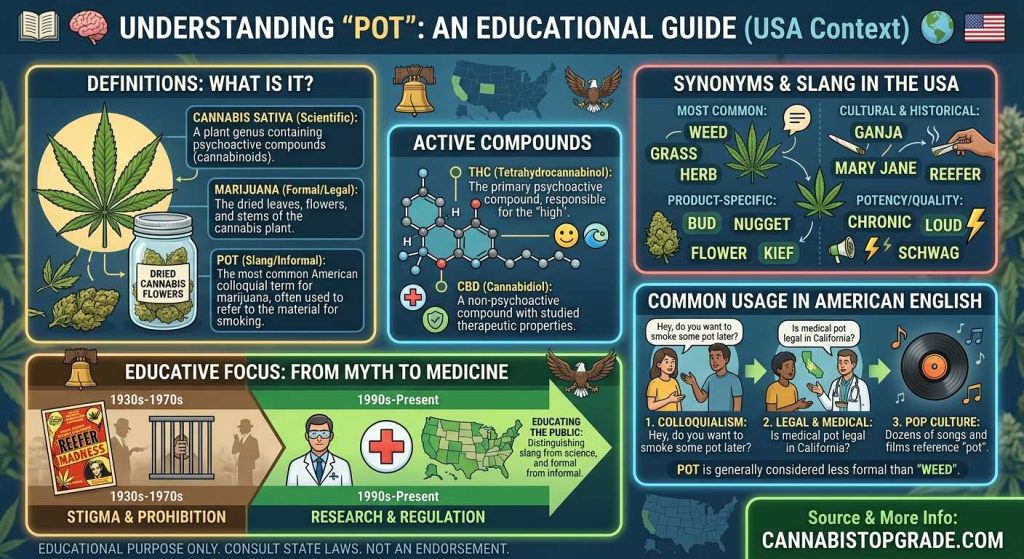
Pot – Definitions, Synonyms, and Usage explores one of the most familiar slang terms associated with cannabis in the United States.
In cannabis conversations, pot generally means marijuana or cannabis. Cornell Law School’s Legal Information Institute describes pot as a slang term for cannabis and notes that cannabis is also commonly called marijuana and weed. Merriam-Webster likewise lists marijuana as a definition of pot.
However, “pot” has many meanings outside cannabis.
It can describe:
- a cooking container;
- a plant container;
- a gambling prize pool;
- marijuana;
- several other objects depending on context.
That makes context extremely important.
Someone saying “a pot of soup” obviously means something very different from someone discussing “pot laws.”
Within cannabis culture, pot belongs to a large family of informal terms including:
- weed;
- marijuana;
- cannabis;
- bud;
- ganja;
- herb;
- grass;
- flower.
Some of these terms are slang, while others are more suitable for scientific, legal, medical, or regulatory writing.
This guide also explains modern cannabis terms including mini pre rolls, cheap pre rolls near me, crystalline THC, cannabis dispensary near me open now within 5 mi, concentrate deals near me, and THC bath bomb.
For more U.S.-focused cannabis terminology and education, explore Cannabistopgrade.com.
What Does Pot Mean?
In marijuana-related conversation, pot is an informal term for cannabis.
It is commonly used in phrases such as:
- smoking pot;
- pot laws;
- pot shop;
- medical pot;
- recreational pot;
- pot legalization.
The term is deeply embedded in American cannabis vocabulary.
However, modern legal agencies and health organizations generally prefer cannabis or marijuana when describing regulated products and laws.
Pot Definition in Cannabis
A simple cannabis-specific definition is:
Pot is an informal or slang term for marijuana or cannabis.
Cornell Law School’s Legal Information Institute defines pot as slang for cannabis and notes that cannabis contains compounds including THC and CBD.
The FDA explains that cannabis contains numerous biologically active compounds, with THC and CBD among the most familiar.
THC is primarily associated with marijuana’s intoxicating effects.
Is Pot the Same as Marijuana?
In ordinary conversation, yes.
When somebody says:
“pot,”
“marijuana,”
or
“weed,”
they may be referring broadly to the same category of cannabis material.
However, terminology can become more complicated in legal and scientific contexts.
“Cannabis” is generally the broadest plant-related term.
“Marijuana” can have specific legal meanings.
“Pot” remains informal slang.
Pot vs. Cannabis
Cannabis is the more formal and scientifically useful term.
It refers to plants within the Cannabis genus and can also be used broadly for products derived from those plants.
“Pot,” by comparison, is conversational slang.
For example:
Informal: Pot laws vary by state.
More formal: Cannabis laws vary by state.
Both can communicate a similar idea, but the second is generally better suited to educational, medical, or regulatory writing.
Pot vs. Weed
Pot and weed are both common cannabis slang.
They frequently function as synonyms.
Examples include:
- pot shop / weed shop;
- pot smoker / weed user;
- pot laws / weed laws.
Neither word provides information about a product’s:
- THC;
- CBD;
- strain;
- format;
- potency.
They are broad informal labels.
Pot vs. Marijuana
Marijuana has historically been one of the most commonly used terms for THC-containing cannabis in American law and culture.
Pot is more informal.
A law is more likely to say “marijuana” or “cannabis” than “pot.”
A casual conversation may use all three.
Pot vs. Ganja
Ganja is another traditional term for cannabis.
It has historical roots outside the United States and remains familiar throughout global cannabis culture.
Pot and ganja can therefore overlap in informal usage.
Neither identifies a specific cannabis strain.
Pot vs. Bud
Bud generally refers more specifically to cannabis flower.
Pot can describe cannabis broadly.
For example, pot can appear as:
- flower;
- concentrates;
- edibles;
- tinctures;
- vape products.
Bud normally refers to floral cannabis material.
Pot vs. Flower
Cannabis flower is a more precise product term than pot.
Flower refers primarily to harvested cannabis blossoms containing substantial concentrations of glandular trichomes.
These trichomes can contain cannabinoids and terpenes.
Pot vs. Hemp
Pot generally implies marijuana rather than hemp.
Hemp and marijuana can both originate from Cannabis plants but are treated differently under applicable legal definitions.
Visual appearance alone may not reliably establish the legal category.
Chemical composition and statutory definitions matter.
Common Synonyms for Pot
Popular terms associated with cannabis include:
- cannabis;
- marijuana;
- weed;
- ganja;
- bud;
- herb;
- grass;
- Mary Jane;
- flower.
These words are not perfectly interchangeable in every setting.
For example, “flower” describes a product format, while “cannabis” is a broader botanical and regulatory term.
Why Cannabis Has So Many Names
Cannabis has accumulated a large vocabulary through:
- traditional use;
- prohibition-era slang;
- regional language;
- music;
- popular culture;
- medical legalization;
- adult-use legalization.
As public policy changed, terminology changed too.
Modern government agencies increasingly use “cannabis,” while older statutes may use “marijuana.”
Is the Word Pot Offensive?
Usually not, but tone matters.
“Pot” is generally considered informal rather than inherently offensive.
In professional contexts, cannabis is usually more precise.
A physician, regulator, researcher, or lawyer is more likely to use terms such as:
- cannabis;
- marijuana;
- THC;
- cannabinoid.
Pot in American English
Pot has been used as cannabis slang in American English for decades.
Merriam-Webster records the marijuana-related usage from the twentieth century.
It remains widely understood today.
Why Context Matters With the Word Pot
“Pot” is highly context dependent.
Compare:
“Put the plant in a pot.”
“The winner collected the poker pot.”
“The state changed its pot laws.”
Only the final example refers to cannabis.
Search engines therefore interpret meaning using surrounding words.
What Are Mini Pre Rolls?
Mini pre rolls are smaller versions of cannabis pre-rolls.
A pre-roll is commercially prepared cannabis flower wrapped in rolling paper.
Mini formats generally contain less flower than a full-size pre-roll.
Names vary by producer.
Common marketing terms can include:
- minis;
- shorties;
- dogwalkers;
- petite pre-rolls.
There is no single universal size implied by “mini.”
Mini Pre Rolls vs. Regular Pre Rolls
| Feature | Mini Pre-Rolls | Standard Pre-Rolls |
|---|---|---|
| Typical size | Smaller | Larger |
| Cannabis amount | Usually less | Usually more |
| Product type | Flower or infused | Flower or infused |
| THC exposure | Product dependent | Product dependent |
| Standardized nationally? | No | No |
The cannabinoid label matters more than the word “mini.”
Are Mini Pre Rolls Less Potent?
Not necessarily.
A smaller pre-roll can contain less material, but potency refers to cannabinoid concentration.
A mini pre-roll made with high-THC flower could have stronger cannabis by weight than a larger pre-roll made with lower-THC flower.
Size and potency are different measurements.
Infused Mini Pre Rolls
Some mini pre-rolls are infused with cannabis concentrates.
These products can contain:
- hash;
- kief;
- oil;
- resin;
- rosin.
Infusion can significantly increase THC concentration.
Consumers should therefore distinguish conventional flower pre-rolls from infused versions.
Cheap Pre Rolls Near Me
The phrase cheap pre rolls near me combines local cannabis retail intent with price comparison.
Where marijuana retail is lawful, licensed dispensaries may offer:
- single pre-rolls;
- multi-packs;
- mini pre-roll packs;
- promotional pricing.
Low price should not be the only factor used to evaluate a cannabis product.
Cheap Cannabis Does Not Automatically Mean Good Value
Important factors include:
- licensing;
- laboratory testing;
- freshness;
- cannabinoid labeling;
- packaging;
- product weight.
An inexpensive regulated product may provide good value, while an unusually cheap unverified product can create additional uncertainty.
What Is Crystalline THC?
Crystalline THC is a phrase often used loosely for highly purified or crystalline cannabis concentrate products.
More technically, many crystalline concentrates contain cannabinoids in acidic precursor forms such as THCA crystals rather than ordinary delta-9 THC crystals.
This distinction matters because cannabis chemistry changes with heat.
THCA vs. THC
THCA is a naturally occurring cannabinoid precursor.
Heating can convert THCA into THC through a process called decarboxylation.
That is why cannabis labels may separately display:
- THCA;
- THC;
- total THC.
Using “crystalline THC” as a generic marketing phrase can obscure this chemistry.
What Are Cannabis Diamonds?
Cannabis diamonds are crystalline concentrate structures commonly rich in THCA.
They may appear alone or combined with terpene-rich concentrate material.
These products can contain very high cannabinoid concentrations.
Crystalline Concentrates vs. Flower
Crystalline cannabinoid products can be dramatically more concentrated than conventional cannabis flower.
Higher concentration can result in greater THC exposure after relevant cannabinoid conversion and consumption.
This increases the importance of:
- accurate labeling;
- laboratory testing;
- understanding potency.
High-Potency Cannabis Risks
High-THC products can increase the likelihood of unwanted effects in some people.
Possible effects include:
- anxiety;
- paranoia;
- panic;
- dizziness;
- impaired coordination;
- impaired memory.
Frequent use of high-potency cannabis can also contribute to greater tolerance.
Cannabis Concentrates
Concentrates are cannabis products in which cannabinoids and other plant compounds have been concentrated from flower or resin.
Common categories include:
- live resin;
- rosin;
- shatter;
- wax;
- budder;
- crumble;
- crystalline products.
Potency can vary enormously.
Concentrate Deals Near Me
The phrase concentrate deals near me reflects local price-shopping intent.
Licensed dispensaries in jurisdictions permitting concentrate sales may advertise:
- temporary discounts;
- loyalty promotions;
- product specials.
However, promotional pricing does not establish product safety or retailer legitimacy.
What to Compare Beyond Concentrate Price
Useful information includes:
- THC and THCA;
- CBD;
- producer;
- batch;
- testing;
- package date;
- ingredients.
Concentrate products deserve particular attention because their THC concentration can be much higher than ordinary flower.
Cannabis Dispensary Near Me Open Now Within 5 Mi
The phrase cannabis dispensary near me open now within 5 mi combines several forms of local intent:
- product access;
- geographic distance;
- current opening hours;
- cannabis retail.
Search engines can provide nearby listings, but a search result does not prove that a business holds a marijuana license.
How to Verify a Cannabis Dispensary
Where legal retail exists, official state cannabis regulators often maintain licensing resources.
These can help verify:
- business name;
- address;
- license category;
- current authorization.
This is particularly useful when multiple smoke shops, hemp retailers, and marijuana dispensaries appear in the same local search.
Cannabis Dispensary vs. Smoke Shop
These businesses should not automatically be treated as identical.
A licensed marijuana dispensary can sell state-regulated marijuana where authorized.
A smoke shop may primarily sell:
- smoking accessories;
- tobacco-related products;
- hemp products.
A storefront using cannabis imagery does not necessarily have a marijuana retail license.
Open-Now Cannabis Searches
Business hours can change because of:
- holidays;
- municipal restrictions;
- retailer policy;
- temporary closures.
For that reason, “open now” information should be checked against current retailer and regulatory information.
Cannabis Laws Vary by State
U.S. cannabis rules remain highly jurisdiction-specific.
The National Conference of State Legislatures maintains a cannabis policy database covering enacted state legislation involving:
- medical cannabis;
- adult-use cannabis;
- dispensary licensing;
- cannabis products;
- testing;
- delivery;
- public health;
- taxes;
- local control.
The database was updated August 31, 2026.
What is Medical Pot
“Medical pot” is informal language for medical cannabis.
Medical programs vary considerably.
Depending on the state, requirements can involve:
- qualifying conditions;
- patient registration;
- clinician recommendations;
- product restrictions;
- purchase limits.
The phrase medical pot is common conversationally, but medical cannabis is more appropriate for formal writing.
Recreational Pot
“Recreational pot” generally means cannabis used within an adult-use marijuana framework rather than a medical program.
A more modern regulatory phrase is:
adult-use cannabis.
State law determines whether adult-use retail is permitted.
Pot Shop
“Pot shop” is an informal term for a marijuana retailer.
It can be used similarly to:
- weed store;
- marijuana shop;
- cannabis dispensary.
The legal status of a store depends on its license, not the nickname used for it.
What Is a THC Bath Bomb?
A THC bath bomb is a topical bath product marketed as containing THC or cannabis-derived ingredients.
Bath bombs generally dissolve in bathwater and can contain combinations of:
- salts;
- oils;
- fragrances;
- botanical ingredients;
- cannabinoid ingredients.
Product formulation varies.
Does a THC Bath Bomb Get You High?
Claims that every THC bath bomb produces intoxication would be misleading.
Skin exposure and cannabinoid absorption depend heavily on formulation.
Ordinary topical products are different from specially formulated transdermal drug-delivery systems.
Consumers should therefore avoid assuming that the amount printed on a package translates directly into bloodstream THC exposure.
THC Bath Bomb vs. THC Edible
These are fundamentally different product categories.
A THC edible is designed to be consumed orally.
A bath bomb is designed for external use in bathwater.
They should never be treated as interchangeable merely because both mention THC.
THC Bath Bomb vs. CBD Bath Bomb
A THC bath bomb contains or claims to contain THC.
A CBD bath bomb contains or claims to contain CBD.
Some products may advertise both.
The FDA continues to emphasize that cannabis-derived compounds such as THC and CBD are biologically active and that many marketed cannabis products have not been evaluated as approved drugs for claimed therapeutic uses.
Can THC Bath Bombs Treat Pain?
Consumers may encounter bath bombs marketed for:
- soreness;
- recovery;
- relaxation;
- pain.
Marketing claims should not be interpreted as proof of clinically established treatment.
A cannabis topical product is not automatically an FDA-approved pain medication.
Cannabis Product Labels
Whether evaluating pre-rolls, crystalline concentrates, or topical products, labels matter.
Useful information can include:
- cannabinoid amount;
- product weight;
- ingredients;
- warnings;
- batch identification;
- testing information.
Requirements vary by state.
Pot and Brain Health
THC-containing cannabis can temporarily affect functions including:
- attention;
- memory;
- decision-making;
- coordination;
- reaction time.
These concerns apply across product formats when psychoactive THC reaches the body.
Pot and Driving
Cannabis impairment can affect abilities required for safe driving.
People should not drive while impaired by cannabis.
A product being legal to purchase does not make impaired driving legal.
Pot and Cannabis Use Disorder
Cannabis use can lead to cannabis use disorder in some individuals.
Possible signs include:
- craving;
- increasing tolerance;
- difficulty cutting down;
- continued use despite problems.
Higher-potency products can increase total THC exposure.
Formal Cannabis Terminology
Different settings favor different terminology.
| Context | Preferred Language |
|---|---|
| Casual conversation | Pot, weed, bud |
| Cannabis retail | Cannabis, marijuana, flower |
| Scientific writing | Cannabis, THC, cannabinoids |
| Public health | Cannabis, marijuana |
| Regulatory writing | Cannabis or statutory legal term |
| Product labeling | Specific cannabinoid/product name |
Choosing the correct term improves clarity.
When to Use the Word Pot
“Pot” works well when:
- explaining slang;
- discussing historical terminology;
- writing conversationally;
- answering common-language searches.
It is less suitable when a precise scientific or legal term is necessary.
Why Cannabis Is Usually the Best Educational Term
Cannabis avoids much of the ambiguity associated with slang.
It can describe the plant and its products without assuming a specific cultural tone.
That makes it particularly useful in:
- education;
- research;
- medicine;
- public policy.
Educational Resources
For additional U.S.-focused cannabis terminology and product education, explore Cannabistopgrade.com.
For a legal-language definition of pot, consult Cornell Legal Information Institute’s Pot Definition.
Regarding information about cannabis-derived compounds including THC and CBD, see the FDA Cannabis and Cannabis-Derived Products Consumer Update.
For current state cannabis legislation and product regulations, consult the NCSL State Cannabis Policy Enactment Database.
Continue researching marijuana terminology, concentrates, pre-rolls, THC, dispensaries, and U.S. cannabis laws through Cannabistopgrade.com.
Frequently Asked Questions
1. What does pot mean in cannabis terminology?
Pot is an informal slang term for marijuana or cannabis. It is widely understood in the United States, although cannabis is generally more appropriate in scientific, medical, and regulatory writing.
2. Are pot, weed, marijuana, and cannabis the same thing?
They frequently refer to similar material in casual conversation, but they are not equally precise. Cannabis is the broad botanical term, marijuana can have specific legal meanings, and pot and weed are mainly slang.
3. What are mini pre rolls?
Mini pre-rolls are smaller commercially prepared cannabis joints. Their size does not establish potency, and infused mini pre-rolls can contain concentrates that substantially increase cannabinoid concentration.
4. What does crystalline THC mean?
The phrase often describes highly purified crystalline cannabis concentrates. Many such products are primarily THCA crystals or “diamonds,” with THCA converting to THC when heated. The product label provides more precise chemical information.
5. How can someone verify a cannabis dispensary near them?
Where marijuana retail is legal, official state cannabis regulators can often be used to verify a retailer’s license. Search-engine proximity, opening hours, reviews, or cannabis imagery alone do not establish authorization.
6. Do THC bath bombs make people high?
Not necessarily. Cannabinoid absorption through skin depends heavily on formulation, and conventional topical products are different from specialized transdermal delivery systems. A THC bath bomb should not automatically be assumed to create systemic intoxication or provide medically proven benefits.
