
Uncategorized
Ohio Cannabis Laws and Dispensaries
Sep
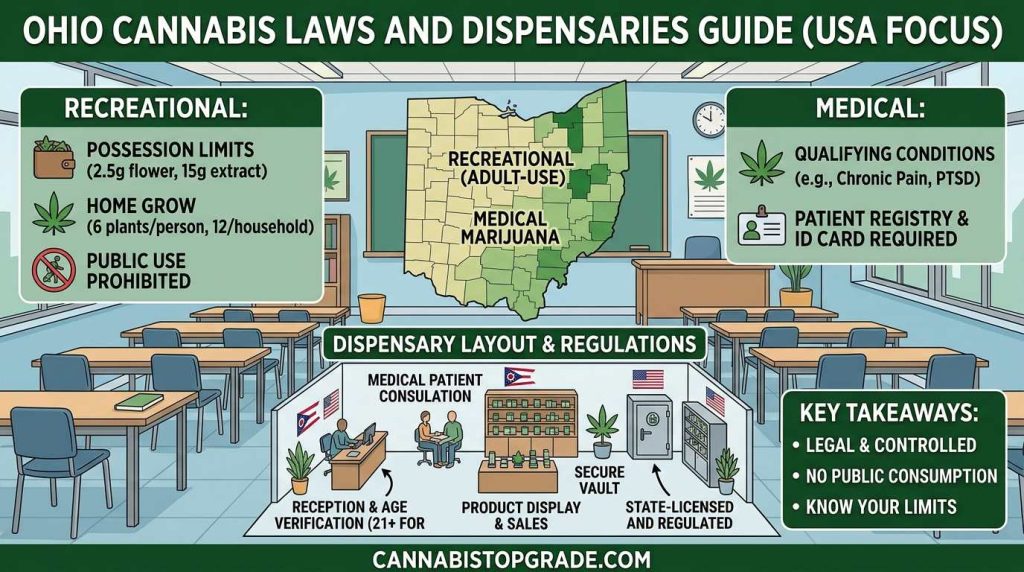
Ohio Cannabis Laws and Dispensaries changed significantly after Ohio voters approved Issue 2 in November 2023 and legal adult-use retail sales began in August 2024. The market has continued evolving, with major statutory changes taking effect in March 2026.
Today, adults 21 and older can legally purchase adult-use marijuana from licensed Ohio dispensaries, possess cannabis within statutory limits and cultivate a limited number of plants at their primary residence.
However, legalization does not mean cannabis is unrestricted.
Ohio regulates:
- possession amounts;
- home cultivation;
- public consumption;
- dispensary licensing;
- cannabis transfers;
- product packaging;
- age verification;
- impaired driving.
These rules matter when people search for a recreational cannabis dispensary near me, Thrive dispensary, Sunnyside dispensary, kief, Connected, March and Ash, Off the Charts, sativa vs indica, Jack Herer strain, or even something as basic as a measure of weed.
For additional U.S. cannabis education, visit Cannabistopgrade.com.
Ohio Cannabis Laws Quick Guide
| Topic | Ohio Rule in 2026 |
|---|---|
| Adult-use cannabis | Legal |
| Minimum recreational age | 21 |
| Adult possession — flower | Up to 2.5 ounces |
| Adult possession — extract | Up to 15 grams |
| Home cultivation | Legal under restrictions |
| Plants per adult | Up to 6 |
| Maximum per residence | 12 |
| Public cannabis consumption | Prohibited |
| Licensed dispensaries | Yes |
| Recreational sales | Operating |
| Driving while impaired | Illegal |
| Unlicensed sales | Illegal |
Is Recreational Marijuana Legal in Ohio?
Yes.
Ohio has a legal adult-use cannabis market.
Adults who are at least 21 years old can purchase adult-use cannabis through licensed dispensaries.
Ohio Administrative Code requires dispensary employees to examine a valid government-issued photo ID and confirm that an adult-use customer is at least 21 before completing a sale.
Ohio’s regulated adult-use market began retail sales in August 2024 and has expanded considerably since then.
How Much Weed Can You Have in Ohio?
Under the Ohio Revised Code effective March 20, 2026, an adult-use consumer generally may possess up to:
2.5 ounces of cannabis plant material
and:
15 grams of cannabis extract.
Those are cumulative possession limits under current state law.
The official provision can be reviewed through Ohio Revised Code Section 3796.221.
Measure of Weed
The keyword measure of weed usually refers to the units commonly used to describe cannabis quantities.
Cannabis flower is frequently measured in:
- grams;
- eighths;
- quarters;
- half-ounces;
- ounces.
A basic conversion guide looks like this:
| Common Term | Approximate Metric Weight |
|---|---|
| 1 gram | 1 g |
| Eighth ounce | 3.5 g |
| Quarter ounce | 7 g |
| Half ounce | 14 g |
| One ounce | 28.35 g |
| 2.5 ounces | About 70.9 g |
These measurements are useful for understanding possession laws, but product weight and THC content are separate concepts.
Ohio Dispensary Daily Purchase Rules
Ohio dispensaries must also follow rules governing how much adult-use cannabis they may dispense.
Current Ohio administrative rules allow a dispensary to dispense to an adult-use consumer per day no more than:
2.5 ounces of plant material
and cannabis products containing no more than:
15,000 milligrams of total THC.
The retail calculation rules are not identical to simply comparing every product by weight.
Ohio’s official dispensing rule is available in Ohio Administrative Code Rule 1301:18-8-08.
Can You Grow Weed in Ohio?
Yes.
Ohio law currently allows qualifying adults to cultivate marijuana at their primary residence.
A person age 21 or older may cultivate up to:
six plants.
A single residence may contain no more than:
12 plants total.
This remains true even when more than two adults live there.
Ohio Home-Grow Requirements
Cannabis cultivation must take place in a secured:
- closet;
- room;
- greenhouse;
- other enclosed area.
The growing area must prevent access by people under 21 and cannot be visible by normal unaided vision from a public space.
Ohio law can also restrict cultivation in certain rental properties when the rental agreement prohibits it.
Read the current requirements at Ohio Revised Code Section 3796.04.
Can You Sell Homegrown Cannabis in Ohio?
No.
Ohio’s home-cultivation law does not authorize adults to commercially sell their homegrown marijuana.
The statute expressly prohibits profiting from homegrown marijuana.
Certain transfers without payment between adult-use consumers are permitted within legal limits and under specified circumstances.
That is different from operating an unlicensed cannabis business.
Can You Smoke Weed in Public in Ohio?
Public consumption is prohibited under Ohio’s 2026 framework.
Ohio law states that an adult-use consumer may not knowingly consume adult-use or homegrown marijuana in a public place.
Cannabis use should therefore not be treated in the same way as merely possessing a legally purchased product.
Legal possession does not create a right to consume cannabis anywhere.
Cannabis and Driving in Ohio
Ohio cannabis legalization does not legalize impaired driving.
State law specifically does not authorize adults to operate:
- automobiles;
- watercraft;
- aircraft;
- other covered vehicles;
while under the influence of marijuana.
THC can affect reaction time, coordination and judgment.
Recreational Cannabis Dispensary Near Me
The phrase recreational cannabis dispensary near me has become increasingly relevant as Ohio’s adult-use market expands.
But a search-engine result alone does not prove that a business has an active Ohio cannabis license.
Consumers can encounter:
- licensed cannabis dispensaries;
- CBD stores;
- hemp retailers;
- smoke shops;
- vape stores.
These are not interchangeable.
The Ohio’s Division of Cannabis Control should be used to verify regulated cannabis businesses.
Ohio’s Dispensary Market in 2026
Ohio’s retail cannabis industry has expanded substantially.
Current industry listings show more than 200 dual-use dispensaries operating across the state, although official state licensing data should be considered the final authority.
Ohio law now provides for a maximum number of dispensary licenses under its revised regulatory structure.
Cities with dispensaries include areas around:
- Columbus;
- Cleveland;
- Cincinnati;
- Toledo;
- Akron;
- Dayton;
- Marion;
- Tiffin;
- Chillicothe.
Thrive Dispensary
Thrive Dispensary Tiffin operates in Tiffin, Ohio.
Current business and company information places the store at 318 W Market Street, Tiffin and identifies it as serving Ohio cannabis consumers.
The dispensary’s own material describes adult-use sales for people age 21+ as well as medical cannabis access.
Inventory can include categories such as:
- flower;
- pre-rolls;
- vapes;
- concentrates;
- edibles;
- tinctures;
- topicals.
Menu inventory and promotions change, so an educational article should avoid presenting specific products as permanently available.
Sunnyside Dispensary
Sunnyside – Marion is one of multiple Sunnyside cannabis locations operating in Ohio.
Cresco Labs’ current retail information lists Ohio Sunnyside stores in communities including:
- Marion;
- Cincinnati;
- Chillicothe;
- Newark;
- Wintersville;
- Proctorville;
- Bridgeport;
- Aberdeen.
Cresco announced new Bridgeport and Aberdeen openings in April and May 2026, showing that its Ohio retail footprint is still evolving.
Sunnyside Marion
The Marion location is at:
326 James Way, Marion, Ohio.
Current listings identify it as serving both medical and non-medical cannabis consumers.
Again, product menus should be treated as dynamic.
Off the Charts
Off The Charts operates a cannabis dispensary in Dayton.
Its current official information lists the Dayton location at:
3145 Salem Avenue, Dayton, Ohio.
The store identifies itself as an adult cannabis retailer and currently lists daily operating hours on its site.
The important SEO distinction is that Off the Charts can refer to different cannabis businesses and phrases in different states, so location should always accompany the term.
March and Ash
March and Ash primarily operates in Southern California, including San Diego-area locations.
Its website describes recreational locations serving adults 21+ and California delivery and pickup services.
Therefore, a person researching March and Ash while reading an Ohio cannabis article should understand:
March and Ash is associated with California’s market, not Ohio’s licensed dispensary system.
This geographic clarification helps prevent misleading local-search content.
Connected Cannabis
Connected Cannabis Co. is primarily a cannabis brand rather than a generic term for an Ohio dispensary.
It is known for branded cannabis flower and related products in regulated markets.
Connected’s own fraud warning states that the company does not use Telegram or Wickr to sell cannabis and warns consumers about fake social-media accounts claiming to represent the company.
That is an important consumer-safety point for branded cannabis searches.
A brand appearing online does not prove that the product is:
- authentic;
- available in Ohio;
- sold by a licensed Ohio dispensary.
Cannabis Brands vs. Dispensaries
A brand manufactures or markets cannabis products.
A dispensary is the licensed retail business selling regulated products.
The two can overlap commercially, but they are not the same.
For example:
Connected Cannabis — primarily a product brand.
Sunnyside — a dispensary brand.
Thrive — dispensary operation.
Off the Charts — dispensary operation in Dayton.
March and Ash — California dispensary company.
This distinction is useful when researching cannabis online.
What Is Kief?
Kief refers to the loose resin glands and trichome material separated from cannabis flower.
It often appears as a fine:
- golden;
- tan;
- greenish;
powder.
Kief contains cannabinoids and terpenes concentrated from cannabis trichomes.
Is Kief Stronger Than Flower?
Kief can contain higher cannabinoid concentrations than the flower from which it was separated because it is rich in resin-producing trichomes.
However, there is no universal THC percentage for kief.
Actual potency depends on:
- plant genetics;
- cultivation;
- processing;
- purity;
- batch composition.
Laboratory results provide better information than appearance alone.
Is Kief Considered a Concentrate?
Kief is generally categorized as a cannabis concentrate or concentrated trichome product.
Ohio’s legal treatment can depend on product classification and regulatory rules.
This matters because current possession law distinguishes cannabis plant material from cannabis extract.
Consumers should rely on how a regulated Ohio product is legally labeled rather than guessing from its appearance.
Kief vs. Hash
Kief is typically loose trichome material.
Hash usually involves further processing, collection or compression of trichome material.
Both products can contain more concentrated cannabinoids than ordinary flower.
Sativa vs Indica
Sativa vs indica remains one of the most common cannabis searches.
Traditionally:
Indica is associated with shorter plants, broader leaves and relaxing consumer descriptions.
Sativa is associated with taller plants, narrower leaves and more uplifting descriptions.
However, these labels have limited ability to predict the chemistry of modern commercial cannabis.
Why Sativa and Indica Are Not Reliable Effect Predictors
Modern cannabis has been extensively hybridized.
Two products both labeled “sativa” can have different:
- THC levels;
- CBD levels;
- terpene profiles;
- minor cannabinoids.
The same applies to indica products.
Chemical testing gives more useful information than a simple indica/sativa label.
Cannabis Chemovars
Researchers increasingly describe cannabis by chemical composition, sometimes using the term:
chemovar.
A chemical profile may include:
- THC;
- CBD;
- CBG;
- myrcene;
- limonene;
- caryophyllene;
- terpinolene.
This gives consumers a more detailed picture than “sativa” or “indica” alone.
Jack Herer Strain
Jack Herer strain is one of the most recognizable sativa-leaning cannabis cultivars in the United States.
It was named after cannabis activist and author Jack Herer.
The strain is commonly associated with genetics involving:
- Haze;
- Northern Lights #5;
- Shiva Skunk.
Commercial descriptions commonly classify Jack Herer as a sativa-dominant hybrid.
Jack Herer THC
Jack Herer products do not have one fixed THC percentage.
THC concentration can vary by:
- producer;
- phenotype;
- cultivation;
- harvest;
- batch.
Consumers should read the batch-specific regulated label instead of assuming a standard potency based on the strain name.
Jack Herer Terpenes
Jack Herer products are often associated with terpenes such as:
- terpinolene;
- caryophyllene;
- pinene.
Aromatic descriptions frequently include:
- pine;
- spice;
- herbs;
- citrus.
Again, actual chemistry differs among batches.
For additional strain information, see Cannabistopgrade.com.
Is Jack Herer a Sativa?
Jack Herer is commonly sold as:
sativa
or:
sativa-dominant hybrid.
But that designation should not be interpreted as guaranteeing that every person will feel energized, focused or creative.
THC can also impair:
- memory;
- reaction time;
- attention.
Individual effects vary.
Ohio Medical Marijuana
Ohio continues to maintain a medical cannabis program alongside adult use.
Medical patients operate under a different framework involving:
- physician recommendations;
- patient registration;
- medical purchasing rules.
Current Ohio rules establish medical possession and purchasing provisions that differ in some respects from ordinary adult-use transactions.
Medical vs. Recreational Dispensary
Many Ohio retailers operate as dual-use dispensaries.
That means they can serve both:
- registered medical patients;
- eligible adult-use consumers.
The two groups can be subject to different:
- purchase rules;
- taxes;
- limits;
- program requirements.
Ohio Adult-Use Identification Requirements
A recreational consumer must provide valid government-issued photographic identification establishing that they are at least:
21 years old.
The dispensary must verify the customer before transferring cannabis.
Ohio Cannabis Packaging
Ohio requires cannabis sold through dispensaries to remain in regulated packaging.
Current adult-use dispensing rules include requirements involving:
- child-resistant packaging;
- tamper-evident packaging;
- dispensary identification;
- license information;
- state inventory tracking.
These protections help distinguish regulated cannabis products from unverified products.
Ohio Cannabis Inventory Tracking
Licensed dispensaries must document cannabis sales in Ohio’s state inventory tracking system.
Regulated tracking supports:
- product accountability;
- recalls;
- compliance;
- inventory controls.
A product sold outside the regulated system may not have equivalent traceability.
Recreational Cannabis Dispensary Near Me: What to Check
When searching recreational cannabis dispensary near me, consumers should verify:
- Ohio licensing;
- adult-use authorization;
- current hours;
- valid location;
- product testing.
A smoke shop should not automatically be described as a recreational marijuana dispensary.
Ohio Cannabis Delivery
Cannabis delivery rules have changed during Ohio’s evolving regulatory process.
Consumers should therefore verify current delivery authorization with the Ohio Division of Cannabis Control instead of assuming every licensed dispensary can deliver marijuana statewide.
Online ordering for licensed pickup is also distinct from interstate cannabis shipping.
Interstate Marijuana Transport
Ohio legalization does not create authorization to transport marijuana freely across state lines.
Crossing into another state introduces another jurisdiction’s laws as well as federal considerations.
Legal purchase in Ohio should not be interpreted as nationwide authorization.
Ohio Public Consumption
Cannabis consumption in public remains prohibited under the 2026 statutory framework.
Ohio law also allows cannabis use to be restricted by:
- landlords;
- employers;
- property owners;
- certain institutions.
Legalization therefore does not create unrestricted consumption rights.
Rental Properties and Cannabis
Ohio’s home-grow statute specifically recognizes that a rental agreement may prohibit home cultivation.
A renter should not assume that statewide legalization overrides every lease restriction.
Employers and Cannabis
Adult-use legalization does not necessarily prevent employers from maintaining workplace cannabis or drug policies.
Employment rules can involve:
- workplace safety;
- impairment;
- drug testing;
- federal contracts.
This is separate from whether possession is lawful under state cannabis law.
Cannabis on Federal Property
State cannabis authorization does not automatically extend to federal property.
People should be particularly cautious around:
- federal buildings;
- federally managed land;
- military facilities.
Cannabis and Children
Ohio-regulated cannabis should be stored securely.
Particular care is warranted with:
- gummies;
- chocolates;
- beverages;
- concentrates.
Children may mistake edible cannabis for ordinary food.
High-THC Products
Modern cannabis products can contain considerably higher THC concentrations than historical cannabis.
Concentrates may be particularly potent.
Greater THC exposure may increase the likelihood of:
- anxiety;
- dizziness;
- disorientation;
- impaired judgment.
Cannabis Use Disorder
Some cannabis users develop cannabis use disorder.
Possible signs include:
- increased tolerance;
- strong cravings;
- unsuccessful attempts to stop;
- continued cannabis use despite problems.
Legal status does not eliminate these health considerations.
Educational Resources
For additional cannabis law, strain and cannabinoid education, explore Cannabistopgrade.com.
For official Ohio home-grow rules, review Ohio Revised Code Section 3796.04.
Regarding current adult-use possession rights, review Ohio Revised Code Section 3796.221.
For current retail dispensing requirements, review Ohio Administrative Code Rule 1301:18-8-08.
Regarding additional U.S. cannabis public-health information, review the CDC Cannabis and Public Health.
Continue exploring cannabis strains and state law at Cannabistopgrade.com.
Ohio Cannabis Laws and Dispensaries: Key Takeaway
Ohio now has a functioning legal adult-use cannabis market.
Adults 21+ can purchase cannabis through licensed retailers, and state law currently allows possession of up to:
2.5 ounces of plant material
and:
15 grams of extract.
Adults can also grow up to six cannabis plants each at their primary residence, subject to a maximum of 12 plants per residence and the state’s security and visibility restrictions.
However, cannabis remains regulated.
Consumers should distinguish licensed Ohio retailers such as Thrive, Sunnyside and Off the Charts from brands or businesses primarily associated with other states, such as March and Ash.
Likewise, terms such as kief, sativa, indica and Jack Herer describe cannabis products or classifications—not legal permission to sell cannabis outside Ohio’s regulated system.
1. Is recreational weed legal in Ohio in 2026?
Yes. Ohio has a regulated adult-use cannabis market. Adults 21 years or older may purchase marijuana from licensed dispensaries and possess it within statutory limits. Ohio’s current possession limit is up to 2.5 ounces of plant material and 15 grams of extract.
2. How much weed can you legally have in Ohio?
Current Ohio law generally allows an adult-use consumer to possess up to 2.5 ounces of cannabis plant material and 15 grams of cannabis extract. Different dispensary transaction rules can apply to cannabis products calculated by total THC.
3. Can you grow marijuana at home in Ohio?
Yes. An eligible adult may grow up to six marijuana plants at the person’s primary residence, with a maximum of 12 plants at one residence. The plants must be secured, inaccessible to people under 21 and not visible from a public space. Rental agreements can prohibit cultivation.
4. Are Thrive and Sunnyside recreational cannabis dispensaries in Ohio?
Yes. Thrive operates an Ohio dispensary in Tiffin serving adult-use cannabis consumers, and Sunnyside operates several Ohio locations. Consumers should still verify current licensing, operating hours and product availability because cannabis retail information changes.
5. Is March and Ash an Ohio dispensary?
No. March and Ash is primarily associated with California, especially the San Diego-area cannabis market. It should not be listed as an Ohio dispensary simply because people search its name alongside Ohio cannabis keywords.
6. What is the difference between sativa, indica and Jack Herer?
Sativa and indica are broad cannabis classifications that do not reliably predict exact effects or chemistry. Jack Herer is a specific well-known sativa-leaning cultivar. Its THC and terpene profile can vary by producer and batch, so laboratory information is more reliable than the strain name alone.
