Uncategorized
Cannabis Laws by Country: A Global Guide for U.S. Consumers
Nov
Cannabis laws by country vary dramatically, and understanding them matters whether you’re planning a trip, following international news, or simply curious how U.S. policy compares to the rest of the world. Some nations treat cannabis as a fully legal product, others allow only medical use, and many still impose harsh criminal penalties. This guide breaks down where cannabis stands globally, explains key terms, and helps you understand what these laws mean in practice. For U.S.-based readers exploring legal products at home, reputable online cannabis resources can help clarify what’s available in your state.
Why Cannabis Laws Differ So Much Around the World
There’s no global consensus on cannabis. Each country sets its own rules based on history, culture, public health priorities, and international treaty obligations. Several United Nations conventions have historically pushed countries toward prohibition, but enforcement and reform have always been uneven.
Today, momentum is shifting. Uruguay became the first country to fully legalize cannabis nationwide, and other nations have followed with medical programs or decriminalization. Still, the legality of cannabis by country remains a patchwork, which is why travelers and consumers need to check the specific rules of each destination.
The Main Categories of Cannabis Legality
Before diving into specific countries, it helps to understand the spectrum of legal status. Most national laws fall into one of several buckets.
Fully Legal (Recreational and Medical)
A small but growing group of countries permits adult recreational use alongside medical access. Uruguay and Canada are the clearest examples. In these places, licensed sales, home cultivation rules, and possession limits are defined in law.
Medical-Only Legal
Many countries allow cannabis strictly for medical purposes, typically with a prescription or government authorization. This category often includes tightly regulated products like oils or capsules rather than flower. Access varies widely, from robust programs to very limited pilot schemes.
Decriminalized but Not Legal
Decriminalization means small amounts for personal use may result in a fine or no penalty at all, but sale and supply remain illegal. This distinction trips people up: decriminalized does not mean legal, and possession can still carry consequences.
Illegal
Some countries maintain strict prohibition with severe penalties, including long prison sentences. Enforcement intensity differs, but the legal risk is real.
Places Where Weed Is Legal in the World
If you’re searching for places where weed is legal in the world, the list of fully legal countries is short. Uruguay pioneered nationwide legalization and operates a regulated market. Canada legalized recreational cannabis federally and allows provinces to set their own retail rules. A handful of other nations have moved toward regulated adult-use frameworks, though details and timelines vary.
It’s important to distinguish national legalization from local allowances. In some countries, certain regions or cities have loosened enforcement even though federal law hasn’t changed. That creates confusion for visitors, so always verify current rules before travel.
A Note on the Weed Legalization Map
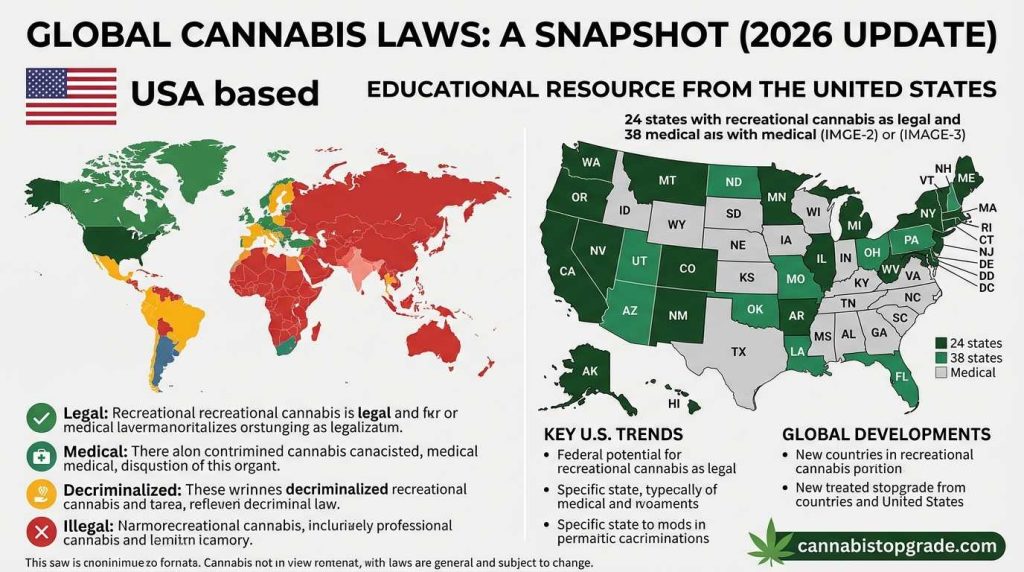
A world weed legalization map changes frequently. Countries that were fully illegal a decade ago now run medical programs, and reform bills appear regularly. Treat any map as a snapshot, not a permanent reference, and confirm details with official government sources close to your travel date. For perspective on how legal status has evolved over time, the historical record of cannabis prohibition is a useful starting point.
Comparing U.S. Cannabis Law to the Rest of the World
The United States occupies an unusual position. Cannabis remains illegal at the federal level, yet many states have legalized medical or recreational use. This state-by-state approach is rare globally; most countries regulate cannabis nationally.
That split creates practical quirks. State-legal businesses operate under local rules while navigating federal uncertainty. Consumers in legal states can buy regulated products, but crossing state lines with cannabis can raise legal issues. Understanding how U.S. state programs work helps consumers stay informed about what’s permitted where they live.
What These Laws Mean for Travelers
Cannabis laws don’t travel with you. A product that’s legal at home may be illegal at your destination, and bringing cannabis across international borders is prohibited in nearly every case—even between places where it’s legal. Customs and border agencies enforce national law, not your home state’s rules.
Research your destination before you go. Check whether medical or recreational use is permitted, whether you need authorization, and what possession limits apply. When in doubt, leave cannabis at home.
Special Cases: Shipping and Interstate Sales
Consumers often wonder about ordering cannabis online, especially across state or national lines. International shipping of cannabis is illegal in virtually all circumstances. Within the U.S., interstate cannabis commerce remains legally complex even between legal states.
Some consumers search for an online dispensary that ships to NC or other states with restrictive laws. North Carolina currently permits limited medical cannabis access through a pilot program for specific conditions, but recreational use is not legal there. Ordering recreational cannabis across state lines is not permitted, and relying on unlicensed sellers carries real safety and legal risks. Reputable resources can clarify what’s actually allowed in your state.
Frequently Asked Questions
Which country was the first to legalize cannabis nationwide?
Uruguay was the first country to legalize cannabis for recreational use nationwide. Canada followed with federal legalization of recreational cannabis.
Is cannabis legal anywhere in the world for tourists?
Rules vary, and even where recreational use is legal, tourists may face restrictions or be excluded from legal purchase systems. Always check the specific country’s rules before assuming access.
Can I bring cannabis to another country if it’s legal there?
No. Bringing cannabis across international borders is prohibited almost everywhere, regardless of legal status at your destination. Border enforcement follows national law.
Where is pot legal in the world for medical use only?
Many countries permit medical cannabis, often with a prescription or government authorization. Access ranges from broad programs to limited pilot schemes, so check each country’s current requirements.
Does decriminalization mean cannabis is legal?
No. Decriminalization typically means small amounts for personal use carry reduced or no criminal penalties, but sale and supply usually remain illegal. Legal status and decriminalized status are different.
Is cannabis legal in North Carolina?
North Carolina permits very limited medical cannabis access through a pilot program for specific conditions. Recreational cannabis is not legal in the state, and cross-state shipping of recreational cannabis is not permitted.
Key Takeaways
Global cannabis law is a moving target. A few countries have fully legalized, many allow medical use, and others have decriminalized small amounts or maintained strict prohibition. For U.S. consumers, the state-by-state system adds another layer of complexity. Check official sources before you travel, never assume your home rules apply abroad, and stay cautious about anything promising to ship cannabis across borders. For ongoing guidance on legal products and state rules, trusted cannabis consumer information can keep you grounded.
