
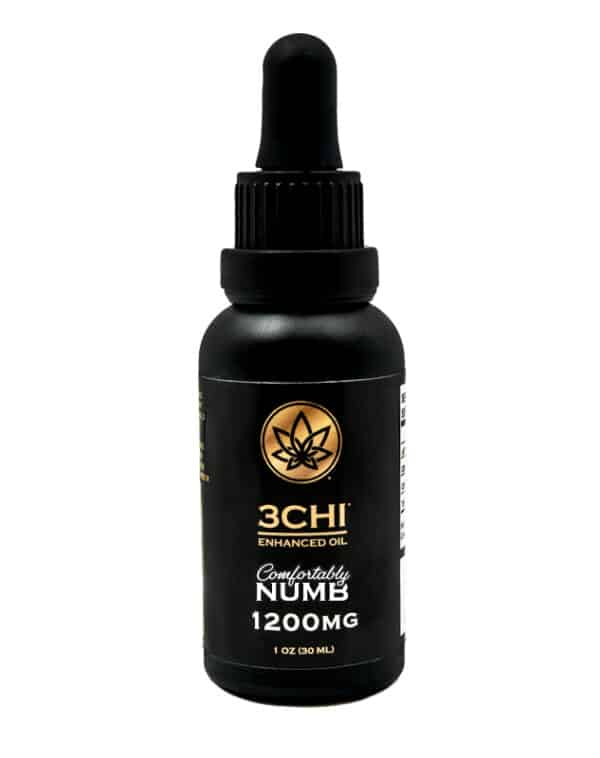
Comfortably Numb 1200MG | Delta 8 THC:CBN Tincture
$30.00
Experience a next-level chill with Comfortably Numb, our new Delta 8 THC and CBN ratio tincture. This product will have you feeling exactly like its name with it’s potent ratios and added CBC for maximum effects.
NOTE: This new version now contains Delta 8 THC. The old Comfortably Numb tincture is now listed as CBN oil – Broad Spectrum.
Comfortably Numb 1200MG is a hemp-derived cannabinoid tincture from 3CHI formulated around delta-8 THC and CBN, with CBC also listed in the cannabinoid blend. It is therefore very different from simply purchasing an indica or sativa cannabis strain.
3CHI’s current product information describes the 1200MG option as containing 600 mg delta-8 THC plus 600 mg CBN, alongside 60 mg CBC, in a 30 mL bottle. The manufacturer states that delta-9 THC was not detected in the listed formulation.
Because the product contains psychoactive delta-8 THC, Comfortably Numb 1200MG should not be assumed to treat anxiety or depression merely because its name suggests relaxation. The manufacturer also warns that the product can impair users and may result in a failed drug test.
| Product detail | Current information |
|---|---|
| Product | Comfortably Numb 1200MG |
| Brand | 3CHI |
| Bottle size | 30 mL |
| Delta-8 THC | 600 mg listed |
| CBN | 600 mg listed |
| CBC | 60 mg listed |
| Approx. delta-8 concentration | 20 mg/mL |
| Approx. CBN concentration | 20 mg/mL |
| Product format | Hemp-derived tincture |
| Psychoactive | Yes, potentially |
| Proven anxiety treatment | No |
| Proven depression treatment | No |
3CHI’s laboratory portal continues to maintain batch-testing records for its Comfortably Numb 1200 mg tincture, including a listed April 2025 batch.
For more general cannabis education, readers can explore Cannabistopgrade Cannabis Education, Cannabistopgrade Hash and Concentrates, and Cannabis Concentrates and Dabbing Guide.
Comfortably Numb 1200MG Quick Facts
| Question | Evidence-based answer |
|---|---|
| Best strain for anxiety: sativa or indica? | Neither label reliably predicts anxiety effects |
| Is sativa good for anxiety? | Sometimes reported subjectively, but THC can also increase anxiety |
| Does indica help anxiety? | Some consumers report relaxation, but the label does not prove an anti-anxiety effect |
| Cannabis for depression? | Evidence remains inconsistent |
| High-THC cannabis | Can increase anxiety and other mental-health risks |
| CBD | Shows some promising anxiety evidence, but research remains incomplete |
| Delta-8 THC | Psychoactive and less studied than delta-9 THC |
| CBN | Less researched than THC or CBD |
| Comfortably Numb | Delta-8 + CBN formulation, not a cannabis strain |
| FDA-approved anxiety treatment? | No cannabinoid is currently FDA-approved specifically for anxiety |
What Is Comfortably Numb 1200MG?
Comfortably Numb is part of 3CHI’s delta-8 THC and CBN product line.
The name might sound like a strain, but it is actually a manufactured cannabinoid formula.
A conventional cannabis strain develops its cannabinoid and terpene chemistry from genetics, cultivation and environmental conditions. Comfortably Numb instead uses selected cannabinoids in a prepared oil.
The current formulation includes approximately:
600 mg delta-8 THC
plus
600 mg CBN
plus
60 mg CBC.
The “1200MG” designation therefore refers principally to the combined headline amount of delta-8 THC and CBN, while CBC is additionally listed in the manufacturer’s formulation.
Comfortably Numb vs. Cannabis Flower
| Feature | Comfortably Numb | Cannabis flower |
|---|---|---|
| Format | Tincture | Dried flower |
| Main cannabinoids | Delta-8 THC + CBN | Usually THCA/THC dominant, depending on strain |
| Genetics | Not a strain | Cultivar-specific |
| Indica/sativa label | Not applicable | Commonly used commercially |
| Potency measurement | mg/mL | Usually percentage |
| Psychoactive | Potentially | Often, with THC-dominant flower |
| Effects guaranteed? | No | No |
Best Strain for Anxiety: Sativa or Indica?
The strongest evidence-based answer is:
Neither indica nor sativa is scientifically established as the universally better cannabis type for anxiety.
Cannabis retailers have traditionally characterized:
indica as relaxing,
and
sativa as energizing.
However, modern chemical and genetic research shows that these labels do not reliably identify chemically distinct types of cannabis.
A large analysis of commercial cannabis from six U.S. states found that indica, hybrid and sativa labels did not consistently correspond to the actual cannabinoid and terpene diversity of the products.
Another genomic study analyzing more than 100 cannabis samples found that plants labeled indica and sativa were largely indistinguishable at the genome-wide level, although certain terpene-related genes showed some associations with commercial labels.
Therefore:
indica ≠ guaranteed relaxation
and
sativa ≠ guaranteed stimulation.
For anxiety, actual THC and CBD concentrations can be more informative than the strain category.
Indica for Anxiety
Many consumers associate indica for anxiety with relaxation.
That association is understandable because dispensary culture has long promoted indica strains as calming or evening-oriented.
But an indica label does not establish that a product treats anxiety.
An indica-labeled flower could contain:
10% THC
or
30% THC
depending on cultivar and batch.
Those products can produce very different cannabinoid exposures despite sharing the same broad dispensary classification.
THC itself can produce anxiety.
A 2026 systematic review and dose-response meta-analysis combining 41 randomized, double-blind, placebo-controlled THC studies involving 1,020 infrequent cannabis users found that THC significantly increased subjective feelings of anxiety and tiredness compared with placebo. It did not significantly increase calmness.
That finding is particularly relevant to the assumption that an indica automatically becomes anti-anxiety cannabis.
Does Indica Help With Anxiety?
Some people report that particular indica-labeled cannabis products make them feel relaxed.
That personal response can be genuine.
But it cannot be generalized into:
“indica treats anxiety.”
A product’s cannabinoid composition matters.
For example, THC-dominant cannabis could increase anxiety even if a dispensary labels the strain indica.
Controlled human research has repeatedly demonstrated anxiety-producing effects from THC. In one randomized study, oral THC increased anxiety, dysphoria, intoxication and psychotic-like symptoms compared with both CBD and placebo.
Another controlled study found that delta-9 THC increased anxiety and altered amygdala responses to fearful stimuli.
Therefore, anyone vulnerable to anxiety should not assume an indica label protects against THC-related anxiety.
Sativa for Anxiety
The phrase sativa for anxiety presents the same basic issue.
Some people report enjoying sativa-labeled strains because they feel more alert, social or positive.
Other people find stimulating THC-rich products uncomfortable or anxiety-provoking.
The sativa label alone cannot tell you which response will occur.
A better product comparison looks at:
- THC concentration;
- CBD concentration;
- THC ratio;
- additional cannabinoids;
- terpene profile;
- personal THC tolerance;
- previous response to cannabis.
This approach is more informative than choosing products solely because the package says sativa.
Does Sativa Help With Anxiety?
There is no strong evidence that sativa cannabis as a category reliably reduces anxiety.
The answer depends much more heavily on product chemistry and the individual.
A THC-rich sativa strain could potentially increase anxiety.
A CBD-dominant product commercially labeled sativa might produce a very different response.
This distinction is supported by controlled research comparing cannabinoid ratios.
One randomized trial found that THC-dominant cannabis increased state anxiety, while cannabis containing equal amounts of THC and CBD produced less anxiety than THC alone. However, the balanced THC/CBD formulation still produced more anxiety than placebo.
Therefore, CBD may modify some THC effects under certain circumstances, but a sativa or indica label cannot substitute for cannabinoid information.
Is Sativa Good for Anxiety and Depression?
There is no reliable evidence supporting a blanket statement that sativa is good for anxiety and depression.
Research into cannabis and mental health is considerably more complicated.
A 2025 systematic review examining medicinal cannabis across mental-health conditions found that product composition mattered substantially. Higher-dose CBD showed some of the most consistent short-term anxiety relief, while THC was more frequently associated with dose-dependent adverse effects. The review did not find convincing evidence of durable long-term medicinal effects across the conditions studied.
A large 2025 systematic review of high-concentration THC products also found mixed results for anxiety and depression. In nontherapeutic studies, high-concentration THC was associated with unfavorable anxiety outcomes in 53% of studies and unfavorable depression outcomes in 41%; some therapeutic studies reported improvement, but overall evidence quality was limited and inconsistent.
A newer systematic review and meta-analysis found that cannabinoid interventions produced a modest average reduction in anxiety symptoms across randomized trials but showed trivial-to-no significant effect on depression, with much of the evidence coming from secondary outcomes in studies primarily investigating other conditions.
So:
sativa is not a proven depression treatment
and
sativa is not a universally effective anxiety treatment.
What Type of Cannabis Is Good for Anxiety?
There is no universally established type of cannabis good for anxiety.
If comparing product chemistry rather than strain names, the strongest existing evidence suggests that lower THC exposure and greater CBD content may be less likely to provoke anxiety than high-THC cannabis for some people.
That still does not mean a particular cannabis product should be prescribed informally as an anxiety treatment.
A 2024 CBD systematic review and meta-analysis found a statistically significant improvement in anxiety outcomes across eight eligible studies involving 316 participants, but the authors emphasized that the small evidence base requires cautious interpretation and additional trials.
Another review concluded that CBD has promising anxiolytic potential but emphasized side effects, drug interactions and the fact that there is currently no FDA-approved cannabinoid medicine specifically for anxiety disorders.
Cannabis Chemistry and Anxiety
| Product characteristic | Anxiety consideration |
|---|---|
| High THC | Can increase anxiety, panic or paranoia in some people |
| Lower THC | Lower THC exposure may reduce risk, but does not guarantee relief |
| CBD dominant | Some promising clinical evidence; not universally proven |
| Balanced THC/CBD | May produce less anxiety than THC alone in some studies |
| Indica label | Poor predictor |
| Sativa label | Poor predictor |
| Hybrid label | Poor predictor |
| Terpenes | Interesting research area, but not a guaranteed anxiety treatment |
Type of Weed for Anxiety
Instead of searching only for a type of weed for anxiety, it is more scientifically useful to examine cannabis chemotypes.
Type I Cannabis
THC-dominant.
These products can be highly intoxicating and may increase anxiety in susceptible people.
Type II Cannabis
Contains meaningful amounts of both THC and CBD.
Some controlled research suggests that CBD may moderate certain anxiety-producing effects of THC, although not universally.
Type III Cannabis
CBD-dominant with relatively little THC.
This category produces far less THC exposure and is more aligned with the part of cannabinoid research investigating CBD for anxiety.
However, even Type III cannabis should not be described as a guaranteed medical treatment.
THC Can Both Feel Relaxing and Cause Anxiety
One reason cannabis-and-anxiety discussions become confusing is that THC can produce different responses depending on person, amount and context.
Someone may experience:
- relaxation;
- euphoria;
- reduced short-term worry;
while another person—or the same person at a different exposure—may experience:
- nervousness;
- racing thoughts;
- panic;
- paranoia;
- rapid heart rate.
A recent prospective study of people beginning medical cannabis reported reductions in self-reported anxiety and depression over six months, but the authors explicitly stated that controlled trials are still needed to determine efficacy and safety.
This highlights an important difference between:
observational improvements
and
proof of treatment effectiveness.
High-THC Cannabis and Anxiety
Higher THC should not automatically be interpreted as more effective.
The 2026 meta-analysis of randomized THC studies found greater anxiety, intoxication and tiredness following THC exposure compared with placebo.
Earlier controlled research similarly found THC caused significant increases in anxiety, sedation and impaired concentration.
Therefore:
more THC ≠ better anxiety relief.
For some people, greater THC exposure may do precisely the opposite.
CBD and Anxiety
CBD receives significant attention because it differs substantially from intoxicating THC.
A 2024 systematic review of randomized controlled trials found several encouraging CBD findings but also considerable variation in dose, patient population and study design.
A separate meta-analysis reported a significant overall reduction in anxiety across eight studies but emphasized the limited number of participants.
The appropriate conclusion is:
CBD is being actively studied for anxiety and has promising evidence, but researchers have not established one universal CBD dose, formulation or treatment protocol for anxiety disorders.
Cannabis and Depression
Cannabis is sometimes used by people attempting to cope with depression, but the evidence does not establish cannabis as a reliable depression treatment.
The newest large systematic review available in this search found no statistically clear benefit for depression in randomized trials overall.
High-concentration THC research has also identified unfavorable associations with depression in a substantial portion of nontherapeutic studies.
This is why a page targeting “is sativa good for anxiety and depression” should not claim that sativa treats either disorder.
Persistent anxiety or depression is better discussed with a qualified healthcare professional, especially when symptoms are severe, worsening, or interfering substantially with daily life.
What About CBN for Anxiety?
Comfortably Numb contains CBN, but CBN should not automatically be interpreted as an anti-anxiety cannabinoid.
CBN is much less researched than THC or CBD.
Its widespread association with nighttime products comes partly from consumer experience and cannabis-industry marketing rather than a large body of controlled anxiety trials.
3CHI positions Comfortably Numb around nighttime use, but that is not equivalent to FDA approval or clinical proof of treatment for anxiety, depression or insomnia.
What About Delta-8 THC and Anxiety?
Comfortably Numb also contains a substantial amount of delta-8 THC.
Delta-8 is psychoactive and should not be treated as CBD-like simply because it can be made from hemp-derived cannabinoids.
Direct high-quality research specifically establishing delta-8 THC as an anxiety treatment remains inadequate.
Therefore, claims such as:
“delta-8 cures anxiety”
or
“delta-8 is anxiety-free THC”
would be unsupported.
A person’s reaction can differ considerably.
Comfortably Numb 1200MG and Anxiety
There is no clinical evidence establishing Comfortably Numb 1200MG itself as an anxiety treatment.
The product contains psychoactive delta-8 THC, CBN and CBC. Its name and customer reviews should not be substituted for controlled medical evidence.
Consumers reviewing the product should distinguish between:
commercial positioning
and
clinical indication.
The product may be marketed around relaxation and nighttime use, but this does not establish effectiveness for generalized anxiety disorder, panic disorder, depression or another psychiatric diagnosis.
Indica vs. Sativa for Anxiety: Better Comparison
| Question | Better answer |
|---|---|
| Is indica always calming? | No |
| Is sativa always stimulating? | No |
| Is indica better for anxiety? | Not established |
| Is sativa better for anxiety? | Not established |
| Can THC increase anxiety? | Yes, particularly in some users and at higher exposure |
| Can CBD affect anxiety? | Promising evidence, but research remains incomplete |
| Does strain name predict response? | Poorly |
| Does cannabinoid chemistry matter? | Yes |
| Does individual response matter? | Yes |
This is a much stronger framework than simply recommending an indica or sativa strain.
Frequently Asked Questions
1. What is Comfortably Numb 1200MG?
Comfortably Numb 1200MG is a 3CHI hemp-derived tincture currently listed with 600 mg delta-8 THC and 600 mg CBN, plus 60 mg CBC, in a 30 mL bottle. The manufacturer lists delta-9 THC as not detected for this formulation.
2. Is indica or sativa better for anxiety?
Neither is scientifically established as universally better. Large-scale commercial cannabis research shows that indica and sativa labels do not consistently reflect actual cannabinoid and terpene chemistry.
3. Does indica help with anxiety?
Some consumers report relaxation from products labeled indica, but THC-rich indica products can still cause anxiety. Controlled studies show THC can increase anxiety in some users, so the word indica should not be treated as an anti-anxiety guarantee.
4. Does sativa help with anxiety?
There is no reliable evidence that sativa as a category treats anxiety. THC concentration, CBD content and individual response are more meaningful factors than the sativa label.
5. What type of cannabis is best for anxiety?
There is no universally proven best cannabis type or strain. Evidence suggests high-THC exposure can increase anxiety, while CBD has shown promising but still incomplete evidence for anxiety symptoms. No cannabinoid medicine is currently FDA-approved specifically for treating an anxiety disorder.
Authoritative Outbound Resources
PubMed — 2026 THC Subjective Effects Meta-Analysis
PubMed — Medicinal Cannabis and Mental Health Systematic Review
Be the first to review “Comfortably Numb 1200MG | Delta 8 THC:CBN Tincture”
Related products
Cannabis Tincture
Cannabis Tincture
Cannabis Tincture
Edibles and Gummies
Cannabis Syrup
Cannabis Tincture
Cannabis Tincture
Hybrid cannabis strains
Reviews
There are no reviews yet.