
Uncategorized
Where Can I Grow Weed? U.S. Home Cannabis Laws, Weed Plants and Online Seller Reviews
Oct
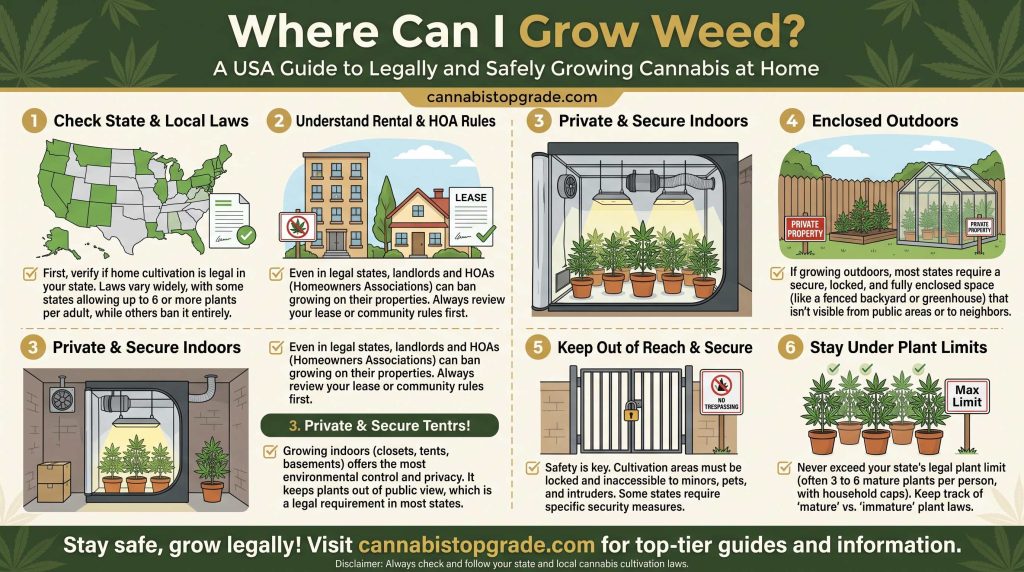
The question where can I grow weed does not have one nationwide answer in the United States. Cannabis home-cultivation laws remain state-specific, and even states that allow adult-use marijuana can impose different plant limits, security requirements, landlord restrictions and local zoning rules.
A January 2026 report from Washington State’s Liquor and Cannabis Board counted 25 states plus Washington, D.C. as allowing cannabis home cultivation in some form. The same review noted that rules differ significantly between medical and adult-use programs.
For example, California permits adults aged 21 or older to grow up to six cannabis plants at home, while New York allows an adult to maintain three mature and three immature plants, subject to household limits. Ohio’s updated 2026 law allows up to six plants per adult-use consumer and no more than 12 at a residence, provided the grow is secured and not visible from a public space.
That means searches such as where can you find weed plants, buying a weed plant, where to find cannabis plant, and marijuana plants to grow should always begin with the law where the cultivation will actually occur.
For broader cannabis education, visit CannabisTopGrade.
Where Can I Grow Weed Legally?
In states that authorize adult-use home cultivation, cannabis normally must be grown at a private residence or another location specifically authorized by state law.
The details matter.
California
California says adults aged 21 or older can grow up to six cannabis plants at home.
Cities and counties can impose additional requirements, including rules that require plants to be grown indoors or require local permits. California also reminds consumers that cannabis remains illegal on federal property and cannot be taken across state lines.
Official California guidance:
California Department of Cannabis Control — Home Growing and Cannabis Laws California cannabis laws
New York
New York permits adult-use home cultivation for people aged 21 or older.
Current New York Office of Cannabis Management guidance allows:
Per adult:
3 mature cannabis plants
3 immature cannabis plants
Per private residence:
6 mature plants
6 immature plants maximum
New York also specifies that adult-use cultivation must occur at a private residence, not a temporary accommodation such as a hotel or motel.
Official guidance:
New York OCM home cultivation FAQs
Ohio
Ohio’s law was updated effective March 20, 2026.
An adult-use consumer may grow up to six plants at their primary residence, with no more than 12 plants at one residence.
The plants must be in a secured closet, room, greenhouse or other enclosed area that prevents access by people under 21 and is not visible from a public space. Rental agreements can also prohibit home cultivation.
Official Ohio law:
Does Every Legal Cannabis State Allow Home Growing?
No.
Legal retail marijuana does not automatically mean residents can grow cannabis at home.
Washington State’s January 2026 regulatory review noted that home cultivation rules continue to differ widely, and some adult-use jurisdictions still restrict ordinary recreational home growing.
That is why someone should not assume:
legal dispensaries = legal home cultivation.
Check the current state regulator and local municipality before planting anything.
Can Local Governments Restrict Cannabis Growing?
Yes.
California explicitly notes that cities and counties can impose specific home-grow requirements.
Local restrictions can concern:
- indoor versus outdoor cultivation;
- visibility;
- electrical and fire safety;
- odor;
- building permits;
- zoning;
- landlord rules.
A state may authorize home cultivation while a city still controls how that cultivation occurs.
Where Can You Find Weed Plants?
The phrase where can you find weed plants can mean either finding cannabis growing naturally or finding legal starter plants.
For legal home cultivation, the important concept is:
use a lawful source recognized by your jurisdiction.
Depending on the state, legal sources may include appropriately licensed cannabis retailers, nurseries or other businesses authorized to handle cannabis plants or seeds.
Do not assume that a website selling cannabis plants nationwide is authorized to send them into every state.
Plant possession and transfer rules can differ from rules covering mature cannabis flower.
For related strain information, explore the CannabisTopGrade Sativa Strains Guide.
Buying a Weed Plant Legally
Buying a weed plant should begin with three questions:
- Does my state permit home cultivation?
- Does my state permit the transfer or retail sale of immature plants?
- Is the source licensed or otherwise legally authorized?
The fact that someone can legally grow cannabis does not necessarily mean any internet seller can ship that person a live plant.
For example, New York’s home-grow rules determine how many mature and immature plants a consumer can possess, but those limits do not create unrestricted interstate cannabis commerce.
The safest approach is to use state-authorized sources where available.
Where to Find Cannabis Plant Material
Legal home growers may encounter several forms of cannabis propagation material:
- seeds;
- seedlings;
- immature plants;
- clones.
These are not necessarily regulated identically.
A clone, for example, is already living cannabis plant material.
A seed may fall under different rules depending on state and federal law.
Consumers should therefore avoid relying solely on statements such as:
“ships plants anywhere”
or
“legal in all 50 states.”
The relevant state regulator is the stronger source.
Marijuana Plants to Grow at Home
The phrase marijuana plants to grow often leads to lists of strain recommendations.
However, before selecting genetics, legality is more important than choosing indica, sativa or hybrid varieties.
If home cultivation is legal, strain selection may depend on lawful personal preferences such as:
- available space;
- local climate;
- permitted indoor or outdoor location;
- plant size;
- flowering characteristics.
This page does not provide a step-by-step cannabis cultivation recipe.
For education on cannabis strain classifications rather than cultivation techniques, see:
CannabisTopGrade Sativa Strains
and the CannabisTopGrade Cannabis Education Hub.
Where Can I Grow Weed if I Rent My Home?
This depends on both state law and the rental agreement.
Ohio’s current home-grow law specifically excludes residential premises where the applicable rental agreement prohibits the activity.
Other jurisdictions can have landlord or property restrictions as well.
Therefore, legal home cultivation under state law does not automatically override:
- lease restrictions;
- condominium rules;
- housing agreements;
- federal housing rules.
Anyone renting should check both state cannabis law and the actual lease.
Can Cannabis Be Grown on Federal Property?
State cannabis legalization does not generally authorize marijuana cultivation on federal property.
California’s regulator reminds residents that cannabis remains illegal under federal law and cannot be used or possessed on federal lands such as national parks.
This is another reason “where can I grow weed?” must include the exact location, not merely the state.
Keep Cannabis Plants Away From Children
States that permit home cultivation often require plants to be secured.
Ohio, for example, requires the grow area to prevent access by anyone under 21.
New York similarly imposes home-cultivation requirements intended to keep cannabis controlled within a private residence.
Home cultivation should therefore not mean plants are freely accessible to children or visitors.
BuyMyWeedUSA.com Legit: What Can Be Verified?
The keyword buymyweedusa com legit should be handled carefully.
There are several things that can be verified publicly, but reviews alone cannot establish that a cannabis business holds every license required for the activities it advertises.
The website’s own FAQ currently claims that it ships throughout the United States and says it does so by classifying its products as hemp. It accepts payment methods including Zelle, Cash App, cards and Bitcoin.
Its shipping page similarly says it ships within the United States using discreet, vacuum-sealed packaging.
These are claims made by the company itself.
They are not independent government confirmation of cannabis licensing.
Can Reviews Prove BuyMyWeedUSA Is Legit?
No.
Public review services show substantial positive feedback, but reviews are only one signal.
At the time checked, Trustpilot displayed approximately 4.8/5 across more than 2,500 reviews for the domain. Trustpilot also states that individual review claims are not necessarily independently verified merely because they appear on the platform.
Trustindex showed a smaller review set with an overall rating around 4.6/5, including both positive reports and recent complaints relating to payments and order confirmation.
Those mixed signals support a cautious conclusion:
Public reviews show that many users report positive experiences, but they do not by themselves verify regulatory legality, state licensing or the legal status of every shipped product.
Buy My Weed Online Reviews: What Should You Check?
When researching buy my weed online reviews, do not rely on one review platform.
Check several categories of information.
1. State licensing
If a seller says it is a marijuana dispensary, determine which state supposedly licensed it.
Then search the official state regulator’s database.
A review score is not a cannabis license.
2. Product certificates
Look for product-specific certificates of analysis rather than one generic laboratory report.
3. Payment protections
BuyMyWeedUSA’s published payment information includes Zelle, Cash App and cryptocurrency alongside cards.
Payment method alone does not establish legitimacy, but payment methods with limited dispute protection deserve extra caution.
4. Refund policy
The site’s current refund policy states that it does not offer cash refunds and instead handles qualifying issues through replacement or store credit.
That is an important term to understand before any transaction.
5. Shipping claims
The website claims nationwide shipping under a hemp-based legal theory.
That claim should be compared with current federal hemp law and the laws of the destination state rather than accepted solely because it appears in an FAQ.
A High Review Rating Does Not Equal a Cannabis License
This distinction is especially important.
Trustpilot can help show customer sentiment.
Scam-detection services can provide technical information about domains.
Neither replaces:
- a cannabis retailer license;
- a hemp license;
- state product registration;
- laboratory documentation;
- destination-state compliance.
ScamAdviser, for example, currently reports some positive technical indicators for buymyweedusa.com while also noting that the domain owner’s identity is hidden through WHOIS privacy and that its hosting environment has negative signals.
Another web-security service assigns the domain a generally positive trust assessment and reports that the domain dates to March 2024.
Those tools assess website or domain risk—not marijuana licensing.
Be Careful With Similar Domain Names
The exact domain matters.
Search results also show similarly named domains.
For example, buymyweedusa.cc is a different domain from buymyweedusa.com, and ScamAdviser currently flags the .cc domain with substantial risk indicators.
Therefore:
buymyweedusa.com and buymyweedusa.cc should not be treated as the same website.
Cannabis shoppers are particularly vulnerable to look-alike domains, cloned storefronts and copycat payment pages.
Should You Trust “Ships to All 50 States” Claims?
Not automatically.
The company’s own FAQ says it ships throughout the USA through what it calls a hemp “loophole.”
But federal hemp rules and individual state laws can change, and states can impose restrictions stricter than federal baselines.
A retailer’s willingness to ship a product does not independently prove that possession or sale is lawful at the destination.
This is especially important in late 2026 because federal hemp rules are changing significantly.
What Makes an Online Cannabis Website More Trustworthy?
Look for independent, verifiable evidence such as:
- clearly stated legal business identity;
- verifiable state license where one is required;
- physical licensed-market address;
- batch-specific certificates of analysis;
- clear age verification;
- realistic shipping claims;
- transparent refund terms;
- multiple independent review sources.
Be cautious when marketing emphasizes secrecy or legal “loopholes” more heavily than licenses and compliance.
Can I Buy Cannabis Plants From an Online Weed Store?
Do not assume an online flower seller is authorized to sell or ship live marijuana plants.
Flower, seeds, clones and immature plants can fall under different rules.
If your state allows cultivation, check the state regulator for information on authorized cannabis plant or seed sources.
This is safer than using a nationwide marijuana storefront as proof that a live plant may legally be shipped to you.
Home Grow vs. Buying Cannabis
Home cultivation and retail cannabis purchasing are legally distinct.
A state can:
- authorize both;
- allow retail sales but restrict home growing;
- allow medical home cultivation but not adult-use growing;
- impose separate rules for plants and finished flower.
That is why the question where can I grow weed should be answered from state law rather than from a dispensary website.
Cannabis Plants vs. Cannabis Concentrates
Plant cultivation is also completely different from concentrate production.
Hash and other concentrates involve processing resin-rich cannabis material and may be regulated more strictly than simply possessing plants.
For additional internal education:
CannabisTopGrade Hash and Concentrates Guide
For pre-roll and vape information:
CannabisTopGrade Vapes and Pre-Rolls Guide
Frequently Asked Questions
1. Where can I grow weed legally in the USA?
Only where state and local law permit home cannabis cultivation. A 2026 Washington State regulatory review counted 25 states plus Washington, D.C. as permitting home cultivation in some form, but plant limits and eligibility vary widely.
2. Where can you legally find weed plants?
Where permitted, legal sources can include cannabis businesses authorized by the relevant state to handle seeds, clones or immature plants. Check the state cannabis regulator before buying or accepting a cannabis plant.
3. Can I buy a weed plant online?
Possibly in some jurisdictions, but home-grow legality does not automatically authorize interstate shipment of living marijuana plants. Confirm both your state’s cultivation rules and the seller’s legal authority before treating an online plant listing as lawful.
4. Is buymyweedusa.com legit?
Public review platforms show many positive consumer reviews, but there are also complaints, and review scores do not independently prove cannabis licensing or nationwide legal compliance. The site itself claims nationwide shipping under a hemp-based legal theory. Verify product legality, licensing where applicable and your destination state’s law independently before relying on that claim.
5. Are Buy My Weed Online reviews trustworthy?
Reviews can provide consumer-experience information, but no single review platform should be treated as proof that a cannabis transaction is legally compliant. Compare independent reviews with official licenses, laboratory reports, payment protections and refund terms.
Final Summary: Where Can I Grow Weed?
The answer to where can I grow weed depends on state and local law.
California allows up to six plants for adults 21 and older, subject to local requirements. New York permits three mature and three immature plants per adult, with household caps. Ohio allows six plants per adult and twelve per residence under secured-home-grow requirements.
For the supporting searches:
Where can you find weed plants: use sources authorized under your state’s cannabis rules where cultivation is permitted.
Buying a weed plant: confirm the legality of both possession and transfer before purchasing.
Where to find cannabis plant: state-licensed or otherwise legally authorized plant sources are safer than anonymous online sellers.
Marijuana plants to grow: check plant-count, residence, landlord and local rules before choosing cannabis genetics.
Buymyweedusa com legit: the site has substantial positive review-platform activity but also some complaints; its nationwide shipping claims come from the company itself and do not substitute for government licensing verification.
Buy my weed online reviews: use reviews as one data point, not as proof of cannabis legality or licensing.
For further internal reading, visit CannabisTopGrade, the Sativa Strains Guide, the Hash and Concentrates Guide and the Vapes and Pre-Rolls Guide.
