
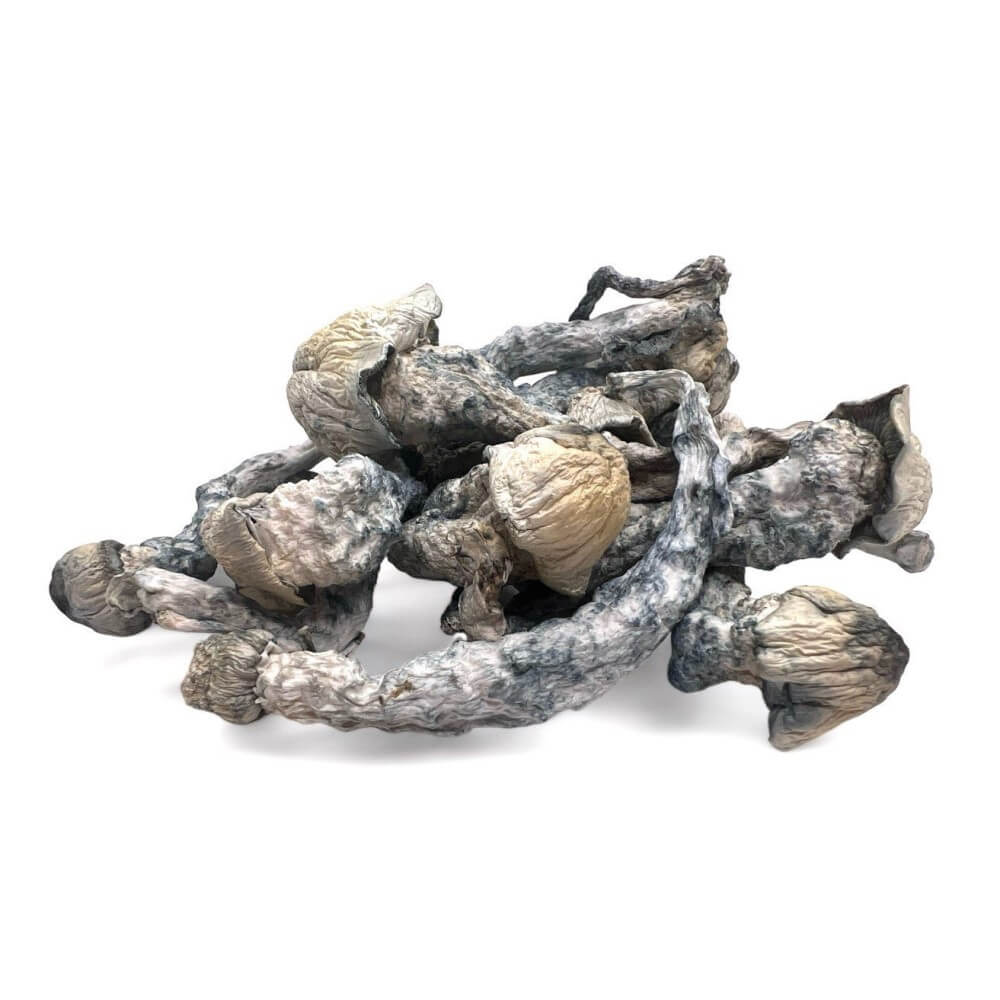
BIOFREEZE Mushrooms
BIOFREEZE Mushrooms is an obscure name that should be approached cautiously. I could not verify BIOFREEZE as a formally recognized mushroom species or as a well-documented Psilocybe cubensis cultivar in the major scientific and community lineage sources currently available.
That matters because modern psychedelic-mushroom culture contains hundreds of informal names, selections, hybrids and renamed lines. Unlike a scientific species name, a label such as BIOFREEZE does not by itself establish genetics, psilocybin concentration, lineage or predictable effects.
By comparison, names such as Amazonian and Cambodian have significantly more historical documentation as cultivated Psilocybe cubensis lines. A 2025 scientific review discussing P. cubensis diversity includes both Cambodian and Amazonian among commonly recognized informal strains while emphasizing that many strain descriptions still originate largely from cultivation communities rather than standardized taxonomic systems.
Recent research makes another important point: even when the cultivar name is known, chemistry can vary dramatically. A 2026 laboratory study involving 14 P. cubensis strains found more than a 7.8-fold difference in total measured tryptamine concentrations, along with considerable variation between individual mushrooms from the same strain.
This is especially important for searches involving 25 mg psilocybin, cubensis dosing, how much shrooms first time, or how many grams is one mushroom.
A milligram amount of purified psilocybin used in a clinical trial is not interchangeable with a gram amount of whole mushroom material.
For more U.S.-focused educational material on psychoactive substances, visit CannabisTopGrade educational resources.
What Are BIOFREEZE Mushrooms?
At present, BIOFREEZE should be treated as an unverified informal mushroom name rather than a scientifically standardized cultivar.
I could not find reliable evidence establishing:
Its original breeder or collector.
A documented parent lineage.
A recognized species separate from Psilocybe cubensis.
A verified chemical profile.
A stable psilocybin concentration.
A formally accepted taxonomic status.
That does not necessarily mean no mushroom has ever been distributed using the name BIOFREEZE.
It means the name itself provides too little reliable information to make strong statements about its genetics or potency.
This is common with modern P. cubensis naming.
A recent scientific review notes that P. cubensis contains numerous enthusiast-recognized strains and selective breeding lines, while formal academic documentation has lagged behind the proliferation of cultivar names.
Therefore, claims such as “BIOFREEZE is stronger than Amazonian” or “BIOFREEZE contains a specific percentage of psilocybin” would require actual laboratory evidence from the material being discussed.
Psilocybe Cubensis and Cultivar Names
Psilocybe cubensis is the scientific species.
Names such as:
Amazonian.
Cambodian.
B+.
Golden Teacher.
Penis Envy.
Blue Meanie cubensis.
and numerous newer hybrids
are cultivation-line names below the formal species level.
A September 2026 review of P. cubensis strain naming notes that these cultivar names are not standardized taxonomic designations and cannot by themselves prove a fixed genotype or predictable potency.
That is why two mushrooms sold under the same cultivar label can differ chemically.
The cultivar name is useful for discussing history and selection.
It is much less reliable for calculating pharmacological exposure.
Cubensis Amazonian
The keyword cubensis Amazonian usually refers to the Amazonian or PES Amazonian heritage line of Psilocybe cubensis.
A current community lineage archive describes Amazonian as a heritage P. cubensis lineage whose origins are attributed to the Amazon basin, with documentation extending back to roughly the 1970s.
A peer-reviewed review of P. cubensis strains also lists Amazonian among commonly recognized strains and describes it as a line associated with larger fruiting bodies in cultivation-community reports.
The historical story is useful, but it should not be confused with proof that every Amazonian mushroom circulating today comes from exactly the same genetic source.
Amazonian Mushrooms
Amazonian mushrooms is a broad search term.
Depending on context, it could refer to:
Amazonian Psilocybe cubensis.
Other mushroom species occurring naturally in the Amazon basin.
Commercial supplements using “Amazonian” branding.
Psychedelic products using an informal cultivar name.
When the context is psychedelic mushrooms, “Amazonian” usually means the P. cubensis cultivation line.
The cultivar name should still not be used to guarantee an exact psilocybin percentage.
A 2026 laboratory analysis of P. cubensis strains demonstrated substantial chemical variability even when fungi were cultivated under standardized conditions.
Amazon Cubensis
Amazon cubensis is another informal way of referring to Amazonian Psilocybe cubensis.
Scientifically, the species remains Psilocybe cubensis.
“Amazon,” “Amazonian,” or “PES Amazonian” functions as the cultivation-line descriptor.
This is important for SEO because search engines may return all these versions:
Amazon cubensis.
Cubensis Amazonian.
Amazonian mushrooms.
Amazonian strain.
Psilocybe Amazonian.
They are commonly discussing the same broad cultivar concept rather than five separate scientific mushroom species.
Amazonian Mushroom Strain
The phrase Amazonian mushroom strain is widely used, although “cultivar” or “cultivation lineage” is often more precise.
The word strain has no universally standardized system in the modern P. cubensis market.
A peer-reviewed review specifically notes that the large number of P. cubensis strains recognized by practitioners remains incompletely characterized scientifically.
Therefore, an Amazonian mushroom strain should not be treated like a standardized prescription medication where the name guarantees one chemical concentration.
That distinction becomes crucial when discussing dose.
Psilocybe Amazonian
Psilocybe Amazonian is not generally treated as a separate formally recognized species name.
The name usually points back to:
Psilocybe cubensis — Amazonian cultivar or lineage.
Using the scientific species first is clearer:
Psilocybe cubensis “Amazonian.”
This prevents consumers from mistakenly thinking “Psilocybe Amazonian” is taxonomically separate from other P. cubensis cultivation lines.
Amazonian Strain Potency
Cultivation communities often attach potency reputations to the Amazonian strain.
Those claims need caution.
A scientific review contains historical analytical values for material identified as Amazonian, but such measurements describe particular tested specimens—not every Amazonian mushroom available today.
More importantly, newer research demonstrates major variation between and within P. cubensis strains.
In a 2026 study, psilocybin concentrations across tested strains ranged from roughly 2.03 mg/g to 19.60 mg/g under the researchers’ standardized conditions. Individual mushrooms within a strain also varied substantially.
Those figures illustrate variability.
They should not be used as a formula for estimating a personal mushroom dose.
Cubensis Cambodian
Cubensis Cambodian refers to another heritage Psilocybe cubensis cultivation line.
A current community lineage archive attributes the Cambodian line to ethnomycologist John W. Allen, reporting that material was collected near Cambodia’s Angkor Wat complex around 1994.
The peer-reviewed P. cubensis strain review also recognizes Cambodian as one of the widely circulated cultivation lines.
Like Amazonian, Cambodian remains P. cubensis rather than a separate species.
Cambodian Mushrooms
The broad phrase Cambodian mushrooms can refer to more than one fungal species from Cambodia.
When used in psychedelic cultivation communities, however, the phrase frequently means the Cambodian P. cubensis lineage.
Historical scientific literature confirms that P. cubensis has been recorded in Cambodia, alongside other psychoactive Psilocybe species documented in the region.
That geographical history helps explain the cultivar’s name.
It does not establish that every product labeled Cambodian has identical genetics to the original collected material.
Magic Mushrooms Cambodian
For magic mushrooms Cambodian, the same terminology distinction applies.
A Cambodian P. cubensis line may be described informally as a Cambodian magic mushroom.
But “Cambodian” does not function as a pharmaceutical strength rating.
It does not tell the reader:
Exactly how much psilocybin is present.
How large a mushroom will grow.
And How intense an experience will be.
How long an experience will last.
Whether one batch is stronger than another.
Scientific analysis increasingly demonstrates why these predictions are unreliable.
Even individual fruiting bodies sharing the same strain can differ meaningfully in tryptamine content.
Amazonian vs Cambodian Cubensis
Amazonian and Cambodian are both widely recognized informal P. cubensis lineages.
A simple educational comparison looks like this:
| Feature | Amazonian | Cambodian |
|---|---|---|
| Scientific species | Psilocybe cubensis | Psilocybe cubensis |
| Informal status | Heritage cultivation line | Heritage cultivation line |
| Reported geographical association | Amazon basin | Cambodia |
| Historical documentation | Commonly traced to older cultivation networks | Associated with John W. Allen collection near Angkor Wat |
| Guaranteed potency? | No | No |
| Separate formal species? | No | No |
Community sources often describe different growth or appearance characteristics, but these should not be turned into guaranteed pharmacological differences.
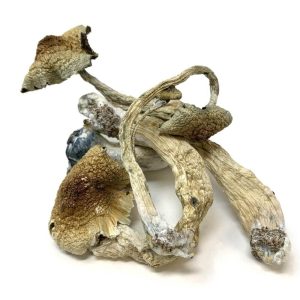
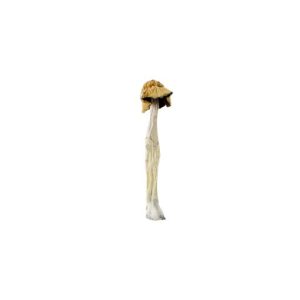
Mushroom With Gold Cap
The phrase mushroom with gold cap is far too broad for species identification.
Numerous mushrooms develop:
Golden caps.
Yellow-brown caps.
Caramel caps.
Tan caps.
Orange-brown caps.
Darkening caps.
Some are edible.
And Some are psychoactive.
Some are toxic.
Some are potentially dangerous.
Several P. cubensis cultivation lines—including Golden Teacher and some Amazonian or Cambodian specimens—may be described as having gold, caramel or yellow-brown caps.
But cap color alone cannot identify a wild mushroom as Psilocybe cubensis.
Unknown wild mushrooms should never be consumed based solely on a photograph, cap color, blue staining or resemblance to an online strain image.
Why Gold-Colored Caps Are Not Enough
Mushroom appearance can change according to:
Age.
Moisture.
Sun exposure.
Genetics.
Drying.
Environmental conditions.
One P. cubensis cap can look different at different stages of maturity.
At the same time, unrelated mushrooms can converge on similar colors and shapes.
This is why scientific mushroom identification considers multiple morphological characteristics and, increasingly, DNA evidence.
A molecular study of Psilocybe collections documented widespread historical misidentifications and inconsistencies even among curated fungal specimens.
If trained collections can contain identification errors, cap color alone is clearly insufficient for deciding whether an unknown wild mushroom is safe.
25 mg Psilocybin
The phrase 25 mg psilocybin usually refers to the amount of purified or standardized psilocybin drug administered in certain clinical trials.
It does not mean 25 mg of dried mushrooms.
A major randomized clinical trial involving 104 adults with major depressive disorder administered a single 25-mg dose of psilocybin with psychological support. Researchers reported significant reductions in depressive symptoms compared with niacin placebo, while adverse events occurred more frequently around the dosing period.
Other clinical trials have also investigated standardized 25-mg psilocybin doses.
For example, a 2026 randomized NHS feasibility trial used 25 mg of psilocybin with preparation, dosing support and integration.
Another large treatment-resistant depression trial also evaluated a 25-mg psilocybin condition with psychotherapy.
These are clinical research protocols—not recommendations for unsupervised use.
25 mg Psilocybin Is Not 25 mg of Mushroom
This distinction is essential.
25 mg psilocybin means:
25 milligrams of the active psilocybin compound.
It does not mean:
25 milligrams of dried mushroom.
And 25 milligrams of Amazonian mushrooms.
25 milligrams of Cambodian mushrooms.
One mushroom.
A standard number of caps.
A universally equivalent weight of whole fungi.
Whole mushroom material contains many substances in addition to psilocybin.
More importantly, psilocybin concentration varies considerably.
That makes a direct conversion between a research dose and an arbitrary quantity of mushroom material unreliable.
Cubensis Dosing
For cubensis dosing, there is no universal whole-mushroom dose that can be determined from the cultivar name alone.
Scientific evidence explains why.
The 2026 controlled study of 14 P. cubensis strains found total tryptamine concentrations ranging from 2.62 to 20.65 mg per gram across tested material—a difference of more than sevenfold.
The same study found substantial differences among individual mushrooms belonging to the same strain.
An earlier molecular and chemical study likewise found meaningful differences in psilocybin and psilocin concentration between mushroom parts and between fruiting bodies grown from the same mycelial stock.
Therefore:
Cultivar name ≠ dose.
Mushroom size ≠ dose.
Number of mushrooms ≠ dose.
Appearance ≠ dose.
Even weight alone does not reveal the amount of active drug without chemical analysis.
For more psychedelic research education, visit CannabisTopGrade research resources.
How Much Shrooms First Time?
For how much shrooms first time, there is no universal quantity that can be recommended safely from a search query.
Several factors can alter the experience, including:
Actual psilocybin concentration.
Species.
Individual mushroom chemistry.
Medications.
Mental-health history.
Cardiovascular health.
Other substances.
Expectation.
Environment.
NCCIH states that psilocybin effects are difficult to predict and can depend on amount, health, personality, mood, expectations, surroundings, mushroom type, previous psychedelic experience and other drugs.
Possible adverse effects include:
Anxiety.
Panic.
Paranoia.
Nausea.
Dizziness.
Increased heart rate.
Increased blood pressure.
Headache.
Poor sleep.
Confusion.
NCCIH also identifies particular concerns for people with psychotic disorders and severe forms of certain psychiatric conditions.
Because whole mushrooms vary so substantially, converting online dose charts into a supposedly safe “first-time amount” can create false precision.
Why First-Time Mushroom Dose Charts Can Be Misleading
A chart might assume that every dried P. cubensis mushroom contains approximately the same psilocybin concentration.
Laboratory data show otherwise.
In 2026 researchers grew different P. cubensis strains under standardized conditions and still observed more than a sevenfold difference in total tryptamine concentration.
That means two equal-weight samples can potentially contain very different quantities of psychoactive compounds.
Additional uncertainty comes from:
Storage.
Drying method.
Age.
Individual specimen.
Cap-to-stem differences.
Chemical degradation.
Mislabeling.
This is why standardized clinical research uses measured psilocybin rather than simply telling participants to consume a certain weight of an informal mushroom strain.
How Many Grams Is One Mushroom?
For how many grams is one mushroom, there is no standard answer.
A single mushroom can vary enormously in:
Cap diameter.
Stem thickness.
Water content.
Maturity.
Species.
Cultivar.
Fresh versus dried state.
A tiny fruiting body and a large mature specimen can both be “one mushroom.”
Fresh mushrooms also contain far more water than dried material.
Therefore, the number of mushrooms cannot be reliably converted into grams without actually weighing them, and neither mushroom count nor weight alone reveals the amount of psilocybin present.
For psychedelic mushrooms specifically, the 2026 analytical evidence showing substantial individual-mushroom chemical variability makes this especially important.
One Mushroom Does Not Equal One Dose
The concept of “one mushroom” as one dose is scientifically misleading.
One fruiting body could be:
Small.
Large.
Partially dried.
Fully dried.
Chemically weak.
Chemically stronger.
Mislabeled.
A different species.
Even two mushrooms produced by the same strain can have different alkaloid concentrations.
Therefore, the phrase “one mushroom” has almost no pharmacological precision.
Clinical 25 mg vs Whole Mushroom Material
Clinical researchers use measured psilocybin because it makes treatment reproducible.
A participant receiving 25 mg psilocybin receives a known drug amount.
A person holding a mushroom generally does not know its exact:
Psilocybin content.
Psilocin content.
Baeocystin content.
Norbaeocystin content.
Other tryptamines.
Contaminants.
This is why research involving 25 mg of pharmaceutical psilocybin cannot responsibly be converted into a fixed number of grams of Amazonian, Cambodian, BIOFREEZE or another whole-mushroom product.
Does Amazonian Have a Standard Dose?
No.
The Amazonian label does not establish a standardized dose.
A review of P. cubensis strains lists analytical information from particular Amazonian samples, but that is not a universal specification for all material carrying the name.
Current biochemical research provides an even stronger reason for caution: strain and individual fruiting-body variation can be substantial.
The same applies to Cambodian.
Does Cambodian Have a Standard Dose?
No.
Cambodian is an informal P. cubensis cultivation lineage, not a pharmaceutical formulation.
Its historical association with material collected near Angkor Wat does not establish one fixed chemical profile.
Commercial names can provide clues about lineage.
They cannot provide the analytical precision needed for medical dosing.
Why Mushroom Potency Changes
Several factors can affect mushroom chemistry.
Research has documented differences involving:
Strain or lineage.
Individual fruiting body.
Cap versus stem.
Growing environment.
Microenvironment.
Drying.
Storage.
Specimen history.
One chemical-authentication study found that caps and stems could contain different concentrations and that mushrooms derived from the same mycelial stock still showed measurable chemical differences under different microenvironmental conditions.
The newer 2026 controlled study confirmed substantial variability even when many cultivation factors were standardized.
Why “Strongest Strain” Claims Need Caution
Online sellers frequently describe a cultivar as:
Extremely potent.
Beginner friendly.
Moderate.
Advanced.
Strongest.
Gentle.
Those descriptions often come from reputation or anecdote rather than batch-specific laboratory analysis.
A cultivar with a strong historical reputation can still produce variable material.
Conversely, an apparently ordinary cultivar can produce an unusually concentrated specimen.
Batch testing is more informative than marketing language.
Amazonian vs Cambodian Effects
Community descriptions sometimes assign Amazonian and Cambodian different subjective personalities.
One may be described as:
Visual.
Energetic.
Introspective.
Euphoric.
Social.
“Spiritual.”
But these descriptions are not reliable clinical predictions.
NCCIH notes that psychedelic experiences depend heavily on the individual, environment, expectations, health and amount consumed.
The strain name alone cannot tell a person what psychological experience they will have.
Are Amazonian and Cambodian Different Species?
No.
Both names normally refer to cultivation lines within:
Psilocybe cubensis.
They are not equivalent to separate species such as:
Psilocybe mexicana.
And Psilocybe caerulescens.
Psilocybe cyanescens.
Panaeolus cyanescens.
This species-versus-cultivar distinction is one of the most important parts of accurate psychedelic-mushroom education.
Is BIOFREEZE the Same as Amazonian?
There is not enough reliable documentation to establish BIOFREEZE as Amazonian, Cambodian, a hybrid of either, or an independent P. cubensis lineage.
Unless lineage records or genetic evidence are available, such claims should be treated cautiously.
The safest description is:
BIOFREEZE is an inadequately documented mushroom name whose precise lineage cannot presently be verified from reliable sources.
That is preferable to inventing an origin story simply to produce stronger SEO copy.
Psilocybin Safety
Psilocybin research is expanding, particularly in mental health, but the compound still carries meaningful risks.
NCCIH lists potential adverse effects such as:
Increased blood pressure.
Increased heart rate.
Headache.
Nausea.
Dizziness.
Fatigue.
Anxiety.
Paranoia.
Poor sleep.
Hallucinations.
Rare persistent psychiatric complications.
Controlled clinical trials reduce some risks through:
Participant screening.
Known drug identity.
Standardized doses.
Professional supervision.
Controlled environments.
Psychological support.
Emergency procedures.
Those conditions differ substantially from taking an unknown whole-mushroom product.
Frequently Asked Questions
1. What are BIOFREEZE Mushrooms?
BIOFREEZE appears to be an obscure informal mushroom name. I could not verify it as a recognized species or well-documented Psilocybe cubensis lineage in reliable scientific or major lineage references. Claims about its genetics or potency therefore require independent evidence.
2. What are Amazonian mushrooms?
Amazonian usually refers to a heritage cultivation lineage of Psilocybe cubensis whose origins are attributed in community records to the Amazon basin. It is a cultivar name rather than a separate scientific species.
3. What are Cambodian mushrooms?
Cambodian commonly refers to a Psilocybe cubensis cultivation line associated with material collected near Angkor Wat by ethnomycologist John W. Allen in the mid-1990s.
4. Does 25 mg psilocybin equal a certain number of grams of mushrooms?
No reliable universal conversion exists. Clinical studies using 25 mg administer a measured amount of psilocybin, while whole mushrooms have variable concentrations of psilocybin and other compounds. Research has demonstrated major differences both between strains and between individual mushrooms.
5. How much shrooms should a first-time user take?
There is no universal whole-mushroom amount that can be safely recommended from cultivar name or mushroom count. Potency varies substantially, while individual medical, psychiatric and environmental factors can also affect the response. NCCIH emphasizes that psilocybin experiences are difficult to predict.
Final Thoughts on BIOFREEZE Mushrooms
BIOFREEZE Mushrooms should currently be treated as an insufficiently documented informal name rather than a recognized species or well-established heritage P. cubensis line.
For cubensis Amazonian, amazonian mushrooms, amazon cubensis, amazonian mushroom strain, psilocybe Amazonian, and amazonian strain, these searches generally refer to the Amazonian heritage cultivation line of Psilocybe cubensis. Community records associate it with the Amazon basin, while scientific literature recognizes Amazonian as one of numerous informal P. cubensis strains requiring further genetic and chemical characterization.
Regarding cubensis Cambodian, Cambodian mushrooms, and magic mushrooms Cambodian, the Cambodian line is commonly associated with material collected near Angkor Wat by John W. Allen around 1994.
For 25 mg psilocybin, the phrase commonly refers to measured pharmaceutical psilocybin used in controlled clinical research. A major randomized trial involving 104 adults administered 25 mg with psychological support; this should not be confused with 25 mg of dried mushrooms.
Regarding cubensis dosing, the most important scientific fact is variability. A 2026 study found more than a 7.8-fold difference in total tryptamine concentrations across 14 P. cubensis strains and additional variation among individual mushrooms.
For how much shrooms first time, those variations prevent a cultivar name or generic online chart from providing a universally safe amount.
For how many grams is one mushroom, there is no standard weight because mushroom size, moisture and maturity vary considerably. One mushroom should never be treated as a standardized unit of drug exposure.
Finally, for mushroom with gold cap, cap color alone is not sufficient for mushroom identification. Numerous unrelated fungi can produce yellow, caramel or brown caps, and unknown wild mushrooms should never be identified for consumption solely from color or photographs.
The central lesson is simple: whole psychedelic mushrooms are chemically variable biological material, while clinical psilocybin doses are measured drug quantities. The two should not be treated as interchangeable.
For more evidence-based educational content, explore CannabisTopGrade mushroom and psychedelic research guides.
Recommended Outbound Resources
National Center for Complementary and Integrative Health — Psilocybin
PubMed Central — Variability in Psilocybe cubensis Tryptamine Profiles
JAMA — 25 mg Psilocybin Clinical Trial
PubMed Central — DNA Authentication and Chemical Analysis of Psilocybe Mushrooms
Journal of Fungi — Psilocybe cubensis Strains and Research Gaps
| Quantity | 1/8 oz(3.5g), 1/4 oz (7g), 1/2 oz (14g), 1 oz (28g) |
|---|
Be the first to review “BIOFREEZE Mushrooms”
Related products
Bulk Mushrooms
Bulk Mushrooms
Bulk Mushrooms
Bulk Mushrooms
Bulk Mushrooms
Bulk Mushrooms
Bulk Mushrooms
Bulk Mushrooms
Reviews
There are no reviews yet.