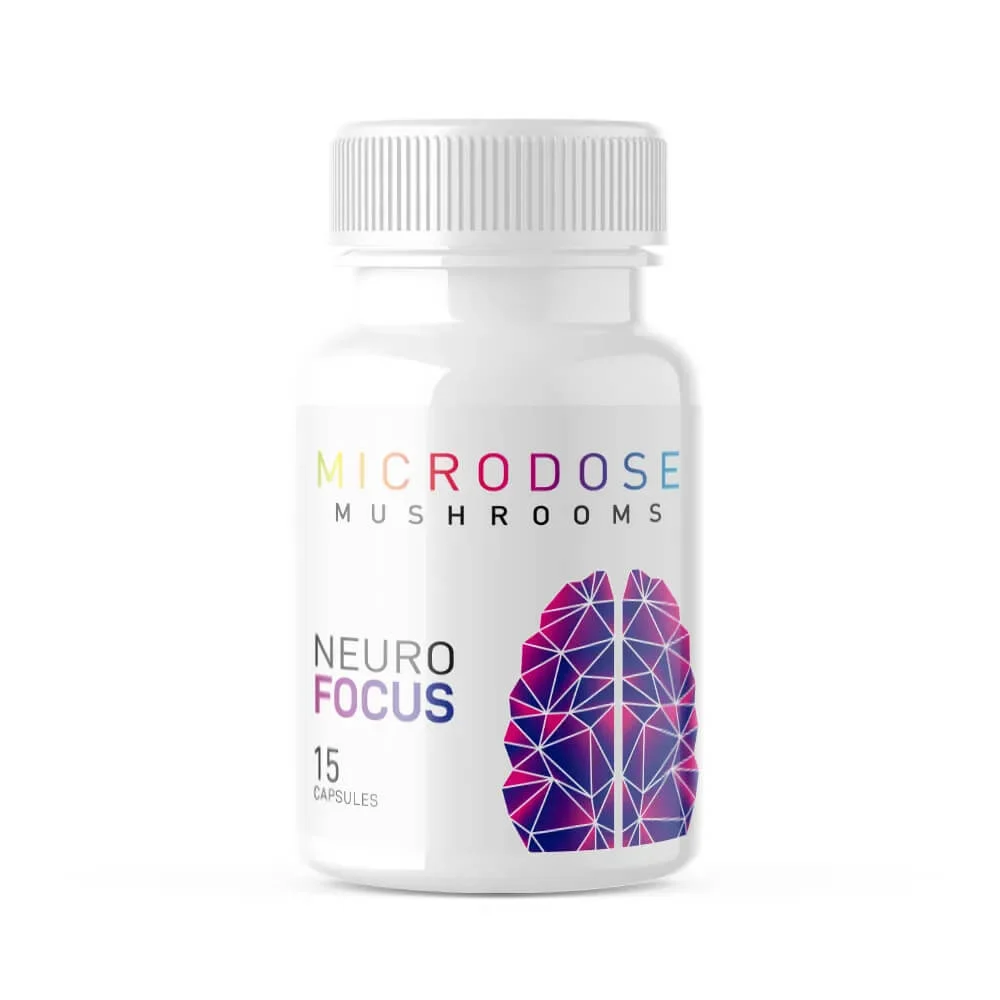
Neuro Focus Microdose
Neuro Focus Microdose is a product-style phrase that should be approached carefully because the name alone does not establish what a product contains.
I could not independently verify a single standardized product called Neuro Focus Microdose with a consistent, authoritative ingredient specification. Current searches for “Neuro Focus” also return unrelated nonpsychedelic cognitive supplements, making it especially important not to infer psilocybin content from the name alone.
A product using words such as:
Neuro.
Focus.
Microdose.
Mushroom.
Wellness.
does not automatically contain psilocybin.
Likewise, a milligram quantity on a package could refer to total mushroom material, an extract, a proprietary mixture, or another ingredient rather than pure psilocybin.
This matters because searches for Neuro Focus Microdose commonly overlap with questions such as is microdosing mushrooms good for you, microdosing psychedelics for mental health, micro dosing for anxiety, is microdosing safe, and how often can you microdose.
The newest research remains cautious.
A 2026 systematic review and meta-analysis examining 24 studies and 3,681 participants found that randomized controlled trials of psilocybin and LSD microdosing produced subjective and physiological effects but showed minimal consistent improvements in cognition, sustained mood, depression, anxiety or stress compared with placebo.
For broader educational material on mushrooms and psychoactive substances, explore CannabisTopGrade educational resources.
What Is Microdosing?
Microdosing generally refers to taking a small quantity of a psychedelic substance intended to produce much subtler effects than a conventional psychedelic experience.
The substances most commonly discussed are:
Psilocybin.
LSD.
Other classic psychedelics.
The National Center for Complementary and Integrative Health explains that some people use very small amounts of psilocybin because they believe it may help depression, stress, productivity or pain. However, NCCIH states that it remains unclear whether microdosing is safe or effective.
That distinction is crucial.
Popular use does not equal proven medical benefit.
Microdosing in a Sentence
For microdosing in a sentence:
Microdosing is the repeated use of very small amounts of a psychedelic drug with the intention of producing subtle effects without a full psychedelic experience.
That is the most useful general definition.
It does not imply that microdosing has been proven to improve mental health, productivity or cognition.
What Are Microdosing Effects?
Possible microdosing effects vary between individuals.
People commonly report:
Mild changes in mood.
Changes in energy.
Greater emotional sensitivity.
Changes in focus.
Changes in creativity.
Subtle perceptual effects.
Altered social feelings.
Changes in motivation.
However, controlled studies have not consistently confirmed many of these claimed benefits.
A 2026 cognitive meta-analysis covering 14 studies and 1,614 participants found no overall cognitive benefit from psychedelic microdosing. Researchers actually identified a small reduction in cognitive control, while other cognitive domains showed no significant improvement.
This challenges popular claims that microdosing reliably improves:
Attention.
Memory.
Problem-solving.
Productivity.
Mental performance.
Is Microdosing Mushrooms Good for You?
For is microdosing mushrooms good for you, current research does not support a simple yes.
Some participants in observational studies report improvements in:
Well-being.
Mood.
Creativity.
Relationships.
Mental health.
Physical health.
Curiosity.
Pain.
But observational research cannot easily separate the actual drug effect from expectations, lifestyle changes, selection bias and other factors.
A 2026 systematic review specifically examining psilocybin mushroom and truffle microdosing analyzed 11 studies involving 3,262 adults. Some studies reported perceived health benefits, but the reviewers concluded that the evidence had low certainty and was too methodologically inconsistent to establish whether mushroom microdosing is effective or safe.
The better answer is therefore:
Some users report benefits, but controlled evidence does not currently establish mushroom microdosing as broadly beneficial to health.
Microdosing Psychedelics for Mental Health
Microdosing psychedelics for mental health has attracted major public interest because full-dose psychedelic-assisted therapy has produced promising results in several psychiatric research programs.
However, full-dose psychedelic therapy and microdosing are not the same intervention.
Clinical psilocybin treatment may involve:
Medical screening.
Mental-health assessment.
Measured pharmaceutical psilocybin.
Professional supervision.
Preparation sessions.
A clearly psychedelic treatment experience.
Psychological support.
Follow-up.
Microdosing usually involves much smaller exposures intended to avoid a full psychedelic state.
Evidence supporting supervised full-dose psilocybin for depression therefore cannot automatically be applied to microdosing.
NCCIH specifically separates these subjects: it describes growing evidence around psilocybin-assisted treatment while stating that the effectiveness and safety of microdosing remain unclear.
Does Microdosing Improve Depression?
Observational reports frequently describe improvements in depressive symptoms.
Randomized evidence is considerably less convincing.
The 2026 systematic review and meta-analysis found that randomized trials did not demonstrate clear immediate reductions in depressive symptoms compared with control conditions.
A separate 2026 umbrella review also concluded that self-reported mood benefits become much less convincing when placebo-controlled evidence receives greater weight.
That does not prove that nobody experiences an improvement.
It means microdosing should not currently be described as an established antidepressant treatment.
Micro Dosing for Anxiety
For micro dosing for anxiety, the evidence is similarly uncertain.
People may experiment with microdosing because they hope it will:
Reduce worry.
Improve mood.
Decrease social anxiety.
Increase emotional flexibility.
Reduce stress.
However, a 2026 meta-analysis found no clear reduction in anxiety symptoms among randomized controlled studies.
Anxiety can also appear as an unwanted effect.
NCCIH lists increased anxiety among the possible problems reported with psilocybin microdosing.
Therefore, microdosing is not an evidence-based substitute for established anxiety treatment.
Micro Dose for Anxiety
The search phrase micro dose for anxiety can imply that there is an established medicinal dose for anxiety.
At present, there is not.
No universally accepted psilocybin microdose has been established as an FDA-approved treatment for:
Generalized anxiety disorder.
Panic disorder.
Social anxiety disorder.
PTSD.
Obsessive-compulsive disorder.
Other anxiety disorders.
This is particularly important because anxiety disorders differ significantly from one another.
A result observed in people experiencing distress associated with cancer, for example, cannot automatically be generalized to someone with generalized anxiety disorder.
Is Microdosing Mushrooms Safe?
For is microdosing mushrooms safe, research has not established complete long-term safety.
Short clinical experiments often report relatively mild or temporary adverse effects.
But community microdosing may continue for much longer than laboratory studies.
A 2026 systematic review of mushroom and truffle microdosing found that side-effect reporting was incomplete across many studies. Where side effects were reported, they included:
Nausea.
Stomach discomfort.
Reduced appetite.
Anxiety.
Disorientation.
Impaired focus.
Mental confusion.
Dissociation.
Sensory distortions.
The researchers specifically highlighted the absence of an established long-term safety profile.
Is Microdosing Safe?
For is microdosing safe, the most accurate answer is:
Short-term controlled studies have not revealed a large signal of severe harm in typical research participants, but evidence is insufficient to conclude that repeated long-term microdosing is safe.
The newest 2026 review of healthy adults found adverse-event rates broadly similar between microdose and control groups in the small randomized datasets available. But the authors emphasized that larger studies are still necessary.
An umbrella review similarly concluded that short-term tolerability appears reasonably acceptable while long-term cardiovascular and other risks remain insufficiently characterized.
These conclusions are much more cautious than saying:
“Microdosing is completely safe.”
Microdosing Side Effects
NCCIH identifies potential psilocybin microdosing effects including:
Insomnia.
Increased anxiety.
Depressed or poor mood.
Low energy.
Gastrointestinal discomfort.
Headache.
Changes in sensory processing.
Problems regulating body-temperature sensations.
Poor concentration.
Reduced cognitive functioning.
Impaired social functioning.
Different people can respond differently.
A subtle stimulant-like feeling for one person could feel like uncomfortable anxiety to another.
Pros and Cons of Microdosing Mushrooms
The pros and cons of microdosing mushrooms should distinguish reported experiences from scientifically demonstrated outcomes.
Potentially reported advantages include:
Better mood.
Greater creativity.
Greater emotional awareness.
Increased motivation.
Improved sense of well-being.
Some users also report improvements in anxiety or depressive symptoms.
Possible disadvantages include:
Anxiety.
Insomnia.
Gastrointestinal symptoms.
Poor concentration.
Mental confusion.
Sensory changes.
Uncertain product potency.
Possible medication interactions.
Unknown long-term risks.
Legal concerns.
Expectancy effects that make benefits difficult to separate from placebo.
Most importantly, recent randomized research has not consistently reproduced the broad benefits described in testimonials.
Microdosing Psychedelic Mushrooms Benefits
For microdosing psychedelic mushrooms benefits, much of the strongest positive evidence comes from self-report rather than rigorous blinded experiments.
The 2026 mushroom-specific systematic review found reports of possible improvements in:
Well-being.
Mental health.
Creativity.
Relationships.
Cognition.
Pain.
Physical health.
However, the reviewers concluded that causal effects could not be established because studies were highly heterogeneous and frequently at significant risk of bias. Placebo-controlled trials did not show significant improvements.
This is a particularly important distinction for SEO content.
A scientifically accurate article should say:
“Users report…”
or
“Researchers are investigating…”
rather than:
“Microdosing improves…”
when causation has not been demonstrated.
The Placebo and Expectancy Question
One of the biggest questions in microdosing research is whether expectations contribute substantially to reported benefits.
People who decide to microdose frequently already believe it will:
Improve focus.
Reduce anxiety.
Increase creativity.
Improve mood.
Make work easier.
Those expectations can influence subjective ratings.
A review of placebo-controlled studies found that psychedelics at low doses can produce measurable physiological and subjective changes, meaning it is probably too simplistic to describe microdosing as “nothing but placebo.”
At the same time, newer analyses show that many reported mood benefits weaken significantly in blinded studies.
The most accurate conclusion is:
Microdoses can have biological effects, but many popular claims about their psychological benefits remain difficult to separate from expectancy.
Does Microdosing Improve Focus?
“Focus” is one of the most common promises associated with products using names such as Neuro Focus Microdose.
The current controlled evidence does not establish reliable enhancement.
The 2026 meta-analysis found:
No overall cognitive improvement.
It also reported a small reduction in cognitive control.
Cognitive control includes processes involved in:
Maintaining goals.
Ignoring distractions.
Controlling automatic responses.
Organizing behavior.
Therefore, using the word “focus” in a product name is not proof that the product scientifically improves attention.
Does Microdosing Improve Creativity?
Creativity is difficult to measure objectively.
Users often report feeling more creative.
Controlled studies have produced inconsistent findings.
The 2026 review of healthy adults found minimal consistent effects on creativity in randomized trials.
Feeling more creative and producing objectively better creative work are not necessarily the same outcome.
This distinction applies to many psychoactive substances.
How Often Can You Microdose?
For how often can you microdose, there is no medically established, evidence-based schedule that can be recommended as universally safe or effective.
Published studies use widely varying protocols.
The 2026 mushroom-specific systematic review described extreme heterogeneity across dosing protocols and preparations, which makes it difficult to compare studies or identify an optimal schedule.
This is important because repeated use introduces questions that one-time studies cannot answer.
Researchers still need better evidence on:
Long-term cardiovascular effects.
Psychiatric effects.
Sleep.
Cognition.
Tolerance.
Interactions with medications.
Effects of repeated serotonergic receptor stimulation.
Therefore, popular internet schedules should not be treated as medically validated instructions.
Why There Is No Standard Microdosing Schedule
A standardized medical schedule normally requires evidence showing:
Which dose works.
How frequently it should be taken.
How long treatment should continue.
Who should avoid it.
Which side effects occur.
What happens after months or years.
What medications interact with it.
Microdosing science has not answered all these questions.
The 2026 umbrella review specifically notes that long-term risks remain insufficiently characterized, including theoretical cardiovascular concerns related to repeated serotonergic activity.
Without that information, there is no scientific basis for calling one recurring schedule universally safe.
Long-Term Microdosing Safety
Long-term safety is especially important because microdosing differs from many psychedelic clinical treatments.
Full-dose psilocybin research may involve only one or a few treatment sessions.
Microdosing can involve repeated exposure over extended periods.
The cumulative consequences of that pattern are much less studied.
Researchers need more information about:
Cardiovascular health.
Mood stability.
Sleep.
Cognitive effects.
Tolerance.
Psychological dependence on routines.
Medication interactions.
Long-term serotonergic effects.
The mushroom-specific 2026 review explicitly describes the lack of an established long-term safety profile as a critical research gap.
Microdosing and Psychiatric Vulnerability
Microdosing should not be assumed safe simply because psychedelic effects are subtle.
NCCIH states that psilocybin is considered unsafe for people with certain psychotic disorders and severe forms of some psychiatric conditions.
Clinical psychedelic trials commonly screen participants carefully.
Community products do not necessarily provide equivalent screening.
Relevant considerations can include:
History of psychosis.
Bipolar-spectrum disorders.
Current psychiatric medications.
Cardiovascular disease.
Other psychoactive substances.
Pregnancy.
Severe anxiety.
Medication interactions.
This is another reason broad wellness claims require caution.
Neuro Focus Microdose and Product Identity
The name Neuro Focus Microdose does not provide enough information to establish what is actually in a package.
Before interpreting any claim about such a product, the relevant questions are:
What exact mushroom species is listed?
Does it actually contain psilocybin?
Is the stated milligram amount total mushroom weight or active ingredient?
Is there batch-specific laboratory analysis?
What other ingredients are included?
Who manufactured it?
What jurisdiction is it sold in?
Does the packaging make disease-treatment claims?
Current searches also reveal several unrelated supplements simply called “Neuro Focus,” including products containing vitamins, minerals or lion’s mane rather than psilocybin.
The name alone therefore cannot establish that a Neuro Focus product is psychedelic.
Functional Mushroom Supplements vs Psychedelic Microdosing
This distinction is frequently overlooked.
A supplement containing:
Lion’s mane.
Reishi.
Cordyceps.
Chaga.
Turkey tail.
is not automatically a psychedelic microdose.
These species are generally used as culinary or functional mushrooms and do not provide the classic psilocybin psychedelic effect.
A small capsule containing lion’s mane may have a low physical weight, but that does not make it “psychedelic microdosing.”
Psychedelic microdosing specifically refers to low exposure to psychedelic substances such as psilocybin or LSD.
Can Microdosing Replace Anxiety Treatment?
Current evidence does not support replacing established anxiety care with mushroom microdosing.
Anxiety disorders can respond to treatments including:
Psychotherapy.
Cognitive behavioral therapy.
Certain prescribed medications.
Other evidence-based interventions depending on diagnosis.
NCCIH advises people not to use psilocybin to postpone professional care for medical or mental-health problems.
This is particularly relevant if anxiety is:
Persistent.
Severe.
Interfering with work.
Causing panic attacks.
Associated with depression.
Associated with suicidal thoughts.
A commercial product promising effortless anxiety relief should not be treated as equivalent to validated treatment.
Psychedelic-Assisted Therapy Vs Microdosing
Microdosing and psychedelic-assisted therapy should remain separate concepts.
Microdosing: repeated small exposures intended to produce little or no obvious psychedelic effect.
Psychedelic-assisted therapy: professionally managed treatment research generally involving a clearly active dose, screening, preparation, supervision and follow-up.
Positive clinical results from psychedelic-assisted therapy cannot simply be transferred to microdosing.
This is one of the most frequent errors in online psychedelic-health marketing.
For more evidence-focused mental-health education, explore CannabisTopGrade psychedelic research guides.
Frequently Asked Questions
1. Is microdosing mushrooms good for you?
Current evidence does not provide a universal yes. Observational studies report possible improvements in mood, well-being and creativity, but placebo-controlled research has not consistently confirmed these effects. A 2026 systematic review concluded that evidence remains insufficient to determine whether mushroom microdosing is effective or safe.
2. Is microdosing mushrooms safe?
Long-term safety has not been established. Reported effects include gastrointestinal discomfort, anxiety, impaired focus, confusion and sensory changes, while many studies do not systematically report adverse events.
3. Does microdosing help anxiety?
Current randomized evidence does not demonstrate a clear anxiety benefit. Increased anxiety can also occur as an adverse effect.
4. What are the pros and cons of microdosing mushrooms?
Reported potential benefits include improved mood, creativity and well-being. Potential disadvantages include anxiety, sleep disturbance, gastrointestinal symptoms, cognitive disruption, uncertain potency and unknown long-term risks. Controlled studies generally find fewer benefits than observational reports.
5. How often can you microdose?
There is no established medically validated schedule proven to be universally safe or effective. Research protocols vary substantially, and long-term effects of repeated microdosing remain inadequately characterized.
Final Thoughts on Neuro Focus Microdose
Neuro Focus Microdose should not be assumed to contain a standardized psychedelic formulation simply because its name includes the word microdose. I could not verify one consistent authoritative formulation associated with this exact product name, and unrelated “Neuro Focus” products currently exist in the supplement market.
For is microdosing mushrooms good for you, current studies show an important gap between positive self-reports and less convincing randomized evidence.
For microdosing psychedelics for mental health, research interest is substantial, but microdosing should not be confused with professionally supervised psychedelic-assisted therapy.
Regarding is microdosing mushrooms safe and is microdosing safe, short-term trials have not identified a large signal of severe harm among carefully selected participants, but long-term safety remains inadequately understood.
For microdosing psychedelic mushrooms benefits, observational studies report improvements in several domains, but a 2026 mushroom-specific systematic review concluded that the evidence is too uncertain and heterogeneous to establish causality.
For micro dosing for anxiety and micro dose for anxiety, current randomized evidence does not establish microdosing as an effective anxiety treatment, while increased anxiety itself can occur as a side effect.
Regarding microdosing effects, people may experience subtle changes in mood, perception, energy or attention, but some also experience sleep disturbance, gastrointestinal problems, anxiety and reduced concentration.
For pros and cons of microdosing mushrooms, potential subjective benefits need to be weighed against uncertain efficacy, product variability, side effects and the lack of long-term safety data.
For microdosing in a sentence: microdosing means repeatedly taking small psychedelic amounts intended to avoid a full psychedelic experience.
Finally, for how often can you microdose, science has not established a universal safe frequency. The wide variation among research protocols and the absence of strong long-term safety data make fixed internet schedules scientifically unjustified.
The strongest 2026 evidence therefore supports a cautious conclusion: microdosing can produce real subjective and physiological effects, but claims of reliable improvements in anxiety, mood, focus, creativity or cognition remain considerably stronger in popular marketing than in placebo-controlled research.
For additional educational reading, explore CannabisTopGrade mushroom and mental-health research.
Recommended Outbound Resources
National Center for Complementary and Integrative Health — Psilocybin
PubMed — 2026 Microdosing Psychological Outcomes Meta-Analysis
PubMed — 2026 Microdosing Umbrella Review
Frontiers in Psychiatry — Psilocybin Mushroom Microdosing Systematic Review
| Quantity | 5 Capsules, 25 Capsules |
|---|
Be the first to review “Neuro Focus Microdose”
Related products
Bulk Mushrooms
Bulk Mushrooms
Bulk Mushrooms
Bulk Mushrooms
Bulk Mushrooms
Bulk Mushrooms
Bulk Mushrooms
Bulk Mushrooms
Reviews
There are no reviews yet.