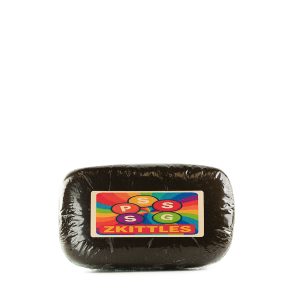
Hash Zkittlez is a cannabis hash or concentrate associated with Zkittlez-style cannabis genetics. Cannabis hash is produced by concentrating the resin-rich trichomes found on cannabis plants, so the finished material can contain substantially different cannabinoid concentrations from ordinary dried flower.
The cultivar commonly associated with Zkittlez is also known as The Original Z. Leafly describes The Original Z as an indica-leaning hybrid associated with alleged Grape Ape and Grapefruit genetics crossed with an undisclosed strain. Its database lists grapefruit, grape and berry among commonly reported flavors and caryophyllene, linalool and humulene among its referenced terpenes. Consumer-reported effects are subjective and should not be interpreted as guaranteed medical benefits.
Leafly – The Original Z cannabis profile
A particular Hash Zkittlez product should not automatically be assumed to match the cannabinoid percentages or terpene profile of flower listed on a strain database.
Actual composition depends on the source material, processing method and individual production batch.
Researchers should therefore consider information such as:
- total THC;
- CBD;
- minor cannabinoids;
- terpene testing;
- batch number;
- contaminant testing;
- manufacturing information;
- storage conditions.
For more information about cannabis concentrates, explore:
Cannabistopgrade.com – Cannabis Concentrates and Dabbing Guide
Cannabistopgrade.com – Hash and Cannabis Concentrates
And Cannabistopgrade.com – Cannabis Education and Product Research
Hash Zkittlez Quick Facts
| Topic | Educational Overview |
|---|---|
| Product | Hash Zkittlez |
| Product type | Cannabis hash/concentrate |
| Associated cultivar | The Original Z / Zkittlez |
| Exact THC | Depends on individual batch |
| Exact CBD | Depends on individual batch |
| Medical cannabis card | State-specific |
| National U.S. medical cannabis card | None |
| Healthcare-provider evaluation | Required in many medical programs |
| State registration | Required in many states |
| Physical card | Required in some states; not all |
| Medical cannabis purchases | Must follow the applicable state program |
How to Get a Med Card for Weed
The first thing to understand about how to get a med card for weed is that the United States does not operate one national medical marijuana card.
Medical cannabis programs are controlled primarily at the state level.
That means eligibility, qualifying conditions, physician requirements, fees, application procedures and renewal periods can differ substantially from one state to another.
A typical legal process looks like this:
- Confirm that your state has a medical cannabis program.
- Review the state’s eligibility requirements.
- Speak with a healthcare professional authorized to certify medical cannabis patients.
- Receive a medical cannabis certification or recommendation if the clinician determines that it is appropriate.
- Complete any required state registration.
- Provide proof of identity and residency where required.
- Pay the state application fee, if applicable.
- Receive your card, registry identification or certification.
- Use an authorized medical cannabis dispensary according to state rules.
The exact order differs among states.
For example, Florida requires an active Medical Marijuana Use Registry identification card, while New York no longer issues traditional permanent patient registry cards and instead uses a provider certification containing a registry ID number.
How to Get Medical Weed License
People often search “how to get medical weed license,” but patients generally are not applying for a cannabis business license.
A patient usually applies for one of the following:
- a medical cannabis card;
- registry identification;
- medical marijuana patient registration;
- healthcare-provider certification;
- physician recommendation.
A cannabis license, by contrast, generally refers to authorization for a commercial business such as a cultivator, processor, testing laboratory or dispensary.
Therefore, if the goal is personal medical cannabis access, the correct search is usually medical cannabis patient certification or card, not a commercial cannabis license.
Medical Cannabis Card: What Does It Do?
A medical cannabis card identifies someone as a participant in a state’s regulated medical cannabis program.
Depending on the jurisdiction, it may allow a qualifying patient to purchase regulated cannabis from licensed medical dispensaries and receive other protections provided by that state’s medical cannabis law.
However, a medical cannabis card from one state is not automatically valid nationwide.
States also differ regarding reciprocity.
Someone traveling should check the destination state’s medical cannabis rules before assuming another state’s patient credential will be accepted.
How to Get Medical Marijuana Card: General Steps
1. Start With Your State’s Official Program
Search for the medical cannabis program operated by your state’s health department, cannabis regulator or comparable government agency.
Avoid assuming that the first commercial website advertising “instant medical cards” is the government program.
Official state websites explain:
- eligibility;
- required documents;
- authorized practitioners;
- fees;
- renewal requirements;
- dispensary access.
2. Determine Whether You Meet State Requirements
Some states publish specific qualifying medical conditions.
Others give clinicians greater discretion.
Florida, for example, requires a patient to be a permanent or seasonal Florida resident, have a qualifying condition diagnosed by an authorized physician, be entered into the Medical Marijuana Use Registry and obtain an MMUR identification card.
Florida Office of Medical Marijuana Use – Patient Requirements
3. Meet With an Authorized Healthcare Provider
A licensed healthcare professional must usually determine whether the patient qualifies under the state’s medical cannabis rules.
The clinician—not a cannabis retailer—makes the medical determination.
The exact type of professional who can certify patients varies by state.
4. Complete State Registration
After certification, some states require a separate patient application.
Florida, for instance, requires patients to obtain an MMUR identification card. Patients can submit an application online or by mail, and the current card application fee is $75.
Other states handle the process differently.
5. Receive Your Patient Credential
Depending on the state, this may be:
- a physical card;
- digital card;
- registry ID;
- certification document;
- combination of certification and government-issued identification.
Once approved, patients should use only the access methods recognized by their state program.
Where to Get Medical Weed License
If by “where to get medical weed license” you mean a medical cannabis patient credential, begin with the official cannabis or health agency in your state.
Do not start with an unverified online seller.
The state regulator can usually tell you:
- which doctors or practitioners may certify patients;
- how to apply;
- what documentation is required;
- what fees apply;
- where licensed dispensaries are located.
For example, Florida’s Office of Medical Marijuana Use provides an official directory of qualified physicians and state-authorized Medical Marijuana Treatment Centers.
How to Get Medical Marijuana in Florida
Florida provides a useful example of a card-based system.
A qualifying patient must:
- be a permanent or seasonal Florida resident;
- receive a diagnosis of a qualifying condition from a qualified physician;
- be entered into the Medical Marijuana Use Registry;
- apply for an MMUR identification card.
After approval, the patient can fill a physician’s medical marijuana order through a licensed Medical Marijuana Treatment Center, or MMTC.
Florida states that MMTCs are the only businesses authorized to dispense medical marijuana and low-THC cannabis to qualified patients and caregivers.
The card application currently requires a $75 processing fee, along with the applicable documentation.
Where to Get Med Card in California
California works differently.
California’s official Medical Marijuana Identification Card Program, or MMICP, is voluntary.
A qualified patient can apply for a Medical Marijuana Identification Card through the program in their county, rather than receiving the official state MMIC directly from a physician or private evaluation center.
California currently requires applicants to provide documentation including:
- a medical recommendation;
- proof of identity;
- proof of residency;
- the required county fee.
The county fee cannot exceed $100 under the state’s program, with reductions or waivers available for specified applicants.
The state says an MMIC can be valid for up to one year.
Importantly, participation in California’s MMICP is voluntary, not mandatory for every qualified medical cannabis patient.
California Department of Public Health – Medical Marijuana Identification Card Program
Where Can I Get a Medical Cannabis Card in New York?
New York illustrates why the phrase medical cannabis card can sometimes be outdated.
New York stopped issuing permanent patient registry cards in March 2023.
Instead, patients speak with an authorized certifying healthcare provider. If the healthcare provider determines that medical cannabis is clinically appropriate, the practitioner issues a certification containing a registry ID number. The patient then uses the certification together with government-issued photo identification at a registered medical cannabis dispensary.
New York also allows patients to find participating healthcare providers through the state’s program and, where appropriate, use participating telemedicine providers for certification.
New York Office of Cannabis Management – Medical Cannabis Program FAQ
So someone searching “where can I get a medical cannabis card?” in New York should actually be looking for an authorized medical cannabis certification, rather than expecting a separate plastic patient card.
Getting a Medical Cannabis Card Online
Some states permit some or all of the certification process to happen through telehealth.
Others require particular in-person steps.
For example:
New York: participating healthcare providers may certify eligible patients through telemedicine.
Florida: patients must be entered into the Medical Marijuana Use Registry by an authorized physician, after which the card application may be completed electronically or by mail.
California: the official MMIC application is processed through county programs, and California’s current FAQ states that the applicant applies through the county program rather than obtaining the official state card from a physician or evaluation service.
Therefore, advertisements promising a universal “online medical marijuana card valid everywhere” should be approached cautiously.
Documents Commonly Needed for a Medical Cannabis Card
Requirements differ, but common documents can include:
Government-issued identification: such as a state ID or driver’s licence.
Proof of residency: some programs require evidence that the applicant lives—or in certain states seasonally resides—in that jurisdiction.
Healthcare certification: documentation from an eligible healthcare professional.
Photograph: required by some card programs.
Application fee: varies by state.
Caregiver information: where the patient needs or designates a caregiver.
California, for example, requires a medical recommendation plus proof of identity and residency for its voluntary MMIC program.
Florida requires qualifying patients to be entered into the state’s registry before obtaining their MMUR identification card.
How Long Does It Take to Get a Medical Cannabis Card?
There is no national processing time.
California says that after receiving a complete MMIC application, a county has up to 30 days to verify it and then five additional days to make the card available, meaning a complete application can take up to 35 days.
Florida’s official guidance says online MMUR card applications typically take around 10 business days for approval, although processing conditions can change.
New York works differently because a patient may use the certification issued by a healthcare provider rather than waiting for a separate permanent registry card.
This is another reason to avoid generic claims such as “every medical marijuana card arrives in 24 hours.”
Do Medical Cannabis Cards Need Renewal?
Usually, yes, although procedures vary.
Florida requires patients and caregivers to renew their MMUR identification card annually and permits submission beginning 45 days before expiration.
California MMICs may be valid for up to one year, and renewal generally follows the same application process as an initial application.
New York patients instead need to ensure their healthcare-provider certification remains active; the state’s current system does not rely on a permanent patient registry card.
Medical Cannabis Card vs. Recreational Cannabis
A state may allow recreational marijuana and still operate a separate medical cannabis program.
Medical programs can have different:
- product rules;
- possession limits;
- taxes;
- age requirements;
- healthcare-provider requirements;
- patient protections;
- purchasing rules.
California is one example where adult-use cannabis exists alongside a separate voluntary medical identification program.
New York also has both adult-use and medical cannabis markets, but medical patients receive certifications through healthcare providers.
Therefore, someone who lives in an adult-use state should not assume that a medical cannabis card has no legal or practical purpose.
Frequently Asked Questions
1. How do I get a med card for weed?
Start with your state’s official medical cannabis program. In most card-based states, you need to meet eligibility requirements, speak with an authorized healthcare provider, receive a certification or recommendation, complete the state application and provide any required identification, residency documents and fees.
2. Where can I get a medical cannabis card?
Use your state’s official health department or cannabis regulator to find the correct application process and authorized certifying providers. Requirements vary substantially by state, and there is no national U.S. medical marijuana card.
3. Do I need a doctor to get a medical marijuana card?
In medical cannabis programs, a qualifying healthcare professional generally needs to determine that you satisfy the state’s medical eligibility requirements. Florida, for example, requires a qualified physician to diagnose an eligible patient and enter them into the Medical Marijuana Use Registry.
4. Can I get a medical cannabis card online?
Sometimes. Whether telehealth or online registration is allowed depends on the state. New York permits certification through participating telemedicine healthcare providers, while other states may require additional in-person steps.
5. Is a medical marijuana card valid in every state?
No. Medical cannabis programs are state-specific, and reciprocity rules vary. A patient card or certification issued by one state should not be assumed valid in another jurisdiction.
Four Authoritative External Resources
Florida Office of Medical Marijuana Use – Patients
California Department of Public Health – Medical Marijuana Identification Card Program
New York Office of Cannabis Management – Medical Cannabis FAQ
| Quantity | 7G, 14G, 28G, 1/4 LB |
|---|
Be the first to review “Hash Zkittlez”
Related products
Hash
Hash
Buy THC Extracts Online
Hash
Hash
Buy THC Extracts Online
Hash
Reviews
There are no reviews yet.