
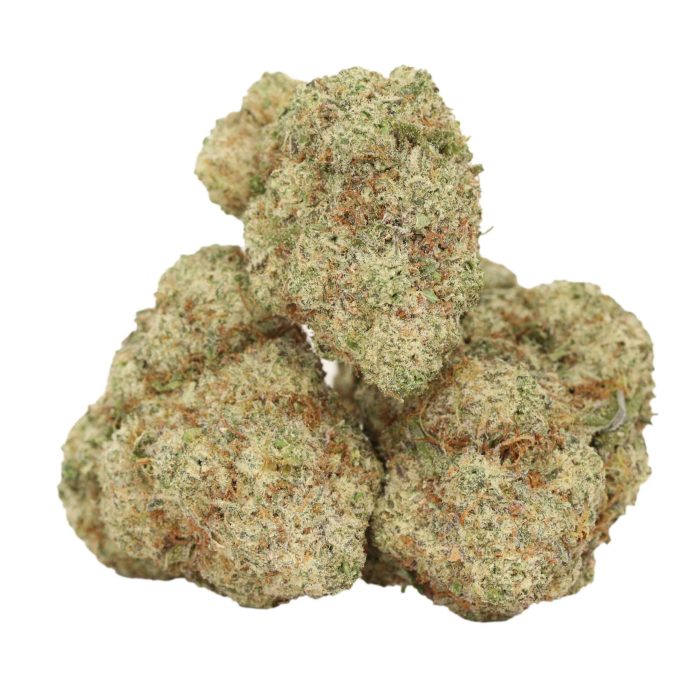
Chemo Kush Strain
Chemo Kush Strain is an indica-dominant cannabis cultivar associated with strong OG and Chem-family genetics, resinous flowers, lemon and pine aromas, and relatively high THC potential.
One clearly documented version comes from IZI Seeds, which lists the genetics as:
OG Kush × Chem #4
SeedFinder records this Chemo Kush as approximately:
- 70% indica;
- 30% sativa;
- around 22% THC according to breeder information;
- lemon, pine, tropical, and spicy-oil aroma characteristics.
This exact cultivar should not automatically be confused with the older Chemo, UBC Chemo, or BC Chemo strain family.
Leafly currently lists traditional Chemo/UBC Chemo separately at approximately 18% THC and 1% CBG, with woody, chestnut, and pungent flavors.
That naming overlap makes Chemo Kush especially useful for understanding why strain names alone are not enough to establish genetics or potency.
The cultivar also provides a strong educational foundation for topics such as high quality dispensary, high tolerance strain, and high tolerance weed.
For more U.S.-focused cannabis strain, cannabinoid, terpene, and marijuana education, explore Cannabistopgrade.com.
Chemo Kush Strain Quick Profile
| Characteristic | Chemo Kush Strain |
|---|---|
| Documented breeder version | IZI Seeds |
| Genetics | OG Kush × Chem #4 |
| General classification | Indica-dominant hybrid |
| Indica proportion | About 70% breeder-stated |
| Breeder-stated THC | About 22% |
| Aroma | Lemon, pine, tropical, spicy |
| General effect description | Relaxing with some energetic character |
| Related but separate name | Chemo / UBC Chemo |
| Leafly Chemo reference | About 18% THC, 1% CBG |
| Best potency reference | Batch-specific laboratory result |
| High-tolerance strain? | Not a scientific category |
| Standardized nationwide? | No |
What Is Chemo Kush Strain?
Chemo Kush is a cannabis strain name used for more than one related or similarly named product in cannabis markets.
The most clearly documented modern breeder version is from IZI Seeds.
Its lineage is:
OG Kush × Chem #4
That combination brings together two highly influential American cannabis families.
OG Kush contributes the broad Kush heritage, while Chem #4 belongs to the famous Chemdog genetic family.
Chemo Kush Genetics
SeedFinder currently documents the IZI Seeds version as:
OG Kush × Chemdog #4
The breeder describes it as mostly indica.
That makes Chemo Kush different from traditional UBC Chemo, whose exact historical genetics remain much less certain.
OG Kush Parentage
OG Kush is one of the most influential cannabis cultivars in the United States.
Its descendants frequently display aromas associated with:
- fuel;
- pine;
- citrus;
- earth;
- spice.
OG Kush genetics appear in a large number of modern hybrids.
Chem #4 Parentage
Chem #4 is a selection from the broader Chemdog family.
Chem-family strains are often associated with:
- diesel;
- chemical-like pungency;
- fuel;
- earth;
- strong resin production.
Combining Chem #4 with OG Kush creates a genetic profile heavily rooted in classic U.S. cannabis lines.
Is Chemo Kush Indica or Sativa?
The IZI Seeds Chemo Kush is described as approximately:
70% indica
and therefore classified as an indica-dominant hybrid.
However, percentages such as 70/30 should be treated as breeder or commercial descriptions rather than exact laboratory measurements.
Modern cannabis strains are highly hybridized.
Chemo Kush THC Percentage
The breeder-stated THC level for the IZI Seeds version is:
about 22% THC.
This is a reference value.
Actual flower could test:
- lower;
- similar;
- higher.
Cannabinoid content changes according to phenotype, growing environment, harvest, curing, storage, and laboratory methodology.
Chemo Kush vs. UBC Chemo
This distinction is important.
Leafly currently lists Chemo, also called:
- UBC Chemo;
- Kemo;
as a separate indica strain at approximately:
18% THC and 1% CBG.
Leafly describes leading consumer-reported effects as:
- sleepy;
- hungry;
- relaxed.
The exact Chemo Kush from IZI Seeds instead has documented:
OG Kush × Chem #4 genetics.
Therefore the two names should not automatically be treated as identical.
Chemo Kush vs. BC Chemo Kush
Current commercial references also use BC Chemo Kush.
One Canadian craft cultivar listing describes BC Chemo Kush at approximately:
- 25–30% THC;
- 1.5–2% terpenes;
- indica classification.
Again, that demonstrates how the broader Chemo Kush name can appear on genetically or commercially distinct products.
Why Cannabis Strain Names Can Be Confusing
Cannabis cultivars do not operate under a single nationwide naming registry.
The same or similar name may appear from:
- different breeders;
- regional producers;
- legacy growers;
- seed companies.
That means a name such as Chemo Kush should be paired with:
- breeder identity;
- lineage;
- laboratory result;
- producer;
- batch information.
Chemo Kush Aroma
The IZI Seeds description emphasizes:
- lemon;
- pine;
- tropical notes;
- spicy oil.
This differs somewhat from traditional UBC Chemo descriptions emphasizing:
- woody;
- pungent;
- earthy.
The difference reinforces the importance of distinguishing exact cultivars.
Chemo Kush Flavor
Common reported flavor themes include:
- pine;
- lemon;
- spice;
- fuel;
- earth.
Actual flavor depends strongly on terpene expression and freshness.
Chemo Kush Appearance
Breeder descriptions characterize the flowers as becoming:
- swollen;
- resin-covered;
- dense.
High resin production is common among both OG and Chem-derived genetics.
Visible resin comes largely from glandular trichomes.
What Are Cannabis Trichomes?
Trichomes are microscopic resin-producing structures found on cannabis flowers.
They contain many compounds including:
- cannabinoids;
- terpenes;
- other plant metabolites.
Dense trichome coverage can make cannabis look frosty or crystalline.
Does Frosty Cannabis Mean High THC?
Not necessarily.
A frosty appearance may indicate substantial resin production, but the eye cannot accurately measure THC.
Two highly frosted flowers may have noticeably different cannabinoid concentrations.
Laboratory testing remains more reliable.
Is Chemo Kush a High-Potency Strain?
A breeder-stated 22% THC level places Chemo Kush in a relatively potent flower category compared with many lower-THC cultivars.
However, terms such as:
- strong;
- potent;
- high potency;
remain relative.
A 22% THC product may feel very strong to one person and less intense to another.
What Is a High Tolerance Strain?
The phrase high tolerance strain is not a scientific cannabis classification.
People often use it to describe a strain marketed toward consumers who have developed substantial tolerance to THC.
That concept should be treated carefully.
Tolerance belongs to the person, not the strain.
A cannabis plant does not become a “high-tolerance strain” simply because it contains high THC.
What Is High Tolerance Weed?
High tolerance weed usually refers informally to potent cannabis products that experienced users believe produce noticeable effects despite frequent cannabis exposure.
Again, this is not a standardized product category.
A better way to describe cannabis is through objective measurements such as:
- total THC;
- CBD;
- minor cannabinoids;
- terpene profile.
Cannabis Tolerance Explained
Cannabis tolerance can develop when repeated THC exposure causes the body to become less responsive to the same amount.
A person may then perceive that they need more THC to achieve effects similar to previous experiences.
This does not mean increasing potency is risk-free.
High Tolerance Does Not Mean Immunity
A person with substantial cannabis tolerance can still experience:
- impaired coordination;
- delayed reaction time;
- impaired judgment;
- anxiety;
- unwanted intoxication.
Tolerance does not eliminate all impairment.
Why Tolerance Develops
Repeated exposure to THC can influence cannabinoid receptor activity.
Over time, some consumers experience reduced sensitivity.
Tolerance patterns can differ according to:
- frequency;
- product potency;
- duration of use;
- individual biology.
Is Chemo Kush for High-Tolerance Consumers?
Some consumers might describe a 22%+ THC Chemo Kush batch as suitable for experienced users.
That should not be interpreted as a recommendation to consume more THC.
The safer and more accurate statement is:
Chemo Kush can be relatively high in THC, so its actual batch potency should be checked carefully.
High THC vs. High Tolerance
These concepts are different.
| Concept | Meaning |
|---|---|
| High THC | Product contains relatively high THC concentration |
| High tolerance | Person has reduced response after repeated exposure |
| High tolerance strain | Informal marketing phrase |
| Strong strain | Subjective description |
| Potency | Measurable cannabinoid concentration |
Why Higher THC Is Not Always Better
Higher THC does not automatically mean:
- higher quality;
- better flavor;
- better terpenes;
- better experience.
Some lower-THC flower can have excellent:
- aroma;
- freshness;
- cannabinoid balance;
- terpene complexity.
Chemo Kush and Potency Labels
A cannabis flower package may list:
- THC;
- THCA;
- CBD;
- CBG;
- total cannabinoids.
These numbers can provide a more objective basis for comparison.
What Is THCA?
THCA is:
tetrahydrocannabinolic acid.
It is a major cannabinoid precursor in raw cannabis flower.
Heating converts some THCA into delta-9 THC.
That is why flower labels may show much more THCA than delta-9 THC.
Total THC
Some cannabis labels calculate total potential THC by considering:
- existing delta-9 THC;
- THCA that can convert into THC.
Because labeling methods vary, consumers should compare equivalent measurements.
What Is a High Quality Dispensary?
A high quality dispensary is best defined through regulatory compliance and transparency rather than expensive branding.
In a legal U.S. market, a strong dispensary should generally demonstrate:
- valid state licensing;
- properly labeled products;
- traceable inventory;
- required laboratory testing;
- compliant packaging;
- age or patient verification.
High Quality Dispensary vs. Luxury Dispensary
A luxurious-looking store is not automatically higher quality.
Interior design cannot establish:
- product purity;
- license status;
- accurate THC testing;
- regulatory compliance.
Official licensing remains more important.
How Licensing Helps Identify a High Quality Dispensary
Each legal cannabis state maintains its own licensing framework.
Depending on jurisdiction, regulators may license:
- retailers;
- cultivators;
- manufacturers;
- testing laboratories;
- delivery businesses.
Consumers should verify businesses through official state sources.
High Quality Dispensary Product Labels
Transparent dispensary products may show:
- producer;
- batch or lot number;
- cannabinoid content;
- net weight;
- required warnings;
- packaging information.
Requirements differ by jurisdiction.
High Quality Dispensary Laboratory Testing
Regulated cannabis markets generally require some level of laboratory analysis.
Testing may evaluate:
- cannabinoid potency;
- pesticides;
- microorganisms;
- residual solvents;
- heavy metals.
Exact testing rules vary considerably by state.
Why Batch Numbers Matter
A batch number connects a specific product to:
- production records;
- laboratory results;
- inventory tracking.
This is more informative than a strain name alone.
Why Packaging Dates Matter
Cannabis chemistry can change during storage.
Older flower may lose:
- terpene intensity;
- moisture;
- freshness.
Package or harvest dates can therefore contribute to quality evaluation.
What High Quality Cannabis Flower Looks Like
Visual characteristics may include:
- intact buds;
- healthy coloration;
- visible trichomes;
- proper trimming;
- no obvious mold.
Appearance alone should never substitute for testing.
High Quality Weed and Aroma
A strong cultivar-specific aroma can indicate retained terpenes.
Chemo Kush may express:
- lemon;
- pine;
- spice;
- fuel.
Muted aroma can sometimes indicate aging or poor storage, although aroma intensity varies naturally.
High Quality Weed and Moisture
Properly stored flower should not be excessively wet or extremely brittle.
Too much moisture can increase microbial concerns.
Excessive dryness can reduce aroma and physical quality.
High Quality Dispensary and Product Storage
Cannabis quality can be affected by:
- heat;
- excessive light;
- oxygen;
- poor packaging.
Retail storage practices therefore influence product freshness.
High Quality Dispensary and Staff Knowledge
In regulated markets, knowledgeable staff should be able to explain factual product information such as:
- THC concentration;
- CBD concentration;
- product format;
- package information.
They should not substitute marketing claims for medical diagnosis.
High Quality Dispensary and Medical Claims
Cannabis businesses should not treat strain descriptions as proof that a product cures or treats a medical condition.
Consumer reports about:
- pain;
- insomnia;
- nausea;
are not equivalent to clinical evidence.
The Chemo Name and Medical Claims
Traditional Chemo/UBC Chemo is often associated with a story that it was developed in Canada for people undergoing chemotherapy.
That historical claim is widely repeated, but it should not be converted into a claim that Chemo Kush is clinically proven to treat chemotherapy side effects.
The exact IZI Seeds Chemo Kush is genetically documented as:
OG Kush × Chem #4.
Does Chemo Kush Treat Cancer?
There is no basis for presenting Chemo Kush as a cancer treatment.
Cannabis strains should not be described as curing cancer.
Medical cannabis research involves specific cannabinoids, formulations, doses, and clinical contexts rather than simply strain names.
Chemo Kush and Nausea
Traditional Chemo strain users have reported using cannabis in connection with nausea and appetite issues.
Those reports do not prove that a specific Chemo Kush flower batch is an appropriate medical therapy.
Patients undergoing cancer treatment should discuss cannabis use with qualified healthcare professionals.
Chemo Kush and Sleep
Traditional Chemo/UBC Chemo consumer reports frequently include sleepiness.
The IZI Seeds Chemo Kush is described as balancing relaxation with more energetic characteristics.
Neither description establishes Chemo Kush as a proven insomnia treatment.
Chemo Kush and Anxiety
High-THC cannabis can affect anxiety differently among individuals.
Possible responses include:
- relaxation;
- discomfort;
- anxiety;
- paranoia.
Product potency and individual sensitivity matter.
Chemo Kush and Driving
THC can impair:
- reaction time;
- attention;
- coordination;
- judgment.
People should not drive while impaired by Chemo Kush or another intoxicating cannabis product.
High Tolerance and Driving
Tolerance does not make impaired driving safe.
Even experienced cannabis consumers may have:
- altered reaction time;
- reduced divided attention;
- impaired decision-making.
Legal impairment rules still apply.
High Tolerance and Cannabis Use Disorder
Increasing tolerance can be one sign associated with cannabis use disorder when it occurs alongside other problematic patterns.
Other signs can include:
- craving;
- unsuccessful attempts to reduce use;
- continued use despite problems.
Tolerance alone does not establish a diagnosis.
Potency Escalation
Repeatedly seeking stronger products to overcome tolerance can increase THC exposure.
Higher exposure can increase risks such as:
- unwanted intoxication;
- anxiety;
- dependence-related problems.
That is why “high tolerance weed” should not be framed as a goal.
Concentrates vs. High-THC Flower
Cannabis concentrates often contain much greater THC concentrations than flower.
Examples include:
- live resin;
- wax;
- shatter;
- distillate.
A 22% Chemo Kush flower product is chemically different from a concentrate containing much higher THC.
High Tolerance Strain vs. Concentrate
A strain itself does not need to be extremely high in THC to be commercially popular.
Concentrates achieve high THC through processing rather than simply plant genetics.
This distinction matters when comparing products.
Chemo Kush Flower
The strain is commonly associated with resin-rich flower.
Flower represents dried cannabis buds rather than concentrated extract.
The actual THC percentage should be read directly from the laboratory label.
Chemo Kush Pre-Rolls
A Chemo Kush pre-roll generally contains prepared flower.
Some pre-rolls may be infused with concentrates.
Infused products can be significantly more potent than ordinary flower.
Chemo Kush Vape Products
If a vape carries the Chemo Kush name, the product may contain:
- cannabis extract;
- distillate;
- live resin;
- added terpene blends.
Its chemistry should not be assumed to match flower.
Strain Name vs. Product Form
| Product | What the Chemo Kush Name Tells You |
|---|---|
| Flower | Claimed cultivar identity |
| Pre-roll | Flower cultivar, unless infused |
| Vape | May indicate source genetics or flavor profile |
| Concentrate | Extract derived from or marketed as the cultivar |
| Edible | May only indicate formulation or branding |
Product format matters as much as strain name.
Cannabis Quality and Terpenes
Terpenes contribute aroma and flavor.
Common terpene families associated with OG/Chem genetics include:
- limonene;
- myrcene;
- caryophyllene;
- pinene.
Exact Chemo Kush terpene data should be determined by batch testing rather than assumed.
Why Chemo Kush Can Smell Like Fuel
Fuel and chemical-like aromas are common in Chem-family strains.
These odors arise from mixtures of volatile aromatic compounds.
The smell does not indicate that gasoline or industrial chemicals are literally present.
Lemon and Pine Notes
The IZI Seeds breeder description emphasizes:
- lemon;
- pine.
These aroma characteristics are commonly found across OG-family cannabis.
Chemo Kush vs. Chem Valley Kush
Chemo Kush should not be confused with Chem Valley Kush.
Leafly currently documents Chem Valley Kush as:
Chemdawg × SFV OG Kush
with approximately 25% THC.
It is a separate cultivar.
Chemo Kush vs. GMO Kush
GMO Kush is also distinct.
Leafly identifies GMO Kush as:
GMO × Topanga Canyon OG
with approximately 29% THC.
Similar “Chem,” “Kush,” and gas-related names do not indicate identical genetics.
Chemo Kush vs. Remo Chemo
Remo Chemo is another separate hybrid.
Leafly describes its base genetics as involving:
UBC Chemo × Bubba Kush
followed by further breeding.
It should not be treated as the same strain as IZI Seeds Chemo Kush.
Why Exact Cultivar Identification Matters
Separating these names prevents inaccurate claims about:
- potency;
- parentage;
- effects;
- terpene profiles.
For Chemo Kush, the breeder name is especially useful.
U.S. Cannabis Laws
Cannabis laws differ significantly across the United States.
Some states permit:
- adult-use cannabis;
- medical cannabis;
- both.
Others maintain more restrictive laws.
No strain name overrides applicable state law.
High Quality Dispensary and State Law
A dispensary considered reputable should operate under the appropriate state license where cannabis retail is permitted.
Consumers can usually verify license status through official state regulators.
Licensed vs. Unlicensed Cannabis
Licensed cannabis businesses operate under state-specific regulatory requirements.
Unlicensed products may lack reliable:
- testing;
- traceability;
- labeling.
A professional-looking website or package alone does not prove licensure.
State Cannabis Testing Rules
Testing requirements differ by state.
Consumers should therefore rely on their local regulator for current information about:
- mandatory tests;
- product recalls;
- license verification.
Cannabis and State Borders
State legalization does not automatically permit marijuana transportation across state lines.
Legal status can change immediately when crossing jurisdictional boundaries.
Why Chemo Kush Is a Useful Potency Example
Chemo Kush demonstrates several important cannabis concepts:
- cultivar names can overlap;
- breeder identity matters;
- THC varies by batch;
- “high tolerance strain” is not a scientific category;
- high THC is not the same as high quality.
These principles apply broadly across the modern cannabis market.
Educational Resources
For more U.S.-focused cannabis strain, cannabinoid, terpene, and marijuana education, explore Cannabistopgrade.com.
Concerning the exact IZI Seeds Chemo Kush lineage, classification, and breeder-stated THC information, review the SeedFinder Chemo Kush Profile.
For the traditional Chemo/UBC Chemo strain profile, including current THC, CBG, reported effects, flavors, and terpenes, review the Leafly Chemo Strain Guide.
For broader cannabis health and safety information, review the CDC Cannabis and Public Health Resources.
Continue exploring U.S. cannabis strains, cannabinoids, potency, product testing, and dispensary terminology through Cannabistopgrade.com.
Frequently Asked Questions
1. What is Chemo Kush Strain?
Chemo Kush Strain can refer to more than one similarly named cannabis line. The exact IZI Seeds Chemo Kush documented by SeedFinder is an indica-dominant OG Kush × Chem #4 hybrid with breeder-stated THC around 22%.
2. Is Chemo Kush the same as UBC Chemo?
Not necessarily. Leafly lists Chemo, also called UBC Chemo, as a separate indica strain at approximately 18% THC and 1% CBG. The IZI Seeds Chemo Kush has specifically documented OG Kush × Chem #4 genetics.
3. What does high tolerance strain mean?
“High tolerance strain” is an informal term rather than a scientific cannabis category. Tolerance describes a person’s reduced response after repeated THC exposure. A more objective way to compare products is through measured THC, CBD, and other cannabinoid concentrations.
4. Is Chemo Kush considered high tolerance weed?
Some people may use that phrase for Chemo Kush because breeder information places it around 22% THC. However, “high tolerance weed” is not a standardized quality classification, and increasing THC exposure to overcome tolerance can increase unwanted effects.
5. What makes a high quality dispensary?
A high quality dispensary in a regulated U.S. market should have valid licensing, compliant product labeling, appropriate laboratory testing and traceability, transparent batch information, and adherence to state rules. Luxury branding alone does not establish quality.
6. How much THC is in Chemo Kush?
The IZI Seeds Chemo Kush profile lists approximately 22% THC. Other similarly named Chemo or BC Chemo products can have different values, so the specific breeder, producer, and batch laboratory result are more reliable than the name alone.
Be the first to review “Chemo Kush Strain”
Related products
Indica strains
Indica strains
Indica strains
Indica strains
Indica strains
Indica strains
Indica strains
Indica strains
Reviews
There are no reviews yet.