Uncategorized
Cannabis Dispensaries and Vape Shops: Why Weed Was Criminalized and When Marijuana Became Illegal
Sep
Modern cannabis dispensaries and vape shops exist within a legal landscape that would have been almost unimaginable during much of the twentieth century.
Today, some U.S. states permit regulated cannabis businesses that sell products such as:
- cannabis flower;
- edibles;
- tinctures;
- concentrates;
- vape cartridges;
- and other state-regulated cannabis products.
At the same time, ordinary vape shops may sell nicotine products, accessories or federally lawful hemp-related products depending on the jurisdiction.
These businesses are not automatically interchangeable.
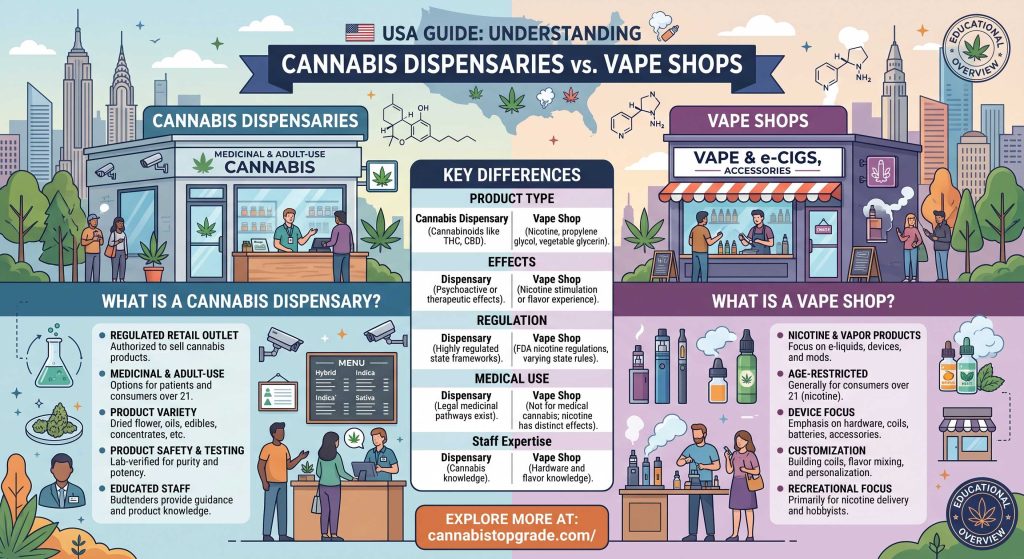
A licensed cannabis dispensary operates under cannabis-specific state regulation, while a general vape shop may operate under a completely different licensing framework.
Understanding this modern marketplace requires answering important historical questions including:
- when was pot made illegal
- why was weed made illegal
- why was weed criminalized
- when was weed made illegal
- why is marijuana illegal
The answers involve more than one law and more than one historical moment.
Cannabis restrictions developed gradually through state laws, federal taxation, criminal enforcement, social attitudes, political campaigns and later federal drug scheduling.
For more U.S.-focused cannabis law, strain and regulated-market education, explore Cannabistopgrade.com.
What Is a Cannabis Dispensary?
A cannabis dispensary is a business authorized under applicable state law to distribute or sell regulated cannabis products.
Depending on the state, dispensaries may serve:
- medical cannabis patients;
- adults participating in an adult-use market;
- or both.
State rules can govern:
- licensing;
- product testing;
- age verification;
- packaging;
- labeling;
- advertising;
- security;
- inventory tracking;
- and allowable product types.
The details vary considerably from one state to another.
What Is a Vape Shop?
A vape shop is generally a retail business focused on vaping products and accessories.
Some vape shops primarily sell:
- nicotine e-liquids;
- vaping devices;
- replacement parts;
- batteries;
- and accessories.
Others may carry hemp-derived products where state and federal laws allow them.
A vape shop should not automatically be assumed to be a licensed cannabis dispensary.
That distinction matters legally and from a consumer-safety perspective.
Cannabis Dispensary vs. Vape Shop
| Feature | Cannabis Dispensary | General Vape Shop |
|---|---|---|
| Primary regulation | State cannabis law | Tobacco/vaping and retail laws |
| Cannabis license | Usually required | Not necessarily |
| THC marijuana products | Only where legally licensed | Not automatically permitted |
| Product testing | Often required by cannabis regulators | Depends on product category |
| Age requirements | State cannabis rules | Tobacco/vape rules |
| Inventory tracking | Common in regulated cannabis markets | Usually different system |
| Medical cannabis | May be available | Usually not a medical-cannabis provider |
This distinction helps explain why the growth of cannabis dispensaries represents a major change from the prohibition era.
When Was Pot Made Illegal?
There is no single date when cannabis suddenly became illegal everywhere in the United States.
Restrictions developed in stages.
Some states had already begun banning or regulating marijuana before federal prohibition intensified.
At the federal level, however, 1937 is one of the most important dates.
Congress passed the Marihuana Tax Act of 1937.
The Congressional Research Service describes the law as creating a de facto federal ban on marijuana through expensive taxes, transfer requirements and regulatory burdens.
So when people ask when was pot made illegal, 1937 is generally the most important early federal turning point.
Was Marijuana Federally Legal Before 1937?
According to the Congressional Research Service, growing and using marijuana was legal under federal law before 1937, although some states had already begun regulating or banning it.
That distinction is important.
Cannabis prohibition did not start as one nationwide state-and-federal ban enacted simultaneously.
Instead:
- some states restricted cannabis first;
- the federal government imposed the Marihuana Tax Act in 1937;
- later federal criminal laws increased penalties;
- and the Controlled Substances Act created the modern scheduling framework in 1970.
When Was Weed Made Illegal?
If the question refers to federal policy, the most useful timeline is:
Before 1937
Cannabis was not broadly prohibited under federal law.
1937
The Marihuana Tax Act created a de facto federal ban.
1951
The Boggs Act increased federal penalties for certain drug offenses.
1956
The Narcotic Control Act further increased drug penalties, including marijuana-related penalties.
1970
The Controlled Substances Act established the modern federal scheduling system.
Marijuana was placed within Schedule I.
This sequence shows that marijuana prohibition became progressively stricter rather than emerging from one single law.
Why Was Weed Made Illegal?
There was no single cause.
The historical development of marijuana prohibition involved a mixture of:
- public-health fears;
- sensational media coverage;
- law-enforcement advocacy;
- political campaigns;
- claims about violent or irrational behavior;
- racial and anti-immigrant prejudice;
- and broader drug-control policy.
Congressional historical reviews describe how federal officials promoted marijuana restrictions using claims that cannabis could lead to:
- crime;
- insanity;
- violence;
- and immoral behavior.
Some of those historical claims were exaggerated or unsupported by modern scientific standards.
Henry Anslinger and Marijuana Prohibition
Henry Anslinger served as the first commissioner of the Federal Bureau of Narcotics.
He became one of the most influential figures in early federal marijuana policy.
During the campaign leading to the Marihuana Tax Act, Anslinger and others testified to Congress about the supposed dangers of cannabis.
The Congressional Research Service notes that congressional testimony included claims linking marijuana to:
- violent behavior;
- insanity;
- criminal activity;
- and moral decline.
Those arguments helped build political support for federal restrictions.
Why Was Weed Criminalized?
Marijuana criminalization developed alongside broader twentieth-century drug-control policy.
Several forces contributed.
Public Fear
Sensational stories portrayed marijuana as unusually dangerous.
Law-Enforcement Policy
Federal and state agencies increasingly favored strict drug controls.
Racial and Immigration Politics
Cannabis was often connected in political rhetoric to marginalized communities, including Mexican immigrants and Black Americans.
Claims About Crime
Cannabis was repeatedly associated with criminal behavior in public campaigns.
Expanding Federal Drug Regulation
The federal government increasingly used criminal law and taxation to control psychoactive substances.
These factors combined over time.
Racialized Cannabis Policy
Race and immigration are important parts of marijuana prohibition history.
During the early twentieth century, the word “marijuana” became increasingly associated in American political discourse with Mexican immigrants.
Cannabis was also connected through sensationalized media stories with:
- Black jazz musicians;
- immigrant communities;
- urban crime;
- and social disorder.
Modern historians frequently examine these racialized narratives when explaining why cannabis criminalization gained political support.
That does not mean every legislator or voter had exactly the same motivation.
The history involved multiple overlapping forces.
Why Is Marijuana Illegal?
The answer today depends on which level of government is being discussed.
Federal Law
Marijuana remains subject to federal controlled-substance law.
State Law
Many states have adopted:
- medical cannabis programs;
- adult-use legalization;
- decriminalization;
- or other reforms.
This creates the well-known federal-state cannabis policy gap.
A cannabis business may operate legally under state law while still facing federal legal complications.
The Controlled Substances Act
The Controlled Substances Act of 1970 created the modern federal drug scheduling system.
Marijuana was placed in Schedule I.
That framework became the foundation of modern federal cannabis prohibition.
The difference between federal and state cannabis law later became increasingly significant as states began legalizing medical and adult-use cannabis.
Why Does Federal Cannabis Law Still Matter?
Federal law can affect cannabis businesses in areas such as:
- banking;
- taxation;
- bankruptcy;
- immigration;
- federal property;
- interstate commerce;
- and employment.
Congressional legal reviews have repeatedly described these consequences of the federal-state marijuana policy gap.
This means a state-licensed dispensary does not operate in the same legal environment as an ordinary federally lawful retail business.
How Cannabis Dispensaries Emerged
For decades, regulated cannabis dispensaries did not exist in the modern sense.
The major turning point came with state medical cannabis legalization.
California became the first U.S. state to establish statewide medical cannabis protections in 1996 through Proposition 215.
Other states followed.
Medical cannabis programs gradually created legal frameworks for:
- cultivation;
- patient registration;
- distribution;
- dispensaries;
- product testing;
- and regulated sales.
Recreational Cannabis Dispensaries
A second major turning point came in 2012, when Colorado and Washington became the first states to legalize adult-use cannabis.
That shift encouraged the development of licensed recreational cannabis stores.
Over time, additional states adopted adult-use systems.
These markets differ in:
- taxation;
- licensing;
- possession limits;
- product rules;
- local zoning;
- and home cultivation.
Cannabis Dispensaries Today
Modern state-regulated dispensaries may sell products such as:
- flower;
- pre-rolls;
- concentrates;
- edibles;
- tinctures;
- capsules;
- topicals;
- and vape cartridges.
Product availability depends on state law.
A legal dispensary must generally operate within a licensing and compliance framework.
Vape Shops and Cannabis Vapes
Cannabis vaping deserves special attention because the term “vape shop” can create confusion.
A nicotine vape shop is not necessarily permitted to sell marijuana-derived THC cartridges.
In regulated cannabis states, THC vape products are typically subject to cannabis-specific rules involving:
- licensing;
- testing;
- packaging;
- labeling;
- potency;
- and distribution.
Consumers should not assume that any shop selling vaping devices is authorized to sell regulated THC cannabis products.
THC Vape Safety
The FDA has previously warned consumers about THC-containing vaping products associated with lung injury, particularly products obtained from informal or street sources.
FDA testing has examined products for substances including:
- THC;
- cannabinoids;
- cutting agents;
- pesticides;
- toxins;
- and other contaminants.
This history reinforces the importance of product source, testing and regulatory oversight.
Street Vape Products vs. Regulated Products
One of the biggest public-health concerns with illicit vaping products is uncertainty about ingredients.
Unregulated products may lack reliable information about:
- cannabinoid concentration;
- additives;
- solvents;
- contaminants;
- pesticides;
- or manufacturing standards.
FDA guidance has specifically warned against THC vaping products obtained from street sources.
Does a Vape Shop Mean Cannabis Is Legal?
No.
The existence of a vape shop does not prove that recreational marijuana is legal in the state.
Vape shops can operate legally in jurisdictions where marijuana remains restricted because vaping businesses may sell nicotine or other lawful products rather than state-regulated marijuana.
Cannabis law and vaping law are separate regulatory categories.
Why Modern Dispensaries Are Historically Significant
Cannabis dispensaries represent a major reversal of twentieth-century marijuana policy.
For decades, cannabis distribution was heavily criminalized.
Today, several states regulate cannabis businesses using frameworks similar in some respects to other controlled consumer-product industries.
These systems can include:
- taxes;
- testing;
- licenses;
- product tracking;
- advertising restrictions;
- packaging requirements;
- and age limits.
Cannabis Legalization Did Not End All Restrictions
Legalization does not mean unrestricted cannabis.
State laws commonly continue regulating:
- possession;
- public consumption;
- home cultivation;
- impaired driving;
- age;
- advertising;
- packaging;
- and commercial activity.
Unauthorized sales can remain illegal even within adult-use states.
Dispensaries and Local Law
Municipalities can also matter.
Some states permit local governments to regulate:
- dispensary locations;
- operating hours;
- zoning;
- cultivation facilities;
- and commercial licenses.
A state may permit adult-use cannabis while a particular city has few or no dispensaries.
Vape Shops and Local Regulation
Vape retailers may also face local rules involving:
- age verification;
- flavored products;
- licensing;
- advertising;
- zoning;
- and school proximity.
Cannabis and vaping regulations can therefore overlap without being identical.
Why Marijuana Laws Differ by State
States have different approaches because cannabis policy has developed through:
- ballot initiatives;
- legislatures;
- regulatory agencies;
- court rulings;
- and local government decisions.
This produces a patchwork rather than one unified national system.
Current U.S. Cannabis Policy
The NCSL State Cannabis Policy Enactment Database was updated August 31, 2026.
It tracks enacted cannabis legislation involving:
- adult-use regulations;
- medical cannabis;
- hemp and CBD;
- product regulation;
- THC;
- concentrates;
- flower;
- edibles;
- testing;
- packaging;
- labeling;
- taxes;
- and public health.
Because cannabis policy changes regularly, older legalization maps can quickly become outdated.
Cannabis Dispensaries and Federal-State Conflict
A dispensary can be:
licensed under state law
while operating within a broader federal legal system that treats marijuana differently.
This legal conflict can affect:
- financial services;
- taxes;
- insurance;
- real estate;
- employment;
- and interstate business.
It is one of the most unusual features of the American cannabis industry.
When Did Public Opinion Begin Changing?
Public attitudes toward marijuana changed gradually over decades.
Important influences included:
- medical cannabis advocacy;
- changing views about drug criminalization;
- scientific research;
- criminal-justice reform;
- voter initiatives;
- and state experimentation.
California’s 1996 medical cannabis law marked a major policy turning point.
Colorado and Washington’s 2012 adult-use measures marked another.
Medical Cannabis vs. Recreational Cannabis
These systems should not be confused.
Medical Cannabis
Typically involves:
- patient eligibility;
- physician certification or recommendation;
- registration requirements;
- and medical-program regulations.
Adult-Use Cannabis
Typically permits possession or purchase by qualifying adults without requiring medical status.
Rules differ by state.
Dispensaries vs. Illegal Sellers
A licensed dispensary operates within state oversight.
An unlicensed seller does not automatically become legal because cannabis is permitted in the state.
Licensed markets may impose:
- testing;
- tracking;
- age verification;
- tax collection;
- and product standards.
This distinction is important for both legal compliance and consumer safety.
Does Legalization Mean Cannabis Is Harmless?
No.
Historical prohibition involved exaggerated claims, but legalization does not mean cannabis is risk-free.
Potential risks can involve:
- impairment;
- cannabis use disorder;
- anxiety;
- memory effects;
- impaired driving;
- and high-THC exposure.
A more accurate modern approach separates legitimate health risks from unsupported prohibition-era rhetoric.
Cannabis Vaping and High THC
Some vape products can contain high concentrations of THC.
High-potency cannabis may produce stronger intoxication than lower-potency flower.
That makes labeling and potency information particularly important.
A familiar strain name does not tell consumers everything about a cartridge’s actual cannabinoid concentration.
Why Regulated Testing Matters
Regulated cannabis programs may require testing for:
- THC;
- CBD;
- pesticides;
- residual solvents;
- microbial contamination;
- heavy metals;
- and other state-defined categories.
Testing requirements vary.
The presence of a professional package or vape device alone does not prove that a product has passed state testing.
Dispensary Cannabis vs. Hemp Products
Cannabis terminology can also be confusing because marijuana and hemp may fall under different legal frameworks.
A vape shop might sell hemp-derived products without operating as a marijuana dispensary.
Consumers should not assume:
hemp product = marijuana product
or
vape retailer = cannabis dispensary
The actual legal classification depends on the product and jurisdiction.
Why the History Still Matters
Understanding prohibition history helps explain why today’s cannabis marketplace is fragmented.
Modern dispensaries developed after decades of criminalization.
That history still influences:
- criminal records;
- licensing policy;
- taxes;
- banking restrictions;
- enforcement;
- social-equity programs;
- and public perceptions.
Cannabis regulation today cannot be fully understood without understanding how prohibition developed.
Educational Resources
For additional U.S.-focused cannabis law, strain and regulated-market education, explore Cannabistopgrade.com.
Concerning the history of marijuana’s federal legal status, see the Congressional Research Service report The Evolution of Marijuana as a Controlled Substance and the Federal-State Policy Gap.
For current state cannabis legislation, consult the NCSL State Cannabis Policy Enactment Database.
For FDA information concerning THC-containing vaping products and vaping-related safety concerns, see FDA THC-Containing Vaping Products.
Readers can continue exploring U.S. cannabis laws, dispensary terminology and regulated-market education through Cannabistopgrade.com.
Frequently Asked Questions
1. When was pot made illegal in the United States?
There was no single nationwide date covering every state. At the federal level, the Marihuana Tax Act of 1937 created a de facto prohibition through taxes and regulatory requirements. The Controlled Substances Act of 1970 later established the modern federal drug-scheduling system.
2. Why was weed made illegal?
Cannabis prohibition developed from several influences, including drug-policy concerns, sensational media reports, law-enforcement advocacy, claims connecting marijuana with crime or insanity, and racialized and anti-immigrant rhetoric.
3. Why was weed criminalized?
Criminalization expanded gradually through state laws, the Marihuana Tax Act, later federal penalty laws and eventually the Controlled Substances Act. Political and social forces played important roles alongside public-health arguments.
4. Why is marijuana illegal federally if dispensaries exist?
Many dispensaries operate legally under state cannabis laws, while federal marijuana law follows a different framework. This creates the federal-state cannabis policy gap.
5. Are cannabis dispensaries and vape shops the same thing?
No. A licensed cannabis dispensary operates under cannabis-specific regulations. A general vape shop may sell nicotine or other lawful vaping products and is not automatically licensed to sell marijuana-derived THC products.
6. Are THC vape products legal everywhere cannabis dispensaries operate?
Not necessarily. States can impose different rules on cannabis concentrates, vape cartridges, product potency, testing and manufacturing. Current state regulations should be checked through authoritative sources.
