
Uncategorized
Cannabis Strains Comparison: U.S. Marijuana Legalization History, Prohibition and State Laws
Sep
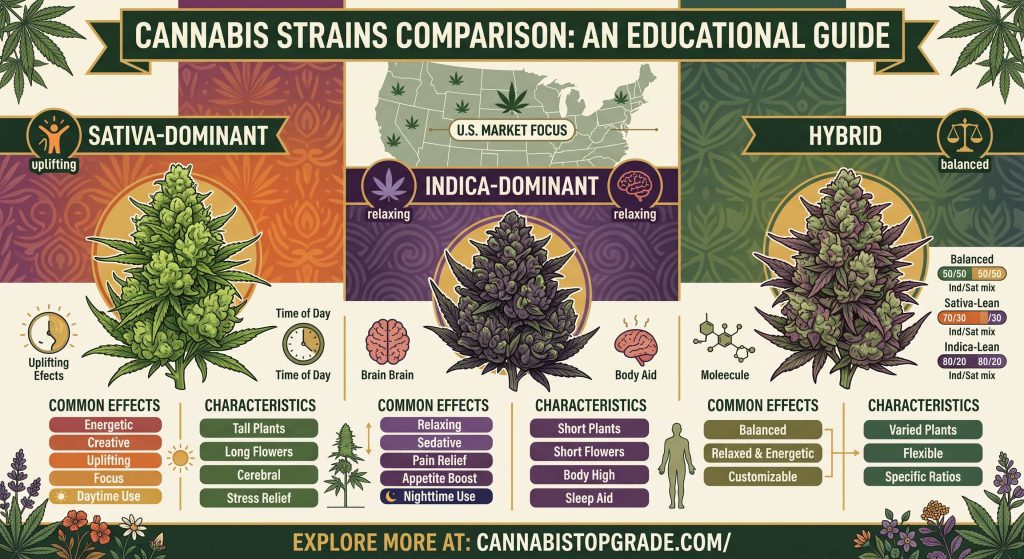
A cannabis strains comparison usually focuses on differences in genetics, THC, CBD, terpenes, aroma, effects and plant characteristics.
However, cannabis strains also exist within a much larger legal and historical story.
That makes questions such as:
- what was the first state to legalize weed
- when did weed become illegal
- when was pot illegal
- when did pot become illegal
- why was marijuana made illegal
important parts of understanding the modern U.S. cannabis market.
Today, consumers may compare strains such as:
- OG Kush;
- Blue Dream;
- Sour Diesel;
- Wedding Cake;
- Super Lemon Haze;
- Chocolope;
- Granddaddy Purple;
- Jack Herer;
- and hundreds of modern hybrids.
But the legal ability to cultivate, possess or purchase cannabis depends much more on federal and state law than on the strain name.
No particular strain is automatically legal simply because another strain is available in a regulated market.
For more U.S.-focused cannabis genetics, strain and legal-market education, readers can explore Cannabistopgrade.com.
What Is a Cannabis Strain?
A cannabis strain is a commercial or cultural name used to identify a particular genetic line or cultivar.
Strains can differ in:
- cannabinoid profile;
- THC;
- CBD;
- minor cannabinoids;
- terpenes;
- aroma;
- flower structure;
- plant size;
- color;
- and consumer-reported effects.
However, strain names are not perfectly standardized.
Two products carrying the same name can have different:
- THC levels;
- terpene concentrations;
- phenotypes;
- cultivation methods;
- and laboratory results.
This is why a useful cannabis strains comparison should consider actual batch-specific testing where available.
Basic Cannabis Strains Comparison
| Strain | General Type | Common Flavor Association | Typical Reputation |
|---|---|---|---|
| OG Kush | Hybrid | Earth, pine, fuel | Relaxing/euphoric |
| Blue Dream | Hybrid | Berry, fruit | Uplifting/balanced |
| Sour Diesel | Sativa-leaning | Diesel, citrus | Energetic |
| Wedding Cake | Hybrid | Vanilla, pepper, butter | Mostly calming |
| Super Lemon Haze | Sativa-dominant | Lemon, citrus | Energetic |
| Granddaddy Purple | Indica-dominant | Grape, berry | Calming |
| Chocolope | Sativa-dominant | Coffee, nutty, earthy | Energetic |
| Jack Herer | Sativa-leaning | Pine, spice, herbal | Uplifting |
These are broad cultural descriptions rather than guarantees.
Cannabis Strains and U.S. Law
The law does not usually classify individual strain names separately.
Instead, legal rules apply to cannabis or marijuana generally, depending on:
- federal law;
- state law;
- local law;
- medical status;
- product type;
- THC content;
- and licensing.
This means OG Kush, Wedding Cake and Blue Dream may all fall under the same state cannabis rules even though their genetics are completely different.
What Was the First State to Legalize Weed?
The answer depends on what type of legalization is being discussed.
First State to Legalize Medical Marijuana
California became the first U.S. state to legalize medical cannabis when voters passed Proposition 215, also known as the Compassionate Use Act, in 1996.
The California Department of Justice confirms that Proposition 215 made California the first state to permit medicinal cannabis use under state law.
The law allowed qualifying patients and caregivers protections relating to possession and cultivation when cannabis use had been recommended by a physician.
For historical information, see the California Proposition 215 archive.
First States to Legalize Recreational Weed
For adult-use or recreational cannabis, the answer is different.
Washington and Colorado were the first states to legalize recreational cannabis in 2012.
Washington voters approved Initiative 502.
Colorado voters approved Amendment 64.
Washington’s state legislative review confirms that Washington and Colorado were the first states to legalize recreational cannabis.
Washington’s legal-use framework took effect in December 2012, while licensed retail sales began later.
Therefore:
Medical cannabis first state: California, 1996.
Adult-use cannabis first states: Washington and Colorado, 2012.
Cannabis Legalization Timeline
A simplified U.S. timeline looks like this:
Before 1937
Cannabis was not broadly prohibited under federal law in the way it later became.
Some states and local governments had already begun imposing restrictions.
1937
The federal Marihuana Tax Act created a major federal barrier to cannabis possession and transfer.
1970
Congress enacted the Controlled Substances Act, establishing the modern federal drug scheduling system.
Marijuana was placed in Schedule I.
1996
California became the first state to legalize medicinal cannabis.
2012
Colorado and Washington became the first states to legalize adult recreational cannabis.
Following Years
Numerous states created:
- medical cannabis programs;
- adult-use programs;
- decriminalization laws;
- expungement systems;
- and regulated cannabis markets.
Cannabis laws remain different from state to state.
When Did Weed Become Illegal?
There is no single date that perfectly answers this question because cannabis restrictions developed gradually.
Different cities and states passed cannabis-related restrictions before a comprehensive federal policy existed.
At the federal level, 1937 is the most important early date.
The Congressional Research Service describes the Marihuana Tax Act of 1937 as creating a de facto federal ban by imposing significant taxes and regulatory requirements on marijuana transfers.
So when people ask when did weed become illegal, 1937 is often cited as the major federal turning point.
Was Marijuana Completely Illegal Before 1937?
Not under one nationwide federal prohibition comparable to the modern Controlled Substances Act.
Cannabis had been used in:
- medicines;
- tinctures;
- industrial products;
- and recreational settings.
However, various states had already started restricting marijuana.
The national legal landscape developed gradually.
That means it is more accurate to say:
Federal prohibition intensified dramatically in 1937
rather than saying cannabis suddenly became illegal everywhere on one exact day.
When Was Pot Illegal?
The slang term pot refers to marijuana or cannabis.
Therefore, questions like when was pot illegal or when did pot become illegal refer to the same legal history.
Important dates include:
1937 — Marihuana Tax Act
and
1970 — Controlled Substances Act
The 1937 law heavily restricted marijuana through taxation and federal controls.
The 1970 law reorganized federal drug policy and placed marijuana in Schedule I.
What Happened in 1970?
The Controlled Substances Act of 1970 established federal drug schedules.
Marijuana was placed in Schedule I.
This created the modern federal legal framework governing cannabis.
The distinction between state and federal cannabis law later became especially important as states began legalizing medical and adult-use cannabis.
Federal Law vs. State Law
The U.S. cannabis system is unusual because state and federal rules can conflict.
A state may permit:
- medical cannabis;
- adult-use possession;
- licensed retail sales;
- or limited home cultivation.
At the same time, federal law can treat marijuana differently.
This federal-state gap remains central to U.S. cannabis policy.
Why Was Marijuana Made Illegal?
There was no single cause.
Cannabis prohibition developed through a mixture of:
- drug-policy concerns;
- political campaigns;
- sensational media coverage;
- changing public attitudes;
- racial and immigrant prejudice;
- law-enforcement advocacy;
- and claims about crime and mental illness.
Historical records show that early federal prohibition campaigns frequently portrayed marijuana as dangerous and associated it with violent or irrational behavior.
Some of those claims were exaggerated or unsupported.
Henry Anslinger and Federal Marijuana Policy
Henry Anslinger was the first commissioner of the Federal Bureau of Narcotics.
He became one of the most influential figures in early federal marijuana prohibition.
During congressional debates and public campaigns, Anslinger and other officials argued that cannabis:
- encouraged crime;
- caused dangerous behavior;
- and represented a major social threat.
Those arguments helped build political support for federal restrictions.
Modern historical scholarship often examines how fear-based claims, racial stereotypes and political messaging influenced these policies.
Race, Immigration and Marijuana Prohibition
Race and immigration played important roles in early U.S. cannabis politics.
The word marijuana became increasingly associated in public discourse with Mexican immigrants during the early twentieth century.
Cannabis was also linked in public messaging to:
- Black jazz musicians;
- immigrant communities;
- urban crime;
- and social disorder.
Many historical researchers argue that racialized rhetoric helped generate public support for prohibition.
This does not mean every lawmaker supported prohibition for exactly the same reason.
The historical picture involved multiple social, political and law-enforcement forces.
Was Marijuana Banned Because It Was Scientifically Proven Extremely Dangerous?
The early prohibition process was not based solely on modern clinical evidence.
Political testimony and sensational claims played a substantial role.
Some officials claimed marijuana caused:
- insanity;
- violence;
- criminal behavior;
- or moral decline.
Modern cannabis research presents a more complicated picture.
Cannabis can produce real risks, including:
- intoxication;
- impaired driving;
- dependence;
- anxiety;
- memory impairment;
- and other health effects.
But those risks are not identical to many of the dramatic claims used during early twentieth-century prohibition campaigns.
The Marihuana Tax Act of 1937
The Marihuana Tax Act did not operate exactly like a simple criminal prohibition.
Instead, it imposed:
- taxes;
- registration requirements;
- transfer documentation;
- and substantial penalties for noncompliance.
In practice, it made legal cannabis transactions extremely difficult.
The Congressional Research Service describes this as a de facto ban on marijuana at the federal level.
Cannabis Before Federal Prohibition
Cannabis had a long history in the United States before prohibition.
Hemp was historically cultivated for:
- fiber;
- rope;
- textiles;
- and other industrial purposes.
Cannabis-based ingredients also appeared in some medicines during the nineteenth and early twentieth centuries.
The legal shift from accepted agricultural or pharmaceutical uses toward prohibition happened gradually.
Why Did Cannabis Laws Change Again?
By the late twentieth century, public opinion and scientific interest began shifting.
Medical cannabis advocacy became especially influential.
Patients and advocates argued that cannabis could have therapeutic value for certain symptoms.
California’s Proposition 215 became a major turning point.
California Proposition 215
California voters approved Proposition 215 on November 5, 1996.
It allowed qualifying patients and caregivers protections under state law for possession and cultivation when cannabis had been recommended for medical purposes.
California therefore became the first state to establish statewide medical marijuana protections through a voter-approved measure.
This changed the direction of American cannabis policy.
Medical Marijuana Expanded Across the U.S.
After California, other states gradually adopted medical cannabis laws.
Medical programs vary substantially.
Differences can involve:
- qualifying conditions;
- product types;
- possession limits;
- patient registration;
- physician requirements;
- cultivation;
- and retail access.
There has never been one identical national medical cannabis program.
Recreational Cannabis Legalization
The next major change came in 2012.
Washington and Colorado voters approved adult-use cannabis legalization.
Washington’s Initiative 502 created a regulated system involving:
- producers;
- processors;
- retailers;
- taxation;
- and sales to adults aged 21 and older.
Colorado developed its own regulated structure.
These policies became models that other states later adapted.
Why Did States Legalize Recreational Cannabis?
Supporters of legalization have commonly argued for:
- reducing criminal penalties;
- regulating production;
- controlling sales;
- generating tax revenue;
- reducing illicit-market activity;
- and redirecting law-enforcement resources.
Opponents have raised concerns involving:
- youth use;
- impaired driving;
- public health;
- commercialization;
- high-potency products;
- and cannabis dependence.
Modern state policies attempt to balance these competing concerns in different ways.
Cannabis Legalization Did Not Happen Everywhere at Once
One of the biggest misconceptions is that marijuana became nationally legal after Colorado and Washington legalized it.
That did not happen.
States adopted different systems at different times.
Some permit:
- adult use and medical cannabis.
Others permit:
- medical cannabis only.
Other jurisdictions maintain more restrictive frameworks.
Rules can also change through:
- legislatures;
- ballot initiatives;
- court decisions;
- regulations;
- and local ordinances.
Current U.S. Cannabis Policy
Cannabis policy continues to change.
The NCSL State Cannabis Policy Enactment Database was updated August 31, 2026.
It tracks enacted legislation across states, Washington, D.C., and U.S. territories.
Topics include:
- adult-use cannabis;
- medical cannabis;
- hemp and CBD;
- licensing;
- criminal justice;
- public health;
- THC;
- flower;
- concentrates;
- edibles;
- testing;
- packaging;
- labeling;
- taxation;
- and local regulation.
This makes current official resources more reliable than older legalization maps.
Cannabis Strain Comparisons in Legal Markets
Legalization changed how cannabis strains are discussed.
Instead of underground strain names alone, modern regulated markets may provide information about:
- THC;
- CBD;
- minor cannabinoids;
- terpene profiles;
- harvest dates;
- batch numbers;
- licensed producers;
- and laboratory testing.
This makes modern strain comparison more data-oriented.
Old Cannabis vs. Modern Cannabis Strains
Cannabis breeding has also changed significantly.
Older strain families include:
- Haze;
- Skunk;
- Kush;
- Thai;
- Afghani;
- Colombian;
- and Mexican genetic traditions.
Modern cultivars often involve complex hybrids such as:
- Cookies;
- Gelato;
- Runtz;
- Wedding Cake;
- Sherbet;
- and Zkittlez-related genetics.
Modern cannabis therefore combines decades of selective breeding with a rapidly changing regulatory environment.
Cannabis Strain Names Are Not Legal Categories
This is important.
A strain called:
- Wedding Cake;
- OG Kush;
- Blue Dream;
- Sour Diesel;
- or Super Lemon Haze
does not receive a separate legal status because of its name.
Law generally regulates cannabis based on broader criteria such as:
- marijuana classification;
- THC content;
- product type;
- licensed status;
- possession;
- age;
- and jurisdiction.
Cannabis Strains Comparison: THC
THC is one common comparison factor.
Higher THC generally means greater intoxicating potential.
However:
higher THC does not automatically mean better cannabis.
A complete comparison should consider:
- cannabinoids;
- terpenes;
- freshness;
- cultivation quality;
- curing;
- testing;
- and individual preference.
Cannabis Strains Comparison: Terpenes
Terpenes contribute significantly to aroma.
Common cannabis terpenes include:
Myrcene
Often associated with earthy or herbal aromas.
Limonene
Associated with citrus.
Caryophyllene
Associated with pepper and spice.
Pinene
Associated with pine.
Terpinolene
Can produce floral, herbal, citrus and woody notes.
These aromatic profiles help distinguish strain families.
Cannabis Strains Comparison: Sativa, Indica and Hybrid
Commercial cannabis markets frequently classify strains as:
- sativa;
- indica;
- hybrid.
These categories can be useful shorthand.
However, they do not reliably predict every individual’s experience.
Actual chemistry and personal response are more complex.
Why Legal History Matters When Comparing Cannabis
Cannabis strain diversity expanded while legal policy changed dramatically.
For much of the twentieth century, cannabis breeding and distribution existed largely outside regulated legal markets.
Modern legalization created:
- licensed cultivation;
- testing laboratories;
- product labels;
- regulated retail systems;
- and commercial breeding industries.
Understanding cannabis today therefore requires both genetics and legal history.
Federal Prohibition and State Legalization Can Coexist
One of the most confusing features of American cannabis policy is that a product can be permitted under state law while still facing different treatment under federal law.
This difference affects:
- banking;
- interstate commerce;
- taxation;
- employment;
- federal property;
- research;
- and business regulation.
State legalization should never be interpreted as automatic nationwide legalization.
What Does Legal Cannabis Mean?
“Legal cannabis” can describe several different things.
It might mean:
Legal Medical Cannabis
Available under a state’s medical program.
Adult-Use Cannabis
Permitted for adults under state law.
Decriminalized Cannabis
Possession may carry reduced or no criminal penalties without creating a legal retail market.
Hemp
Federally and state-regulated cannabis meeting specific THC definitions.
These categories should not be treated as identical.
Cannabis Legalization and Criminal Justice
Modern legalization policies increasingly include criminal-justice provisions.
Some states have adopted:
- expungement;
- record sealing;
- reduced penalties;
- resentencing;
- and social-equity programs.
This reflects a broader reassessment of historical cannabis prohibition.
Cannabis Laws Are Still Changing
Legalization is not a completed historical event.
States continue modifying:
- product limits;
- licenses;
- public consumption;
- taxation;
- potency rules;
- advertising;
- packaging;
- testing;
- and social-equity requirements.
Readers should verify current law instead of relying on old articles.
Educational Resources
For additional U.S.-focused cannabis strain, cannabinoid, terpene and legal-history education, explore Cannabistopgrade.com.
For the historical federal treatment of cannabis, see the Congressional Research Service report, The Evolution of Marijuana as a Controlled Substance and the Federal-State Policy Gap.
Regarding California’s landmark 1996 medical cannabis law, see the California Proposition 215 archive.
For Washington’s adult-use legalization history, see the Washington State Liquor and Cannabis Board cannabis history.
For current state cannabis legislation, consult the NCSL State Cannabis Policy Enactment Database.
Readers can continue exploring cannabis strains, U.S. legalization history and regulated-market terminology through Cannabistopgrade.com.
Frequently Asked Questions
1. What was the first state to legalize weed?
California became the first state to legalize medicinal marijuana in 1996 through Proposition 215. For recreational adult-use cannabis, Washington and Colorado became the first states to legalize in 2012.
2. When did weed become illegal in the United States?
Cannabis restrictions developed gradually, but the Marihuana Tax Act of 1937 was the major early federal turning point. It created a de facto federal ban through taxes and regulatory requirements.
3. When did pot become federally controlled under the modern drug system?
The Controlled Substances Act was enacted in 1970 and established the modern federal scheduling system, placing marijuana in Schedule I.
4. Why was marijuana made illegal?
Cannabis prohibition developed from multiple forces, including drug-policy concerns, sensational media campaigns, racialized and anti-immigrant rhetoric, law-enforcement advocacy and claims that cannabis caused crime or insanity. Modern historians generally treat the history as more complex than a single scientific decision.
5. Were cannabis strains separately made illegal?
No. Individual strain names such as OG Kush, Blue Dream or Wedding Cake are generally not separately scheduled. Laws apply to cannabis or marijuana more broadly according to federal, state and local rules.
6. Are cannabis laws the same in every U.S. state today?
No. State rules vary significantly regarding medical cannabis, adult use, possession, cultivation, concentrates, edibles, retail sales and testing. The NCSL cannabis database provides current state-level policy information.
