
Uncategorized
Psilocybin and Psychedelic Mushrooms: Cannabis Prohibition, Weed Legalization History and U.S. Drug Policy
Sep
Psilocybin and psychedelic mushrooms are increasingly discussed alongside cannabis in conversations about American drug policy, scientific research, criminalization and changing public attitudes.
However, cannabis and psilocybin are very different substances.
Cannabis contains cannabinoids such as THC and CBD.
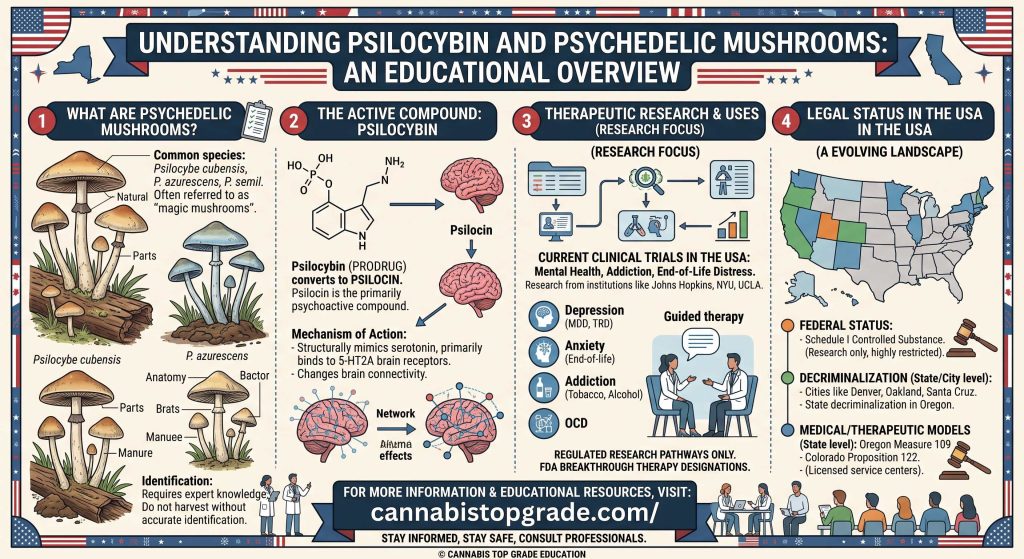
Certain psychedelic mushrooms contain psilocybin, which the body converts into the psychoactive compound psilocin.
Their pharmacology, legal histories and regulatory frameworks are not interchangeable.
Still, the changing way Americans think about both substances makes psilocybin a useful starting point for understanding related searches such as:
- weed prohibition
- when did marijuana become illegal
- history of cannabis in the US
- when did weed become illegal in the United States
- history of weed legalization
Cannabis went from widespread agricultural and medicinal use, through increasingly restrictive laws and federal prohibition, into a modern era where many states permit medical or adult-use cannabis.
Psilocybin remains much more restricted federally, even as scientific research and limited state-level policy experimentation continue.
For additional U.S.-focused cannabis history, cannabinoid and policy education, explore Cannabistopgrade.com.
What Is Psilocybin?
Psilocybin is a naturally occurring psychedelic compound found in certain species of mushrooms.
The U.S. Drug Enforcement Administration states that psilocybin occurs in some Psilocybe mushrooms and is converted in the body into psilocin.
Psilocin is primarily responsible for the psychedelic effects associated with these mushrooms.
Potential effects can include changes in:
- perception;
- mood;
- sense of time;
- thought patterns;
- visual processing;
- and emotional experience.
Effects vary considerably between people and situations.
What Are Psychedelic Mushrooms?
“Psychedelic mushrooms” or “magic mushrooms” are informal terms for fungi containing psilocybin or related psychoactive compounds.
They should not be confused with ordinary culinary or functional mushrooms such as:
- shiitake;
- lion’s mane;
- reishi;
- oyster mushrooms;
- or button mushrooms.
Those mushroom categories do not become psychedelic simply because they are sold in gummy, chocolate or supplement formats.
Product names and packaging are not reliable proof of psilocybin content.
Psilocybin Federal Legal Status
Psilocybin is currently classified by the DEA as a Schedule I controlled substance under federal law.
That federal classification means psilocybin remains tightly restricted outside approved research and other legally authorized settings.
State and local policies can differ, but a state reform does not automatically change federal law.
Psilocybin Research in 2026
Scientific interest in psychedelic drugs has increased substantially.
The U.S. Food and Drug Administration issued final guidance in July 2026 titled:
Psychedelic Drugs: Considerations for Clinical Investigations
The guidance addresses clinical research involving psychedelic substances being investigated for potential use in conditions such as:
- psychiatric disorders;
- substance use disorders;
- and other medical conditions.
The existence of clinical research should not be interpreted as proof that ordinary psilocybin mushrooms are approved medical treatments.
Research and approval are different stages.
Psilocybin vs. Cannabis
| Feature | Psilocybin Mushrooms | Cannabis |
|---|---|---|
| Main psychoactive compound | Psilocybin/psilocin | THC |
| Drug family | Psychedelic/hallucinogen | Cannabinoid |
| Federal status | Highly controlled | Federal restrictions remain |
| State reforms | Limited and evolving | Much broader medical/adult-use reforms |
| Typical experience | Strong perceptual alterations | Intoxication, mood/perception changes |
| Modern research | Rapidly expanding | Extensive but still developing |
This distinction matters because cannabis legalization does not automatically predict future psilocybin policy.
Psilocybin Risks
Psychedelics are sometimes presented online as harmless because they are naturally occurring.
That is misleading.
DEA information notes potential effects such as:
- altered perception;
- anxiety;
- fear;
- paranoia;
- nausea;
- elevated heart rate;
- and increased blood pressure.
Serious psychological distress can occur in some circumstances.
Another major risk is mushroom misidentification.
Some poisonous mushroom species can resemble psychoactive varieties, and accidental ingestion can cause severe poisoning.
Natural Does Not Mean Safe
Both cannabis and mushrooms are plants or fungi-derived substances, but “natural” does not guarantee safety.
Natural substances can still produce:
- intoxication;
- psychological distress;
- drug interactions;
- poisoning;
- impaired judgment;
- or medical complications.
Safety depends on the substance, dose, person, environment and medical context.
Why Cannabis and Psychedelics Are Often Discussed Together
Cannabis and psychedelic policy are often compared because both have experienced:
- prohibition;
- criminal penalties;
- changing public opinion;
- scientific research;
- reform movements;
- and debates over medical use.
However, cannabis legalization is much further advanced at the state level.
Understanding that evolution requires looking at the history of cannabis in the US.
History of Cannabis in the U.S.
Cannabis has been present in North America for centuries.
Historically, hemp varieties were grown for industrial purposes including:
- rope;
- textiles;
- fiber;
- and other agricultural products.
Cannabis-derived ingredients were also included in some pharmaceutical preparations during the nineteenth and early twentieth centuries.
Federal prohibition developed later.
Cannabis Before Prohibition
Cannabis was not always prohibited under U.S. federal law.
Before the twentieth century, cannabis appeared in:
- medicines;
- agricultural production;
- tinctures;
- and commercial products.
The shift toward prohibition happened gradually.
State and local governments began adopting restrictions before comprehensive federal controls appeared.
Weed Prohibition
The term weed prohibition refers broadly to the legal restrictions and criminal penalties imposed on marijuana during the twentieth century.
This process did not occur through one single law.
Major stages included:
- early state restrictions;
- the Marihuana Tax Act;
- increased federal penalties;
- and the Controlled Substances Act.
When Did Marijuana Become Illegal?
For federal history, 1937 is one of the most important dates.
The Marihuana Tax Act of 1937 imposed federal taxes, registration requirements and documentation rules relating to marijuana.
The Congressional Research Service has described the law as creating a de facto federal prohibition.
That means marijuana was not necessarily prohibited using the exact framework Americans associate with modern drug scheduling, but legal transactions became extremely difficult.
When Did Weed Become Illegal in the United States?
There is no single nationwide date that applies perfectly to every state.
Some states had already enacted restrictions before 1937.
A simplified timeline is:
Early 1900s
Some states and municipalities begin restricting cannabis.
1937
The Marihuana Tax Act creates major federal restrictions.
1950s
Federal drug penalties become more severe through laws such as the Boggs Act and Narcotic Control Act.
1970
The Controlled Substances Act establishes the modern federal scheduling system.
1996
California becomes the first state to legalize medical cannabis.
2012
Colorado and Washington become the first states to legalize adult-use cannabis.
2012–2026
Additional states adopt medical cannabis, adult-use legalization, decriminalization, expungement and other reforms.
Why Did Cannabis Become Illegal?
There was no single reason.
The development of cannabis prohibition involved a combination of:
- public-health fears;
- sensational newspaper coverage;
- political campaigns;
- law-enforcement advocacy;
- racial prejudice;
- anti-immigrant sentiment;
- and claims connecting marijuana with criminal behavior.
Historical narratives frequently associated marijuana with marginalized communities.
Marijuana and Mexican Immigration
The term “marijuana” became increasingly prominent in U.S. political discussion during the early twentieth century.
Cannabis was sometimes linked in public rhetoric to Mexican immigrants.
Economic and racial tensions contributed to negative portrayals.
These associations helped shape political support for restrictions in some areas.
Cannabis, Race and Prohibition
Cannabis prohibition was also tied to racialized narratives involving Black Americans, particularly jazz culture.
Sensational reports sometimes associated cannabis with:
- crime;
- violence;
- unconventional music;
- interracial socializing;
- and moral disorder.
Historical scholars widely recognize that race played a role in the political environment surrounding prohibition.
That does not mean every cannabis restriction had exactly one motivation.
Multiple influences overlapped.
Henry Anslinger and Cannabis Policy
Henry Anslinger became commissioner of the Federal Bureau of Narcotics in 1930.
He played a major role in federal marijuana policy.
Anslinger publicly argued that cannabis was linked to:
- violence;
- insanity;
- criminal behavior;
- and social decline.
Those arguments helped build political support for federal restrictions.
Many prohibition-era claims would not satisfy modern scientific standards.
Marihuana Tax Act of 1937
The Marihuana Tax Act relied on taxation and regulation rather than a simple blanket ban.
It required certain marijuana-related transactions to comply with federal requirements.
Failure to comply could result in significant penalties.
In practice, it dramatically restricted legal access and commerce.
This makes 1937 one of the most important dates in weed prohibition history.
Controlled Substances Act of 1970
The next major turning point came in 1970.
Congress enacted the Controlled Substances Act, creating the modern federal drug scheduling framework.
Marijuana was placed in Schedule I.
This became the foundation of contemporary federal cannabis prohibition.
Why Schedule I Matters
Schedule I is the most restrictive category under the Controlled Substances Act.
Historically, that designation shaped:
- research requirements;
- criminal enforcement;
- cultivation;
- distribution;
- possession;
- and federal drug policy.
Cannabis policy has since become complicated by state legalization.
State Cannabis Laws Begin Diverging
Beginning in the late twentieth century, states started moving away from federal prohibition.
Medical cannabis advocacy was an early driver.
Patients, doctors and activists argued that cannabis could have legitimate therapeutic applications.
California became the breakthrough state.
History of Weed Legalization: California 1996
California voters approved Proposition 215 in 1996.
This made California the first U.S. state to establish broad medical marijuana protections under state law.
The measure became a turning point in American cannabis policy.
Other states gradually followed.
Medical Marijuana Expansion
Following California, medical cannabis laws expanded across the United States.
Programs differed in:
- qualifying conditions;
- medical recommendations;
- patient registration;
- possession limits;
- product forms;
- cultivation;
- and dispensary systems.
Medical legalization did not create one uniform national model.
Colorado and Washington 2012
The next major legalization milestone occurred in 2012.
Colorado and Washington became the first states to approve adult-use cannabis legalization.
This meant qualifying adults could possess cannabis under state law without needing a medical justification, subject to state regulations.
Adult-Use Cannabis Expands
Following Colorado and Washington, additional states adopted adult-use legalization.
Modern state cannabis markets may regulate:
- licensed cultivation;
- testing;
- packaging;
- retail stores;
- concentrates;
- edibles;
- THC labeling;
- taxation;
- and advertising.
The rules remain different in each jurisdiction.
History of Weed Legalization
A simplified legalization timeline looks like this:
| Year | U.S. Cannabis Milestone |
|---|---|
| 1937 | Marihuana Tax Act |
| 1970 | Controlled Substances Act |
| 1996 | California medical cannabis legalization |
| 2012 | Colorado and Washington adult-use legalization |
| 2010s | Rapid expansion of state medical programs |
| 2012–2026 | Growing number of adult-use state systems |
This history shows a movement from prohibition toward increasingly diverse state-level regulation.
Federal Law vs. State Legalization
Cannabis legalization in a state does not automatically change federal law.
This creates what legal researchers call the federal-state cannabis policy gap.
It can affect:
- banking;
- taxation;
- employment;
- federal property;
- immigration;
- interstate commerce;
- and regulated cannabis businesses.
Cannabis and Psilocybin: Different Reform Paths
Cannabis reform provides useful historical context for psychedelic policy, but the two should not be treated as identical.
Medical Cannabis state legalization has expanded substantially over several decades.
Psilocybin reforms remain more limited.
Federal psilocybin restrictions continue to apply even while:
- clinical research expands;
- local jurisdictions debate reform;
- and some states experiment with supervised or therapeutic frameworks.
Scientific Research vs. Commercial Legalization
This distinction is essential.
Research into psilocybin does not mean recreational sale is federally legal.
Similarly, FDA guidance supporting clinical research does not create a general commercial psilocybin market.
Clinical trials operate under controlled research protocols.
FDA Psychedelic Guidance in 2026
FDA finalized its psychedelic-drug clinical investigation guidance in July 2026.
The agency states that interest in the therapeutic potential of psychedelic substances has grown, especially for serious mental-health conditions.
The guidance discusses challenges involved in studying psychedelics, including:
- trial design;
- safety monitoring;
- psychological effects;
- participant protections;
- and interpretation of outcomes.
This is evidence of growing institutional scientific interest—not proof of general legal approval.
Cannabis Research Has Followed a Different Path
Cannabis research has also expanded, although federal restrictions historically complicated study.
Today, research examines topics such as:
- pain;
- impairment;
- mental health;
- cannabinoids;
- cannabis use disorder;
- THC potency;
- CBD;
- and public-health outcomes.
Like psychedelic research, findings should not be converted into unsupported medical claims.
Cannabis Legalization and Public Health
Modern legalization debates involve competing priorities.
Supporters often emphasize:
- criminal justice reform;
- regulated access;
- taxation;
- consumer testing;
- and reducing illicit-market activity.
Critics raise concerns about:
- youth access;
- impaired driving;
- cannabis use disorder;
- high-potency products;
- and commercialization.
State systems balance these concerns differently.
Is Cannabis Legal Everywhere in the United States?
No.
Cannabis laws remain state-specific.
The NCSL State Cannabis Policy Enactment Database was updated August 31, 2026 and tracks enacted policies involving:
- medical cannabis;
- adult use;
- hemp and CBD;
- THC;
- flower;
- concentrates;
- edibles;
- testing;
- packaging;
- labeling;
- taxation;
- and public health.
Current legal information should always be checked rather than relying on old legalization maps.
Is Psilocybin Legal Everywhere Cannabis Is Legal?
No.
Cannabis and psilocybin laws are completely separate.
A state with legal adult-use cannabis does not automatically permit psilocybin.
Likewise, local psychedelic reform does not necessarily create licensed commercial sales.
Always distinguish:
- cannabis law;
- psychedelic law;
- federal law;
- state law;
- and local policy.
Psilocybin Is Not Cannabis
Although both appear in drug-policy discussions, their chemistry is fundamentally different.
Cannabis primarily works through cannabinoid receptors.
Psilocin acts mainly through serotonin-related pathways, particularly serotonin 5-HT2A receptors.
Their subjective effects can therefore differ considerably.
Cannabis Intoxication vs. Psychedelic Effects
Cannabis may produce:
- relaxation;
- altered mood;
- time distortion;
- appetite changes;
- impaired coordination;
- or anxiety.
Psilocybin can produce much more pronounced:
- visual alteration;
- changes in sensory perception;
- changes in identity or self-perception;
- emotional intensity;
- and distortions in time and reality.
Neither experience should be treated as universally predictable.
Drug Policy Is Changing, but Evidence Still Matters
The history of cannabis demonstrates that laws can change substantially over time.
However, policy reform and scientific evidence are different questions.
A substance can:
- have legitimate research interest;
- pose genuine risks;
- remain federally controlled;
- and still be debated politically.
That complexity applies to both cannabis and psychedelics.
Educational Resources
For additional U.S.-focused cannabis history, legalization and cannabinoid education, explore Cannabistopgrade.com.
Concerning current federal information on psilocybin, see the DEA Psilocybin Fact Sheet.
For current federal psychedelic research guidance, see the FDA Psychedelic Drugs resource.
Regarding historical information about U.S. marijuana prohibition, see the Congressional Research Service report The Evolution of Marijuana as a Controlled Substance and the Federal-State Policy Gap.
For current state cannabis laws, see the NCSL State Cannabis Policy Enactment Database.
Readers can continue exploring U.S. cannabis laws, strains and legalization history through Cannabistopgrade.com.
Frequently Asked Questions
1. What is psilocybin?
Psilocybin is a psychedelic compound naturally present in certain mushroom species. The body converts it into psilocin, which produces the primary psychoactive effects.
2. Are psychedelic mushrooms federally legal in the United States?
Psilocybin remains a Schedule I controlled substance under federal law. State and local policies may differ, but local reform does not automatically change federal law.
3. When did marijuana become illegal in the United States?
Cannabis restrictions developed gradually. The Marihuana Tax Act of 1937 was the major early federal turning point, while the Controlled Substances Act of 1970 created the modern federal scheduling framework.
4. Why did weed prohibition begin?
Cannabis prohibition developed through a combination of public-health fears, law-enforcement advocacy, sensational media, political campaigns and racialized or anti-immigrant rhetoric.
5. What is the history of weed legalization in the United States?
California became the first state to legalize medical cannabis in 1996. Colorado and Washington became the first states to legalize adult-use cannabis in 2012, followed by additional state reforms.
6. Does psychedelic research mean psilocybin is an approved treatment?
No. FDA supports and regulates clinical research into psychedelic drugs, but research interest does not mean ordinary psilocybin mushrooms are generally approved medical treatments or federally legal.
