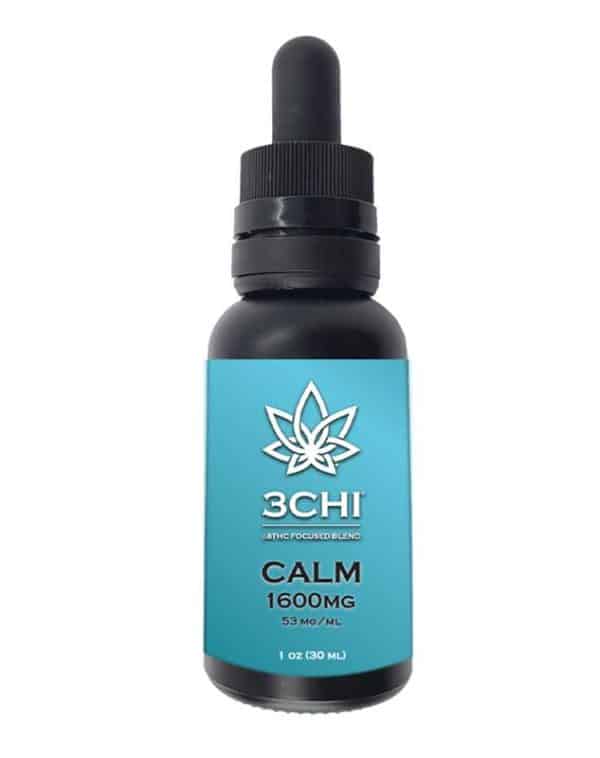
Delta 8 Focused Blends – Calm Oil Tincture
$40.00
Using a blend of 75% Δ8THC distillate, 25% of a variety of cannabinoids (CBT, CBC, CBN, CBD), this designer calm oil tincture gives a more tailored effect than any cannabis strain ever could. This 1oz bottle comes with a metered dropper for easy, accurate dosing.
Delta 8 Focused Blends – Calm Oil Tincture is a hemp-derived cannabinoid tincture currently offered by 3CHI. It is not ordinary marijuana flower or a Utah medical-cannabis product simply because it contains THC-related cannabinoids.
The manufacturer’s current product information lists a 30 mL bottle containing approximately 1,200 mg delta-8 THC, equivalent to roughly 40 mg delta-8 THC per mL, with about 1,600 mg total cannabinoids. The blend is described as 75% delta-8 THC and 25% combined CBT, CBC, CBN and CBD. It uses MCT oil as a carrier and is marketed as a medium-potency product.
| Product detail | Current information |
|---|---|
| Product | Delta 8 Focused Blends – Calm Oil Tincture |
| Brand | 3CHI |
| Bottle size | 30 mL / 1 oz |
| Delta-8 THC | ~1,200 mg |
| Delta-8 concentration | ~40 mg/mL |
| Total cannabinoids | ~1,600 mg |
| Other cannabinoids | CBT, CBC, CBN, CBD |
| Extract type | Broad-spectrum hemp oil |
| Carrier | MCT oil |
| Delta-9 THC | Manufacturer states <0.3% |
| Intoxicating? | Potentially yes |
| Current Utah shipping | Excluded by manufacturer |
The Utah point is particularly important. 3CHI currently lists Utah among the states where it does not ship this product because of state-law restrictions or uncertainty concerning delta-8 THC.
This means Utah consumers should not assume that a hemp-derived intoxicating cannabinoid product is lawful simply because its delta-9 THC concentration is below 0.3%.
For broader cannabis education, see Cannabistopgrade Cannabis Education, Cannabistopgrade Hash and Concentrates and Cannabis Concentrates and Dabbing Guide.
Delta 8 Calm Oil Quick Facts
| Topic | Educational answer |
|---|---|
| Delta 8 Calm Oil | Formulated cannabinoid tincture |
| Delta-8 THC | Psychoactive/intoxicating cannabinoid |
| Utah recreational weed | No general adult-use retail market |
| Utah medical cannabis | Legal within the state program |
| Utah med card | Required for regular patient access |
| Initial provider visit | Generally in person |
| EVS registration | Required |
| First purchase | Requires pharmacist consultation |
| Card duration | Usually one year |
| Utah home delivery | Available through authorized medical-cannabis channels |
| Buying cannabis in another state and bringing it to Utah | Utah says this is illegal |
What Is Delta-8 THC?
Delta-8 THC is a psychoactive cannabinoid related chemically to conventional delta-9 THC.
The current Calm Oil contains substantially more delta-8 THC than naturally occurs in ordinary hemp plant material because commercial delta-8 products generally use concentrated or converted cannabinoids.
3CHI itself warns that the tincture can be intoxicating and advises users not to drive or operate machinery while using it.
The product name Calm should be interpreted as commercial positioning rather than clinical proof that the tincture treats:
- anxiety;
- insomnia;
- chronic stress;
- pain;
- PTSD.
Anecdotal customer reviews cannot establish a medical indication.
Is Delta 8 Calm Oil Legal in Utah?
The most practical answer is that 3CHI currently does not ship its Calm Oil Tincture to Utah.
The manufacturer specifically lists Utah among its excluded states for this delta-8 product.
This distinction is important because Utah separately regulates medical cannabis, hemp-derived products and psychoactive cannabinoids.
Therefore:
hemp-derived does not automatically mean legal in Utah
and
less than 0.3% delta-9 THC does not automatically make every intoxicating cannabinoid product unrestricted under Utah law.
Anyone evaluating a delta-8 product should check the current Utah rules rather than relying solely on a national retailer’s marketing language.
Is Cannabis Legal in Utah?
Medical cannabis is legal in Utah under the state’s regulated medical-cannabis program. General adult-use recreational marijuana is not currently sold through a legal recreational dispensary system.
Utah’s official patient program allows qualified cardholders to purchase approved medical cannabis from licensed Utah medical-cannabis pharmacies.
Utah’s rules also make several important distinctions from recreational cannabis states.
The state says medical patients should:
- purchase medical cannabis from licensed Utah medical-cannabis pharmacies;
- not bring cannabis purchased in another state into Utah;
- not smoke medical cannabis;
- not use medical cannabis publicly except in a medical emergency;
- not share, sell or give their medical cannabis to others.
Vaporizing qualifying cannabis products is permitted within the medical program even though smoking cannabis is prohibited.
Utah Recreational Weed
The phrase Utah recreational weed is commonly searched because neighboring and western states have adopted different marijuana policies.
As of October 4, 2026, Utah’s current legal cannabis framework remains primarily a medical-cannabis system, not a general adult-use retail framework. The state’s 2026 legislative updates focused on changes to the medical program, patient access, pharmacy rules and administration rather than establishing a statewide recreational cannabis marketplace.
This means someone who does not qualify for or hold the appropriate Utah medical-cannabis authorization should not assume ordinary recreational marijuana possession or purchases are lawful.
Is Recreational Marijuana Legal in Utah?
No general adult-use cannabis retail system is currently in force in Utah.
Utah law instead provides specific protections for people participating in the state’s medical-cannabis program. Utah’s controlled-substance code contains medical-cannabis decriminalization provisions for qualifying cardholders and authorized patients who comply with the program.
That is legally different from recreational legalization.
When Will Weed Be Legal in Utah?
There is no enacted date for general recreational marijuana legalization in Utah in the official current sources reviewed as of October 4, 2026.
Utah lawmakers can change cannabis law in future legislative sessions, and future ballot or legislative proposals may emerge, but predicting when recreational marijuana will become legal would be speculation.
The factual current position is:
Medical cannabis: legal within Utah’s regulated program.
General recreational/adult-use retail cannabis: no statewide legal market currently established.
Future legalization date: none enacted in the current Utah laws reviewed.
Utah’s 2026 legislative activity included marijuana-related criminal-law and medical-cannabis proposals, but that should not be confused with establishing an adult-use sales system.
How to Get a Medical Card in Utah
The official Utah medical cannabis card application is handled through the state’s Electronic Verification System, commonly called the EVS.
Utah currently describes the process as follows.
Step 1: Create a UtahID
Applicants start by creating or signing into a UtahID account.
This is used to access Utah’s Electronic Verification System.
Step 2: Create an EVS Account
The Electronic Verification System contains patient cannabis-card information, provider certifications and purchase information.
Patients must register in the EVS to participate in Utah’s medical-cannabis program.
Step 3: Submit the Medical Cannabis Application
Complete the patient application in the EVS and submit it for medical-provider certification.
Utah’s online system guides applicants through personal information, caregiver options where applicable and patient acknowledgments.
Step 4: Meet With a Medical Provider
For an initial card application, Utah generally requires an in-person appointment with an eligible recommending medical provider.
The provider evaluates the patient’s health condition and determines whether medical cannabis is an appropriate option. If the requirements are satisfied, the provider submits the certification in the EVS.
Eligible recommending medical providers can include Utah-licensed physicians, physician assistants, APRNs and certain other authorized practitioners.
Step 5: Pay the State Card Fee
After the provider submits certification, the applicant receives instructions from the state to pay the applicable medical-cannabis card fee.
Provider consultation costs are separate and can vary.
Step 6: Download the Utah Med Card
Once approved, the patient can access the medical-cannabis card through the EVS.
Utah permits the card to be saved electronically or printed.
Patients must show the card together with valid photo identification when visiting a medical-cannabis pharmacy or receiving authorized delivery.
Step 7: Meet With a Medical Cannabis Pharmacist
Before the first purchase, the patient must consult with a medical cannabis pharmacist.
The consultation can sometimes be completed in person, by video or by phone depending on the pharmacy.
Step 8: Purchase Through a Utah Medical Cannabis Pharmacy
After the initial pharmacist consultation, a patient can purchase approved medical cannabis through Utah’s licensed medical-cannabis pharmacies and may use authorized home delivery.
Step 9: Maintain the Card
Utah currently says a standard medical-cannabis card lasts one year, although the provider can specify a shorter period where medically appropriate.
Medical Marijuana Card Utah: Who Can Qualify?
Utah recognizes a defined group of qualifying conditions.
Current state provider guidance includes conditions such as:
- cancer;
- Alzheimer’s disease;
- amyotrophic lateral sclerosis;
- autism;
- cachexia;
- Crohn’s disease;
- ulcerative colitis;
- epilepsy or debilitating seizures;
- HIV/AIDS;
- multiple sclerosis or debilitating muscle spasms;
- qualifying persistent nausea;
- persistent pain lasting longer than two weeks;
- qualifying acute pain;
- PTSD meeting statutory requirements;
- qualifying rare diseases;
- terminal illness;
- hospice care.
A patient’s diagnosis does not automatically guarantee approval. The medical provider must make the required evaluation and certification.
What if a Condition Is Not on Utah’s List?
Utah has a Compassionate Use Board.
The board can review petitions for people who do not have one of the ordinarily listed qualifying conditions but whose provider believes medical cannabis may be appropriate.
The board also reviews certain applications involving patients younger than 21.
This process requires medical-provider involvement; it is not simply a consumer self-application for recreational cannabis.
Utah Med Card and Adults Under 21
Adults are generally eligible to apply from age 18, but Utah has additional requirements for patients younger than 21.
Current state guidance says patients under 21 generally require approval through the Compassionate Use Board.
That makes Utah’s medical-cannabis system more structured than adult-use markets where anyone aged 21 or older can simply enter a recreational dispensary.
Utah Weed: What Products Can Medical Patients Buy?
Utah’s medical-cannabis pharmacies currently offer several product formats.
The state’s patient information specifically describes:
Oral products
such as tablets, gummies and tinctures.
Flower and inhaled products
including unprocessed cannabis flower and vape cartridges.
Topicals
including lotions and patches.
Other authorized medical forms
including certain suppository products.
Smoking cannabis remains prohibited within Utah’s medical program, although vaping authorized cannabis products is allowed.
How Much Medical Cannabis Can a Utah Patient Purchase?
Utah says each patient’s medical provider establishes a monthly amount in the EVS.
The state’s current maximum monthly program limit is:
113 grams of unprocessed cannabis flower
and
20 grams of THC in other cannabis products, such as tinctures, vapes or gummies.
These are legal purchase ceilings, not recommended consumption amounts.
A provider can establish a lower individual limit.
Can Utah Medical Cannabis Be Delivered?
Yes, authorized home delivery is available within Utah’s medical system.
After completing the required first pharmacist consultation, Utah patients can purchase from Utah medical-cannabis pharmacies or use an authorized home-delivery service.
That should not be confused with ordering marijuana from an out-of-state website.
Utah expressly states that buying cannabis in another state and bringing it into Utah is illegal even for a Utah medical-cannabis cardholder.
Can Visitors Get a Utah Med Card?
Utah has a separate non-Utah resident medical cannabis card process.
Eligible visitors can apply through Utah’s EVS. The current nonresident card is valid for 21 days, and Utah says a person may receive up to two nonresident cards in a calendar year.
Visitors still have to comply with Utah’s medical-cannabis purchasing and possession rules.
An out-of-state medical card does not by itself make marijuana purchased outside Utah legal to transport into Utah.
Delta 8 Calm Oil vs. Utah Medical Cannabis
These are not automatically the same legal category.
| Feature | Delta 8 Calm Oil | Utah Medical Cannabis |
|---|---|---|
| Product source | Hemp-derived cannabinoid formulation | Utah-regulated medical cannabis |
| Main cannabinoid | Delta-8 THC | Product-dependent |
| Intoxicating potential | Yes | Often yes |
| Medical card required by product seller? | Different market | Utah card generally required |
| Utah pharmacy product? | Not established as one | Yes |
| Manufacturer currently ships to Utah? | No | Not applicable |
| Utah state-regulated purchase channel | No | Licensed medical-cannabis pharmacy |
The fact that Calm Oil is marketed under federal hemp terminology does not make it equivalent to cannabis sold through Utah’s medical-cannabis program.
Utah Medical Cannabis Changes in 2026
Utah enacted several program changes during the 2026 legislative session.
Current official state guidance says responsibilities now handled by Utah’s Department of Health and Human Services are transitioning toward the Utah Department of Agriculture and Food, with the transition to be completed by January 1, 2027.
Other 2026 changes include provisions concerning low-THC medical products, patient vouchers and medical-cannabis pharmacy regulation.
These changes concern the regulated medical program and should not be mistaken for recreational marijuana legalization.
Frequently Asked Questions
1. What is Delta 8 Focused Blends – Calm Oil Tincture?
It is a 3CHI broad-spectrum hemp tincture containing approximately 1,200 mg delta-8 THC and 1,600 mg total cannabinoids in 30 mL. Other cannabinoids include CBT, CBC, CBN and CBD. It can be intoxicating.
2. How do I get a medical card in Utah?
Create a UtahID and EVS account, submit the medical-cannabis application, complete an initial in-person evaluation with an eligible medical provider, receive certification, pay the state card fee, download the approved card and consult with a medical-cannabis pharmacist before the first purchase.
3. Is cannabis legal in Utah?
Medical cannabis is legal for qualifying patients under Utah’s regulated program. Utah does not currently operate a general recreational/adult-use cannabis retail system.
4. When will recreational weed be legal in Utah?
As of October 4, 2026, the official current Utah sources reviewed do not establish a future effective date for general adult-use marijuana legalization. Future legislation could change the law, but predicting when that will happen would be speculative.
5. Can Delta 8 Calm Oil be shipped to Utah?
3CHI currently lists Utah as a shipping-excluded state for Delta 8 Focused Blends – Calm Oil Tincture.
Authoritative Outbound Resources
Utah — Apply for a Medical Cannabis Patient Card
3CHI — Delta 8 Focused Blends Calm Oil Tincture
Be the first to review “Delta 8 Focused Blends – Calm Oil Tincture”
Related products
Cannabis Tincture
Cannabis Tincture
Cannabis Tincture
Cannabis Tincture
Cannabis Tincture
Cannabis Tincture
Cannabis Tincture
Cannabis Tincture
Reviews
There are no reviews yet.