
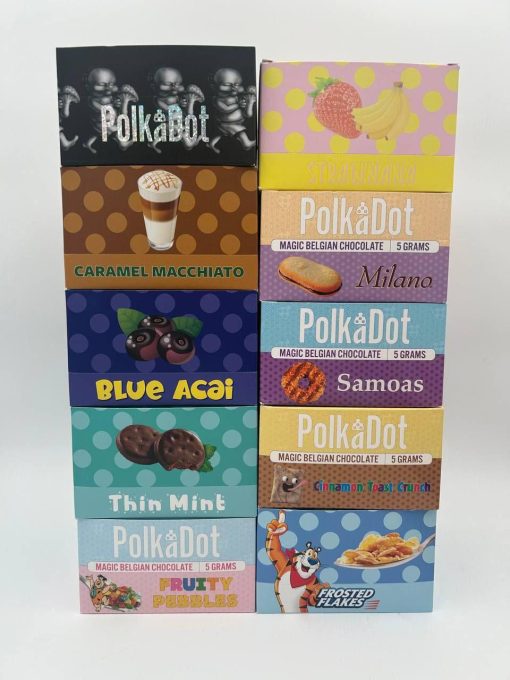
Polkadot Chocolate Bar Online: CBD Gummies for Focus, Energy, Neuropathy and Pain Explained
A polkadot chocolate bar online marketed under psychedelic, mushroom, cannabis-style, or wellness branding is not necessarily a CBD gummy, a regulated cannabis edible, or an FDA-approved therapeutic product. Packaging and brand names alone do not establish a product’s ingredients or medical value.
That distinction is especially important when consumers are looking for products to address pain, neuropathy, fatigue, or concentration.
The FDA continues to warn that, aside from one approved prescription CBD medicine for specific seizure disorders, consumer CBD products have not generally been approved to diagnose, treat, cure, or prevent medical conditions. The agency also warns that CBD may interact with medications and can carry safety risks. (fda.gov)
Readers interested in additional cannabis, cannabinoid, edible, and U.S. legal-market education can explore Cannabistopgrade.com.
What Is a Polkadot Chocolate Bar?
The phrase Polkadot Chocolate Bar is used online in connection with specialty chocolate products, including products that may use mushroom-related or psychoactive branding.
However, a brand name should not be interpreted as a verified ingredient list.
A product promoted online could contain:
- ordinary chocolate ingredients;
- mushroom extracts;
- botanical compounds;
- cannabinoids;
- other psychoactive substances;
- or ingredients not accurately declared on the package.
Because online psychoactive-product markets can include imitations and inconsistent formulations, consumers should not infer potency or composition solely from packaging.
This is especially important when searching Polkadot Chocolate Bar Online.
An attractive wrapper does not prove:
- FDA approval;
- cannabis licensing;
- laboratory testing;
- CBD concentration;
- THC concentration;
- mushroom content;
- or absence of undeclared substances.
Polkadot Chocolate Bar Online vs. CBD Gummies
Polkadot-style chocolate products and CBD gummies are fundamentally different product categories.
| Feature | Specialty Chocolate Bar | CBD Gummies |
|---|---|---|
| Product form | Chocolate | Chewable gummy |
| Possible active ingredients | Product dependent | Marketed as containing CBD |
| CBD guaranteed? | No | Only if accurately formulated/labeled |
| Medical approval | Usually none | Generally none except prescription CBD drug |
| Potency format | Product dependent | Often mg CBD per gummy |
| Testing quality | Variable | Variable |
| Medical claims | Require caution | Require caution |
| U.S. regulation | Product/jurisdiction dependent | Complex federal and state framework |
The table illustrates why one search term should not be used as a substitute for another.
What Are CBD Gummies?
CBD gummies are edible products marketed as containing cannabidiol, commonly abbreviated CBD.
CBD is one of the many naturally occurring compounds found in cannabis.
Unlike delta-9 THC, CBD is not typically associated with the classic intoxicating “high” produced by THC.
However, “non-intoxicating” does not mean risk-free.
The FDA states that CBD can:
- interact with medications;
- affect liver function;
- contribute to sedation;
- and carry other uncertainties concerning long-term use. (fda.gov)
The agency has also found that some marketed CBD products do not contain the amounts claimed on their labels.
Are CBD Gummies FDA Approved?
Generally, no.
The FDA has approved one prescription CBD drug for specific seizure disorders.
It has not approved ordinary consumer CBD gummies as treatments for:
- neuropathy;
- back pain;
- arthritis;
- general chronic pain;
- fatigue;
- concentration problems;
- or productivity.
The FDA specifically warns against unapproved therapeutic claims attached to CBD products. (fda.gov)
Therefore, phrases such as “CBD gummies for pain relief” describe consumer search intent—not an established FDA-approved indication.
CBD Gummies for Focus
The phrase CBD gummies for focus has become common in wellness marketing.
Consumers may be looking for:
- improved concentration;
- reduced distraction;
- calmer thinking;
- less stress;
- or better productivity.
However, there is not enough high-quality evidence to claim that ordinary CBD gummies reliably improve focus in healthy adults.
A consumer may subjectively report feeling calmer after using CBD, but calmness is not the same as improved:
- attention;
- working memory;
- reaction time;
- executive function;
- or task accuracy.
Any product marketed as a guaranteed focus enhancer should therefore be approached cautiously.
Can CBD Improve Focus?
Research on CBD and cognitive performance remains incomplete.
CBD has been investigated in areas involving anxiety, neurological conditions, sleep, inflammation, and pain, but evidence varies greatly by condition, formulation, and dose.
It would be inaccurate to state:
“CBD gummies improve concentration.”
A more defensible conclusion is:
CBD is being studied for several neurological and behavioral effects, but consumer gummies have not been established as reliable cognitive-performance enhancers.
This distinction helps keep wellness marketing separate from clinical evidence.
Best Gummies for Energy
The term best gummies for energy can refer to several different categories.
Some products marketed for energy may contain:
- caffeine;
- vitamins;
- herbal stimulants;
- sugars;
- cannabinoids;
- or combinations of ingredients.
CBD itself should not be automatically classified as a stimulant.
In fact, some users report relaxation or drowsiness.
The FDA warns that CBD can contribute to sedation, particularly when combined with alcohol or other substances that slow brain activity. (fda.gov)
That makes claims such as “CBD gummies are the best gummies for energy” scientifically weak.
What Makes an Energy Gummy Different?
A product designed specifically for energy may rely on ingredients very different from CBD.
For example, formulations can include conventional stimulants such as caffeine.
This means consumers should always read the ingredient panel rather than assuming the word “gummy” describes the effect.
Two gummies could look almost identical while having completely different pharmacological effects.
One may contain CBD.
Another may contain caffeine.
A third could contain THC.
A fourth might contain several botanical ingredients.
Packaging format does not tell consumers what the product will do.
CBD Gummies for Neuropathy
CBD gummies for neuropathy is a medically important search term.
Neuropathy generally refers to nerve damage or dysfunction that can produce symptoms such as:
- burning;
- tingling;
- numbness;
- shooting pain;
- altered sensation;
- or hypersensitivity.
Cannabinoids have been investigated for neuropathic pain, but consumers should distinguish studies of cannabinoid medicines from studies of ordinary over-the-counter CBD gummies.
A 2025 systematic review of 14 randomized controlled trials reported that many cannabinoid interventions were associated with reductions in neuropathic pain. However, the products studied were not simply interchangeable retail CBD gummies, and the overall evidence does not establish that any particular gummy product treats peripheral neuropathy. (pubmed.ncbi.nlm.nih.gov)
CBD Alone vs. Mixed Cannabinoids for Neuropathic Pain
This distinction matters enormously.
Studies examining cannabinoid-based pain treatments may involve:
- THC;
- CBD;
- THC/CBD combinations;
- synthetic cannabinoids;
- prescription formulations;
- oral sprays;
- inhaled cannabis;
- or other delivery systems.
Therefore, evidence supporting one cannabinoid formulation should not automatically be used to advertise another.
A recent systematic review of cannabis-based medicines for neuropathic pain found signals of benefit across several cannabinoid formulations, but the studies included multiple different cannabinoids and conditions. (pubmed.ncbi.nlm.nih.gov)
This does not mean ordinary CBD gummies are proven neuropathy treatments.
Gummies for Neuropathy
People searching gummies for neuropathy may encounter products containing CBD, THC, combinations of cannabinoids, or unrelated botanical ingredients.
The word “gummy” describes the delivery format.
It does not establish therapeutic effectiveness.
Neuropathy can also have many causes, including:
- diabetes;
- nerve injury;
- chemotherapy;
- infections;
- autoimmune disorders;
- nutritional deficiencies;
- compression injuries;
- and other neurological diseases.
Persistent numbness, burning, weakness, or unexplained nerve pain deserves medical evaluation because treating the underlying cause can be important.
A gummy should not replace diagnosis.
CBD Gummies for Pain
CBD has been widely studied in laboratory and clinical research, but the evidence for isolated CBD in human pain treatment remains less definitive than advertising often suggests.
A 2024 systematic review of CBD for pain found promising clinical and preclinical findings but also emphasized that clinical evidence remains limited and more research is required. (pubmed.ncbi.nlm.nih.gov)
This is significantly more nuanced than saying CBD gummies “work for pain.”
The formulation, dose, medical condition, and study quality matter.
Gummies for Pain: What Does the Research Say?
Research examining cannabinoids overall suggests that some cannabinoid medicines can provide modest pain reduction.
However, the effect is not necessarily large.
An updated systematic review of cannabis-based products for chronic pain reported that certain THC-containing or balanced THC/CBD formulations produced small reductions in pain severity, while low-THC-to-CBD products may not improve outcomes. (pubmed.ncbi.nlm.nih.gov)
This finding is important because many commercial gummies are marketed primarily around CBD.
Evidence from THC-containing medicines cannot simply be transferred to a CBD-only gummy.
CBD Gummies for Pain Relief
The phrase CBD gummies for pain relief can unintentionally make the product sound like an approved analgesic.
That is not how the FDA currently treats ordinary CBD gummies.
The FDA warns that unapproved CBD products marketed with therapeutic claims have not undergone the same evaluation as approved medicines for:
- effectiveness;
- proper dosage;
- drug interactions;
- side effects;
- and manufacturing quality. (fda.gov)
Therefore, manufacturers claiming that a CBD gummy “treats neuropathy” or “eliminates chronic pain” should be viewed critically.
What Are the Best Gummies for Pain Relief?
There is no scientifically established universal answer to what are the best gummies for pain relief.
The appropriate treatment depends heavily on the type and cause of pain.
Pain can be:
- neuropathic;
- inflammatory;
- musculoskeletal;
- postoperative;
- headache-related;
- arthritis-related;
- cancer-related;
- or caused by another condition.
A formulation studied for one type of pain may not work for another.
This makes generic “best pain gummy” rankings scientifically unreliable.
CBD Gummies for Pain vs. THC Gummies
CBD and THC are different cannabinoids.
| Characteristic | CBD Gummies | THC Gummies |
|---|---|---|
| Classic intoxicating effect | Usually no | Yes |
| FDA-approved consumer pain use | No | No |
| Pain research | Ongoing | Ongoing |
| Cognitive impairment | Less characteristic | Possible/significant |
| Drug interactions | Possible | Possible |
| State regulation | Complex | Highly state dependent |
| Product quality | Variable | Variable outside regulated systems |
Neither category should be portrayed as universally safe or effective.
Why Product Testing Matters
CBD product quality can vary.
The FDA has previously tested marketed cannabinoid products and found examples that did not contain the CBD amounts claimed on labels. It also warns that contaminants may be present in some products. (fda.gov)
Potential quality questions include:
- Does the product actually contain CBD?
- How much CBD is present?
- Is THC present?
- Are heavy metals tested?
- Are pesticides tested?
- Are solvents or microbial contaminants evaluated?
- Is there a batch number?
- Is the laboratory independent?
These questions matter more than brightly designed packaging.
Reading a CBD Gummy Label
A useful CBD gummy label may include:
CBD Per Gummy
This indicates the amount in an individual piece.
CBD Per Package
The package total should not be confused with the amount in one gummy.
THC Content
Some hemp-derived cannabinoid products may contain measurable THC.
Ingredients
Consumers should check sweeteners, oils, flavors, allergens, and other active ingredients.
Batch or Lot Number
This helps link a product to testing.
Laboratory Certificate
Some products provide access to a certificate of analysis.
Manufacturer Information
Traceable company information provides more accountability than anonymous packaging.
Why “Natural” Does Not Mean Risk-Free
CBD products are frequently described using terms such as:
“natural”
“plant based”
“clean”
“wellness”
or
“non-intoxicating.”
None of these terms proves safety.
CBD can interact with medicines and has been associated with liver-related risks and sedation. (fda.gov)
This is especially relevant to people already using prescription medications for:
- neuropathy;
- seizures;
- anxiety;
- sleep;
- pain;
- or other chronic conditions.
Hidden Ingredients and Pain Products
Consumers should also be cautious with online products promoted aggressively for pain relief.
In April 2026, the FDA warned consumers not to purchase or use a product marketed as “KUKA FLEX CBD” for joint pain after laboratory testing found undeclared diclofenac, a prescription-strength anti-inflammatory ingredient. (fda.gov)
This example does not mean every CBD product contains hidden drugs.
It does demonstrate why unverifiable online health products deserve caution.
Claims such as “all natural” are not laboratory results.
CBD Gummies and Medication Interactions
CBD can alter the way certain drugs are processed.
The FDA specifically warns that CBD may affect how other medications work and can potentially contribute to serious side effects. (fda.gov)
This is particularly relevant for people taking multiple medications.
Anyone considering CBD while using prescription medicines should discuss possible interactions with a qualified healthcare professional or pharmacist.
CBD Gummies and Drowsiness
Consumers sometimes search for CBD as an energy or productivity product.
Yet CBD can produce drowsiness in some circumstances.
The FDA notes that using CBD alongside alcohol or other drugs that slow brain activity can increase sedation and drowsiness. (fda.gov)
This is another reason the phrase best gummies for energy should not automatically be connected to CBD.
Individual effects can differ.
Edible Products and Child Safety
Gummies and chocolate can look like ordinary candy.
This creates a special storage issue.
The FDA has expressed concern about CBD products sold in child-appealing forms such as gummies, hard candies, and cookies because they can be mistaken for conventional food. (fda.gov)
Cannabis edibles containing THC present similar concerns.
Products should be stored:
- away from children;
- away from pets;
- separately from ordinary candy;
- securely closed;
- and preferably in their original labeled packaging.
If a Product Contains THC
A product containing meaningful THC should be treated differently from CBD-only products.
THC can produce intoxication and impairment.
The CDC notes that edible cannabis has different risks from smoked cannabis because effects can take 30 minutes to two hours to begin and may last longer than expected. (cdc.gov)
This delayed onset can increase accidental overconsumption.
Therefore, consumers should never assume that an edible chocolate or gummy has the same effects as a CBD-only product.
Polkadot Chocolate Bar Online and Product Verification
When researching a Polkadot-branded chocolate bar online, several questions are more useful than simply asking where the product is sold:
- What are the declared ingredients?
- Is the product regulated in the relevant jurisdiction?
- Is there independent laboratory testing?
- Does the laboratory result match the product batch?
- Are psychoactive ingredients clearly identified?
- Are potency claims credible?
- Is the packaging traceable?
- Are medical claims being made without evidence?
These questions reduce the risk of confusing branding with quality.
U.S. Cannabis and CBD Laws
Cannabis and cannabinoid regulation remains complicated in the United States.
The NCSL State Cannabis Policy Enactment Database was updated August 31, 2026 and tracks state measures involving:
- hemp and CBD;
- medical cannabis;
- nonmedical adult use;
- THC products;
- edibles;
- concentrates;
- packaging;
- labeling;
- testing;
- and cannabis-business licensing. (ncsl.org)
State law can therefore affect how particular cannabinoid products are manufactured, labeled, sold, or restricted.
Consumers should not assume that online availability equals nationwide legality.
Hemp-Derived Does Not Mean FDA Approved
A common misconception is that a product being described as “hemp-derived” means the FDA has approved it.
That is incorrect.
The FDA explains that CBD products remain subject to federal food and drug laws even after changes to hemp’s status under the 2018 Farm Bill. (fda.gov)
A product may therefore be hemp-derived without being:
- FDA-approved;
- clinically proven;
- accurately labeled;
- or appropriate for treating a disease.
Educational Resources
For additional U.S.-focused cannabis, cannabinoid, edible, and product-safety education, explore Cannabistopgrade.com.
For official information about CBD safety, drug interactions, product quality, and unapproved medical claims, consult the FDA CBD consumer guidance. The FDA emphasizes that most consumer CBD products have not been approved to treat medical conditions. (fda.gov)
Regarding scientific research on cannabinoids and peripheral neuropathic pain, see the 2025 PubMed systematic review on cannabinoids and peripheral neuropathy. It found evidence of modest benefit in several cannabinoid trials while evaluating products and formulations broader than ordinary CBD gummies. (pubmed.ncbi.nlm.nih.gov)
Concerning current U.S. cannabis policy, consult the NCSL State Cannabis Policy Enactment Database, updated August 31, 2026. (ncsl.org)
Readers can continue exploring cannabinoid terminology and product education through Cannabistopgrade.com.
Frequently Asked Questions
1. Are CBD gummies good for focus?
CBD gummies have not been established as reliable cognitive-performance or focus enhancers. Some consumers report relaxation, but that should not be equated with scientifically proven improvements in attention or productivity.
2. What are the best gummies for energy?
There is no universal best energy gummy. Products marketed for energy can contain very different ingredients, including caffeine, vitamins, botanicals, or cannabinoids. CBD itself should not automatically be considered stimulating and can contribute to drowsiness in some circumstances.
3. Do CBD gummies help neuropathy?
Cannabinoids are being studied for neuropathic pain, and systematic reviews have reported modest benefits with some cannabinoid medicines. However, the evidence involves multiple formulations, and ordinary retail CBD gummies have not been established as universally effective treatments for neuropathy. (pubmed.ncbi.nlm.nih.gov)
4. Are gummies effective for pain?
Some cannabinoid-based medicines have produced small reductions in pain in clinical research, but results differ by cannabinoid, formulation, and pain condition. A generic gummy should not automatically be considered an effective pain treatment. (pubmed.ncbi.nlm.nih.gov)
5. What are the best CBD gummies for pain relief?
There is no scientifically established universal “best” CBD gummy for pain relief. The FDA has not approved ordinary consumer CBD gummies as pain medicines, and product quality and cannabinoid content vary. (fda.gov)
6. Is Polkadot Chocolate Bar Online the same as CBD gummies?
No. A Polkadot-branded chocolate product and a CBD gummy are different product categories. Consumers should verify ingredients, cannabinoid content, laboratory testing, and regulatory status rather than assuming the products contain the same substances.
| Quantity | 10 bars, 20 bars, 50 bars |
|---|
Be the first to review “Polkadot Chocolate Bar Online”
Related products
Edibles and Gummies
Bulk Mushrooms
Edibles and Gummies
Edibles and Gummies
Cannabis Tincture
Hybrid cannabis strains
Cannabis Tincture
Edibles and Gummies
Reviews
There are no reviews yet.