
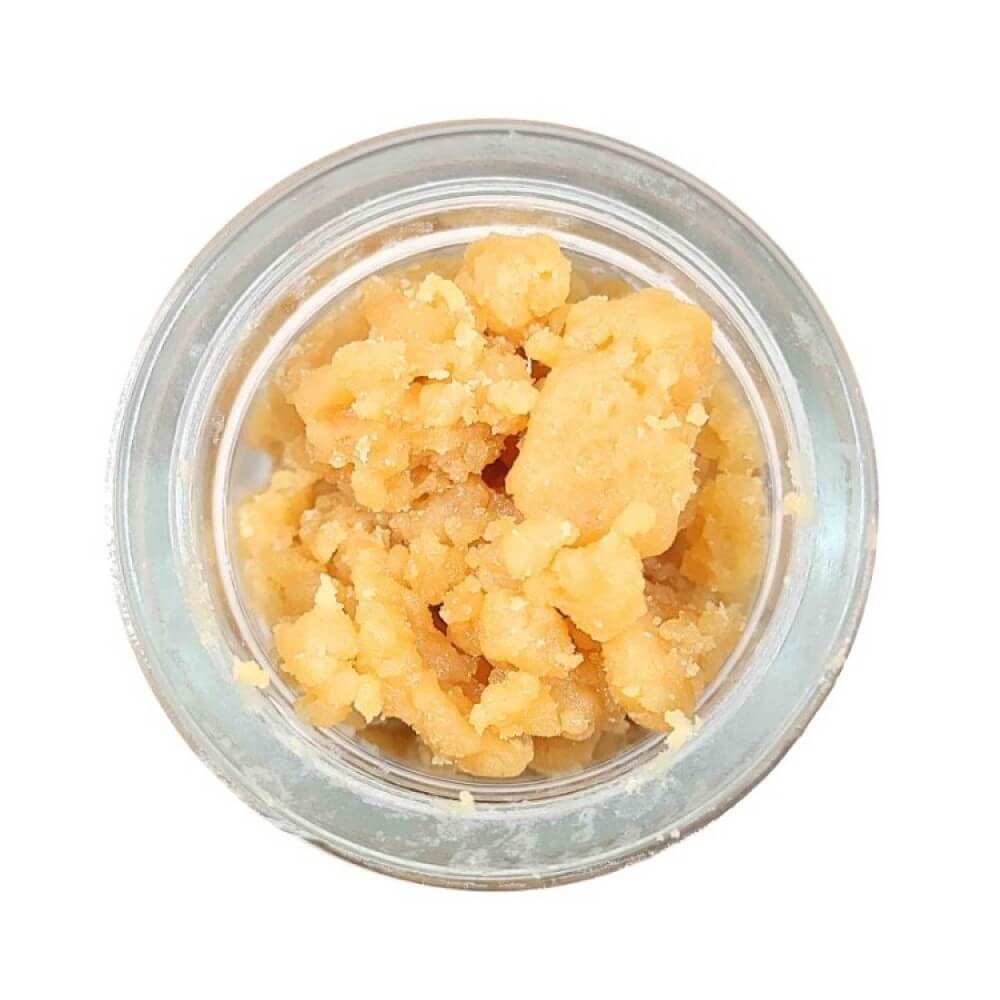
White Rhino Budder is a cannabis concentrate associated with the classic White Rhino cultivar.
Leafly currently identifies White Rhino as an indica produced from White Widow × North American Indica genetics. Its reference flower profile lists approximately 21% THC and 1% CBG, while myrcene is identified as its dominant terpene, followed by pinene and terpinolene. Sleepy, relaxed and tingly are among its most commonly reported consumer effects.
White Rhino’s broader genetic background is associated with cannabis lines originating in Afghanistan, Brazil and India. Its name and reputation are also closely connected to dense resin production.
However, these flower percentages should not be copied onto a White Rhino Budder product.
Budder is a concentrated extract. Its THC concentration can differ substantially from ordinary White Rhino flower, and CDC specifically identifies budder, wax, shatter and live resin among concentrate formats capable of delivering very high concentrations of THC.
For any particular White Rhino Budder product, check:
- total THC and THCA;
- CBD and other cannabinoids;
- terpene results;
- batch number;
- Certificate of Analysis;
- contaminant testing;
- producer information.
For more concentrate education, see the Cannabistopgrade Cannabis Concentrates and Dabbing Guide, explore Cannabistopgrade Hash and Concentrates, or visit Cannabistopgrade.com for broader cannabis education.
White Rhino Budder Quick Facts
| Topic | Educational overview |
|---|---|
| Product | White Rhino Budder |
| White Rhino genetics | White Widow × North American Indica |
| Classification | Indica |
| Reference flower THC | About 21% |
| Exact budder THC | Batch-specific |
| Dominant terpene | Myrcene |
| Common consumer reports | Sleepy, relaxed, tingly |
| Fatal cannabis-only overdose | CDC says unlikely |
| THC | Psychoactive cannabinoid |
| THC a classic hallucinogen? | No; cannabis is categorized separately |
| High-potency concentrates | Can increase intoxication and overconsumption risk |
| “Strongest strain” | Changes by batch and testing methodology |
Can Smoking Weed Kill You?
The direct answer to “can smoking weed kill you?” requires an important distinction.
CDC states that a fatal overdose caused solely by cannabis is unlikely. However, that does not mean cannabis cannot contribute to serious or potentially fatal situations.
Using too much cannabis can cause severe reactions such as:
- extreme confusion;
- panic;
- paranoia;
- rapid heart rate;
- high blood pressure;
- delusions;
- hallucinations;
- severe nausea or vomiting.
Cannabis impairment can also contribute indirectly to injuries such as:
- motor-vehicle crashes;
- falls;
- accidental poisonings;
- other impaired judgment situations.
Combining cannabis with alcohol or other drugs can create greater impairment than using cannabis alone.
So the accurate answer is:
A fatal overdose from cannabis alone is considered unlikely, but cannabis can still cause serious adverse reactions and contribute to dangerous or fatal accidents.
Is THC a Hallucinogen?
THC is a psychoactive cannabinoid rather than a classic hallucinogen such as LSD or psilocybin.
DEA currently categorizes marijuana under Cannabis, while LSD, peyote/mescaline and psilocybin are listed separately under the Hallucinogen category. DEA describes marijuana as a mind-altering psychoactive drug whose primary psychoactive compound is delta-9 THC.
That does not mean THC can never cause hallucinations.
At high exposure, cannabis can cause:
- perceptual distortion;
- paranoia;
- delusions;
- hallucinations.
CDC specifically lists delusions and hallucinations among symptoms that can occur when someone consumes too much cannabis.
Therefore:
THC can produce hallucinatory effects at high exposure, but cannabis is generally categorized separately from classic psychedelic hallucinogens.
Side Effects of Getting High
The side effects of getting high depend heavily on THC concentration and the individual.
Possible cannabis effects include:
- altered perception;
- impaired short-term memory;
- slower reaction time;
- impaired attention;
- coordination problems;
- anxiety;
- paranoia;
- increased heart rate;
- changes in appetite;
- drowsiness.
CDC explains that THC affects memory, attention, decision-making and risk-taking.
High-THC products can produce stronger effects.
CDC says that the greater the THC concentration, the stronger the effects cannabis can have on the brain, and high-THC products can increase the risk of overconsumption.
This is especially relevant to White Rhino Budder because budder is a concentrate rather than ordinary flower.
What Happens if Someone Gets Too High?
Signs of excessive cannabis exposure can include:
Extreme anxiety
Panic
Confusion
Paranoia
Fast heartbeat
Hallucinations
Vomiting
Delusions.
If someone develops severe symptoms, loses consciousness, has difficulty breathing, experiences chest pain, or is otherwise in immediate danger, emergency medical assistance is appropriate.
How to Use Weed Safely: What Health Agencies Emphasize
There is no completely risk-free method of cannabis use.
CDC states that THC-containing cannabis products can carry health risks regardless of how they are used. Scientists also do not currently have enough evidence to say that one method of cannabis consumption is universally safer than all others.
For that reason, this section does not provide step-by-step instructions for consuming cannabis.
Instead, key risk-reduction considerations include:
- follow applicable local and state laws;
- keep cannabis away from children and pets;
- do not drive or operate machinery while impaired;
- avoid combining cannabis with alcohol or other intoxicants;
- be especially cautious with highly concentrated THC products;
- use only regulated and properly tested products where legal;
- discuss cannabis use with a healthcare professional when taking medications or managing health conditions.
CDC notes that concentrates used in vaping or dabbing can contain highly concentrated THC and may also contain additives or contaminants.
White Rhino and THC Potency
Leafly’s current White Rhino reference profile lists approximately 21% THC, describing it as higher-THC than average flower.
However:
21% is not a universal White Rhino potency.
THC varies according to:
- plant phenotype;
- grow conditions;
- harvest timing;
- processing;
- producer;
- laboratory method;
- individual batch.
White Rhino Budder can also contain much more concentrated THC than White Rhino flower.
The only reliable potency figure for a specific product is its batch-specific laboratory result.
Strains With Highest THC
The keyword strains with highest THC is popular, but there is no permanent scientific leaderboard.
THC varies considerably between batches carrying the same strain name.
Leafly’s updated 2026 strongest-strains overview currently highlights high-potency cultivars including:
- Permanent Marker;
- GMO Cookies;
- Motorbreath;
- Runtz;
- Hash Burger;
- Kush Mints;
- Cereal Milk;
- Ice Cream Cake;
- MAC;
- Bruce Banner;
- Fatso;
- Original Glue.
This should be interpreted as a list of commonly recognized high-potency cultivars—not a universal ranking proving one strain is always strongest.
For example, Leafly notes that Motorbreath averages above 26% THC on its platform, while Hash Burger batches can test from the high-20% range into the low-30% range.
But one Motorbreath batch could test lower than another cultivar grown by a different producer.
Strongest Weed Strains
There is no single permanent strongest weed strain.
Potency depends on the particular batch.
Leafly’s 2026 guide groups several cultivars among notable high-THC strains, including:
Permanent Marker
GMO Cookies
Motorbreath
Hash Burger
Kush Mints
Bruce Banner
Original Glue
and others.
The same guide also identifies examples across different categories, including Zkittlez and Grease Monkey among strong indica hybrids, Super Lemon Haze and Durban Poison among notable sativa strains, and Cap Junky, Wedding Cake and Dosidos among strong hybrids.
However, strain names alone cannot guarantee potency.
A laboratory-tested 31% batch of one cultivar could be stronger than a 24% batch of a strain with a more famous high-THC reputation.
Highest Testing Cannabis: Can You Trust the THC Number?
The phrase highest testing usually refers to cannabis products reporting exceptionally high THC percentages.
Those numbers require context.
California’s Department of Cannabis Control requires regulated cannabis laboratories to test products for:
- cannabinoids;
- terpenes;
- pesticides;
- heavy metals;
- residual solvents;
- microbial impurities;
- mycotoxins;
- other contaminants.
A Certificate of Analysis records the batch results.
California also requires standardized cannabinoid testing for dried flower and non-infused pre-rolls in an effort to improve consistency across laboratories.
Can THC Labels Be Higher Than the Actual Product?
Yes, discrepancies have been documented.
A 2025 study analyzing 277 commercial cannabis products purchased from Colorado dispensaries found that observed THC was significantly lower than labeled THC overall. Approximately 96% of concentrates were within ±15% of the labeled value, compared with about 57% of flower products.
Earlier peer-reviewed research also found substantial discrepancies between reported flower THC and independent laboratory testing.
California regulators have likewise identified “lab shopping”—seeking favorable testing results such as higher THC percentages—as a public-health and regulatory concern.
Therefore, a product advertising an extraordinary THC percentage should not automatically be assumed to be the strongest cannabis available.
Does Higher THC Mean Better Weed?
No.
THC is one important characteristic, but higher THC does not automatically mean:
- better quality;
- better aroma;
- better terpene expression;
- better genetics;
- better consumer experience;
- safer cannabis.
A well-produced lower-THC cultivar can have excellent cannabinoid consistency, terpene expression and overall product quality.
The obsession with THC percentages can also encourage misleading marketing.
Batch testing should be viewed as product information, not as a universal quality score.
High-THC Modern Strains Vs. White Rhino
| Feature | White Rhino | Modern high-THC cultivars |
|---|---|---|
| General classification | Indica | Varies |
| Reference THC | About 21% on Leafly | Often 20%+; batch-specific |
| Genetics | White Widow × North American Indica | Varies |
| Dominant terpene | Myrcene | Strain-specific |
| Potency fixed? | No | No |
| Lab testing necessary? | Yes | Yes |
| Strongest automatically? | No | No |
White Rhino remains a relatively potent classic strain, but the modern market contains many cultivars and individual batches testing at higher THC concentrations.
White Rhino Flower vs. Budder
| Feature | White Rhino Flower | White Rhino Budder |
|---|---|---|
| Product format | Dried cannabis flower | Cannabis concentrate |
| Genetics | White Rhino | Usually derived from White Rhino |
| Reference THC | About 21% | Must be tested separately |
| Potency | Batch-specific | Usually more concentrated |
| Terpenes | Myrcene-led reference profile | Extraction/batch dependent |
| Consumer reports | Sleepy, relaxed, tingly | Cannot be assumed identical |
| High-THC risk | Variable | Potentially greater |
| Lab testing important? | Yes | Yes |
This is why the flower’s 21% reference figure should never be inserted as the THC percentage of White Rhino Budder without a product-specific COA.
White Rhino Effects
Leafly currently lists the most frequently reported White Rhino effects as:
Sleepy
Relaxed
Tingly.
The current terpene profile lists:
Myrcene
Pinene
Terpinolene.
Commonly reported negative experiences include dry mouth, headache and dry eyes.
These are consumer reports.
They do not establish that White Rhino Budder treats insomnia, chronic pain, anxiety or another medical condition.
Why Concentrates Require Separate Potency Information
CDC specifically identifies budder as a cannabis concentrate format.
Concentrates can deliver high levels of THC and may therefore produce stronger intoxication than some flower products.
This creates a critical SEO distinction:
White Rhino flower ≠ White Rhino Budder.
The strain name may connect the products genetically or commercially, but the concentration, chemistry and individual effects can differ significantly.
Frequently Asked Questions
1. What is White Rhino Budder?
White Rhino Budder is a cannabis concentrate associated with White Rhino genetics. Leafly identifies White Rhino as White Widow × North American Indica, with approximately 21% THC in its current reference flower profile. The actual budder potency must be determined from its own batch test.
2. Can smoking weed kill you?
CDC says a fatal overdose caused solely by cannabis is unlikely. However, excessive cannabis use can cause severe reactions and impairment can contribute to dangerous injuries, crashes or other emergencies.
3. Is THC a hallucinogen?
THC is primarily classified as a psychoactive cannabinoid. DEA categorizes marijuana separately under Cannabis rather than alongside classic hallucinogens such as LSD and psilocybin, although high THC exposure can cause hallucinations or delusions in some people.
4. Which weed strains have the highest THC?
There is no permanent highest-THC strain because potency varies by batch. Current 2026 high-potency strain discussions include Permanent Marker, GMO, Motorbreath, Hash Burger, Kush Mints, Bruce Banner and Original Glue, among others.
5. Can the highest-testing THC labels be inaccurate?
Yes. Independent research has documented discrepancies between cannabis labels and independently measured THC levels, particularly in flower. A 2025 study found concentrates were more consistently labeled than flower in its sample, but observed THC was still significantly lower than labels overall.
Authoritative Outbound Links
CDC – Cannabis Frequently Asked Questions
CDC – Cannabis Use Disorder and High-THC Products
DEA – Marijuana/Cannabis Drug Information
California Department of Cannabis Control – Cannabis Testing Laboratories
| Quantity | 1/8 oz(3.5g), 1/4 oz (7g), 1/2 oz (14g), 1 oz (28g) |
|---|
Be the first to review “White Rhino Budder for Sale Online”
Related products
Buy THC Extracts Online
Buy THC Extracts Online
Buy THC Extracts Online
Buy THC Extracts Online
Buy Budder Online
Buy THC Extracts Online
Buy THC Extracts Online
Buy THC Extracts Online
Reviews
There are no reviews yet.