
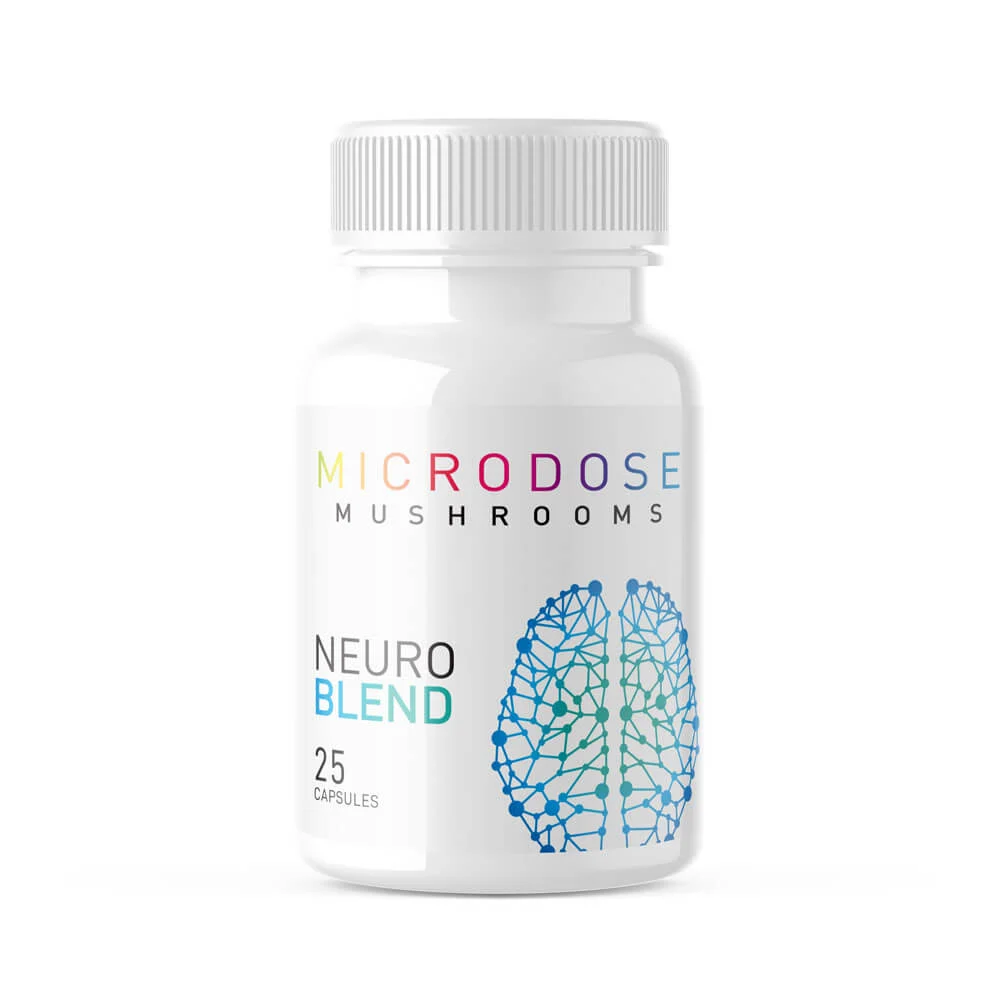
Neuro Blend Microdose
Neuro Blend Microdose is a product-style phrase that should not automatically be interpreted as a standardized psilocybin medicine. I could not verify one authoritative pharmaceutical or consistently formulated commercial product carrying this exact name, so its ingredients, mushroom species, active-compound concentration, and actual meaning of “microdose” should not be assumed from the branding alone.
That distinction becomes especially important for searches involving psilocybin microdose capsules, microdosing mushroom capsules, microdose mushroom pills, and psilocybin for pain.
A capsule containing dried mushroom powder is chemically different from a capsule containing a measured quantity of purified pharmaceutical psilocybin. Likewise, the total milligrams printed on a whole-mushroom supplement label do not necessarily indicate the number of milligrams of psilocybin present.
The scientific picture is becoming clearer in several areas. Psilocybin is a serotonergic psychedelic rather than a conventional stimulant. After ingestion, it is rapidly converted to the active compound psilocin, which acts strongly through serotonin 5-HT2A receptors. Current pharmacokinetic research places psilocin’s terminal half-life broadly around 1.2–4.7 hours, depending on the study and conditions.
At the same time, research into psilocybin for chronic pain is still preliminary. A 2025 systematic review identified potentially encouraging results but judged most of the available evidence to be low or very low quality.
For additional educational material on mushrooms and psychoactive-substance research, explore CannabisTopGrade educational resources.
What Is Neuro Blend Microdose?
The phrase Neuro Blend Microdose sounds like a commercial mushroom or wellness product, but a brand-style name cannot establish its pharmacology.
Before drawing conclusions, the relevant questions would include whether a product contains psilocybin at all, which mushroom species or extract it contains, whether the printed milligram amount refers to total material or active ingredient, whether there is batch-specific laboratory testing, and whether other compounds are present.
This matters because many products marketed with words such as “neuro,” “focus,” “blend,” or “microdose” contain nonpsychedelic functional mushrooms.
Others may use mushroom terminology while containing different psychoactive ingredients.
A product name alone therefore should never be treated as a laboratory analysis.
Psilocybin for Pain
Research into psilocybin for pain has expanded because chronic pain involves more than tissue damage alone.
Pain can involve interactions among:
Peripheral nerves.
Spinal pathways.
Brain networks.
Mood.
Fear.
Stress.
Attention.
Memory.
Inflammatory processes.
A 2025 systematic review examined psilocybin research across chronic-pain conditions and identified 28 relevant studies. The authors concluded that psilocybin shows potential, but 76.2% of the included studies were rated low or very low quality, and better standardized trials are needed.
This means psilocybin is an interesting experimental treatment candidate—not an established general pain medicine.
Chronic Pain Conditions Being Studied
Research discussions have included conditions such as:
Neuropathic pain.
Cluster headache.
Migraine.
Fibromyalgia.
Phantom-limb pain.
Musculoskeletal pain.
Chronic low-back pain.
The proposed mechanisms are complex.
Researchers are examining whether psychedelic effects could influence pain perception, emotional reactions to pain, neuroplasticity, serotonin signaling and inflammatory mechanisms.
But evidence from one type of chronic pain should not automatically be generalized to another.
Migraine, diabetic neuropathy and low-back pain can involve very different biological mechanisms.
Microdosing Mushrooms for Pain
For microdosing mushrooms for pain, the evidence is considerably weaker than popular discussion often suggests.
Some observational reports describe people experimenting with small psychedelic doses for chronic pain.
However, research into microdosing is complicated by:
Placebo effects.
Expectation.
Variable mushroom potency.
Different dosing schedules.
Different pain conditions.
Small study populations.
Self-reported outcomes.
A 2026 systematic review of psilocybin mushroom and truffle microdosing found that some participants reported improvements in pain and physical health, but the studies were highly heterogeneous and did not establish a reliable causal effect.
Therefore, microdosing mushrooms should not currently be advertised as a proven treatment for chronic pain.
Psilocybin and Neuropathic Pain
Neuropathic pain is pain caused by injury or dysfunction in the nervous system.
A recent systematic review specifically assessing psilocybin and chronic neuropathic pain concluded that available findings are encouraging but that the quality of evidence remains generally low.
This is important because neuropathic pain is often difficult to treat.
However, “promising research” does not mean that self-administered mushroom capsules have been demonstrated to relieve neuropathy.
Clinical research and commercial microdose products are different categories.
Psilocybin Half Life
For psilocybin half life, the terminology requires clarification.
Psilocybin itself functions primarily as a prodrug.
After oral administration, the body rapidly converts it into psilocin, which is the principal pharmacologically active compound.
A 2025 systematic review of human pharmacokinetic research found a terminal psilocin half-life ranging approximately from 1.23 to 4.72 hours.
Another pharmacokinetic review reported human oral psilocin half-lives generally around 2–4.8 hours.
Therefore, when people ask for the “psilocybin half-life,” most clinically meaningful measurements actually concern circulating psilocin.
What Does Half-Life Mean?
A drug’s half-life is the time required for its concentration in the body to decline by approximately half during the relevant elimination phase.
It does not mean:
The psychedelic experience ends exactly after one half-life.
The substance is completely gone after two half-lives.
Everybody metabolizes the drug identically.
A half-life describes pharmacokinetics rather than a guaranteed experience duration.
Psilocin’s subjective effects can continue for several hours even as blood concentrations rise and decline.
Metabolism of Psilocybin
The metabolism of psilocybin begins rapidly after oral administration.
Psilocybin undergoes dephosphorylation to produce psilocin.
Research indicates this conversion can involve alkaline phosphatases and nonspecific esterases in the intestine, kidneys and possibly circulation.
Psilocin can then undergo several metabolic pathways.
One important pathway is glucuronidation, producing conjugated psilocin that can be excreted.
Another converts psilocin into 4-hydroxyindole-3-acetic acid, or 4-HIAA.
A 2025 pharmacokinetic review concluded that psilocin is transformed mainly into 4-HIAA and, to a lesser extent, conjugated psilocin.
Psilocybin Absorption and Peak Levels
After oral administration, psilocin appears in blood relatively quickly.
Research indicates that psilocin plasma concentrations typically peak within roughly the first couple of hours.
A detailed metabolism study notes that concentrations often peak around two hours after oral psilocybin and that subjective effects can last approximately six hours in standard-dose studies.
Low-dose pharmacology may follow a different subjective pattern because the psychedelic effects can be much subtler.
How Does the Body Eliminate Psilocin?
The kidneys play an important role in excretion, although only a small proportion of an administered psilocybin dose leaves the body as unchanged free psilocin.
The 2025 clinical pharmacokinetics review found only about 1.5–3.4% of a dose was excreted as psilocin in urine. Much of the drug is metabolically transformed first.
This is a normal pharmacological process.
A drug disappearing from blood does not mean it simply leaves the body unchanged.
Is Psilocybin a Stimulant?
For is psilocybin a stimulant, the standard pharmacological answer is no.
Psilocybin is generally classified as a classic serotonergic psychedelic or hallucinogen.
Stimulants such as amphetamine or cocaine primarily produce their characteristic effects through catecholamine systems involving dopamine and norepinephrine.
Psilocybin works differently.
Its active metabolite psilocin interacts strongly with serotonin receptors, particularly the 5-HT2A receptor.
That does not mean psilocybin cannot produce temporary changes in:
Heart rate.
Blood pressure.
Alertness.
Energy.
A person might subjectively feel stimulated, but that does not make psilocybin pharmacologically equivalent to a conventional stimulant.
Psilocybin Mechanism of Action
The psilocybin mechanism of action begins with conversion to psilocin.
Psilocin is structurally related to serotonin and acts at several serotonin-receptor subtypes, with the 5-HT2A receptor playing a central role in classic psychedelic effects.
5-HT2A receptors are especially important in cortical brain regions involved in:
Perception.
Cognition.
Attention.
Emotion.
Self-processing.
Higher-order association.
Activation of these receptors changes neuronal activity and communication across brain networks.
This contributes to the characteristic changes in perception, thought and consciousness associated with psychedelics.
Psilocybin MOA
For the shorthand psilocybin MOA, MOA simply means mechanism of action.
A simplified pathway is:
Psilocybin enters the body → psilocybin is converted to psilocin → psilocin activates serotonin receptors, especially 5-HT2A → cortical signaling and network dynamics change → altered perception, cognition and emotion can occur.
Scientists are also investigating downstream effects involving:
Glutamate signaling.
Gene expression.
Synaptic plasticity.
Dendritic changes.
Brain-network connectivity.
A 2025 Nature study further strengthened evidence that 5-HT2A receptor signaling and particular cortical pyramidal-cell populations are important to psilocybin’s longer-lasting biological effects.
However, the relationship between acute psychedelic effects and lasting therapeutic changes remains an active research question.
Does Psilocybin Increase Neuroplasticity?
Preclinical studies provide evidence that classic psychedelics can influence structural and functional neuroplasticity.
Researchers have investigated effects involving:
Dendritic growth.
Synapse formation.
Neural flexibility.
Gene-expression changes.
Cortical circuit remodeling.
Modern reviews consider neuroplasticity a plausible contributor to psychedelic treatment effects, although scientists still debate the exact pathways involved.
This should not be simplified into marketing claims such as “microdosing rewires your brain.”
A plausible biological mechanism is not the same as a clinically proven benefit.
Psilocybin Microdose Capsules
Psilocybin microdose capsules can mean different things depending on context.
A research capsule may contain an accurately measured amount of pharmaceutical psilocybin.
A commercial capsule might contain:
Ground mushroom material.
An extract.
A proprietary mushroom mixture.
Functional mushrooms.
Another psychoactive ingredient.
An inaccurately labeled substance.
These forms should not be treated as equivalent.
A 2026 preprint investigating very low measured psilocybin doses found dose-dependent physiological and subjective effects, with some effects becoming distinguishable from placebo at low milligram doses. However, that was a controlled pharmaceutical study, not evidence that commercial mushroom capsules provide the same exposure.
Microdosing Mushroom Capsules
For microdosing mushroom capsules, whole mushroom material creates an additional problem: chemical variability.
Two capsules containing the same total weight of dried mushroom powder do not necessarily contain exactly the same amount of psilocybin unless the material has been adequately homogenized and chemically standardized.
Variation can result from:
Species.
Cultivar.
Individual fruiting bodies.
Caps versus stems.
Growing conditions.
Storage.
Age.
Processing.
That makes total capsule weight a poor substitute for analytical measurement of active compounds.
Microdose Capsules
The phrase microdose capsules therefore tells consumers very little by itself.
Questions that matter more include what active ingredient is present, whether the milligram figure describes the active drug or total mushroom material, whether batch-specific testing exists, whether contaminants were tested, and whether the preparation is part of legitimate clinical research.
Words such as “microdose” and “clinical strength” are marketing language unless supported by objective formulation data.
Microdose Mushroom Pills
The term microdose mushroom pills has the same limitation.
A pill containing lion’s mane is pharmacologically different from one containing Psilocybe material.
A capsule containing mushroom powder is different from purified psilocybin.
A commercial mushroom tablet containing Amanita muscaria constituents is different again.
Consumers should not interpret the word mushroom as a chemical identity.
What Does Microdosing Feel Like?
For what does microdosing feel like, there is no universal experience.
By definition, microdosing is generally intended to produce effects well below a conventional psychedelic experience.
People report a range of experiences, including subtle changes in mood, energy, perception, attention, emotional sensitivity or sociability.
Others report no noticeable change.
Controlled research also shows that microdosing can produce detectable subjective effects without necessarily improving mood or cognition.
Two double-blind placebo-controlled trials published in 2026 found no enhancement of attention, mood, cognitive control or self-reported well-being from psilocybin microdosing.
Another placebo-controlled mushroom study found that active microdoses produced stronger acute subjective effects, but claimed benefits in creativity and cognition were not convincingly demonstrated.
Can You Feel a Microdose?
Sometimes.
“Microdose” is often described online as something a person should not feel at all, but scientific research shows this definition is not absolute.
Low psychedelic doses can create subtle subjective or physiological changes without producing obvious hallucinations.
A 2026 dose-ranging preprint found measurable pupil dilation and dose-related subjective effects even at relatively low psilocybin exposures, while overt altered-state effects remained limited.
That illustrates why “subtle” may be more scientifically accurate than “completely imperceptible.”
Microdosing and Expectancy
One challenge in microdosing research is that people often have strong expectations.
Someone taking a capsule labeled “focus” may expect:
Greater concentration.
More motivation.
Creativity.
Calmness.
Productivity.
That expectation can influence subjective reports.
This is why double-blind placebo-controlled trials are essential.
The fact that some newer controlled studies have failed to reproduce popular mood and productivity claims suggests expectancy may explain part—but not necessarily all—of the microdosing experience.
Microdosing XP
The term microdosing XP is somewhat ambiguous.
“XP” can be used informally to mean “experience,” but Microdosing XP is also used as a commercial name for psilocybin-truffle microdosing products in the Netherlands.
Its website markets microdosing truffles and publishes wellness-oriented content about intention, creativity and mood. Those claims should be distinguished from independent placebo-controlled evidence.
For a U.S. educational article, Microdosing XP should therefore be described as a commercial term rather than a recognized medical category.
Psilocybin Los Angeles
For psilocybin Los Angeles, the current legal position requires particular care.
As of September 2026, California has not enacted statewide recreational psilocybin legalization or a general commercial psilocybin retail system.
California’s earlier SB 58 would have decriminalized personal possession and use of several natural psychedelics, including psilocybin, but Governor Gavin Newsom vetoed the bill in October 2023. California’s official legislative summary records its status as vetoed.
More recent 2025–2026 California legislation has continued exploring psychedelic research and therapeutic frameworks, but existing state law still treats psilocybin as a Schedule I controlled substance. A June 2026 version of SB 1224 explicitly describes current law as prohibiting possession, sale, transport, manufacture and cultivation of psilocybin outside authorized contexts.
Los Angeles therefore should not be described as having an ordinary legal recreational psilocybin marketplace.
For more state-law educational material, explore CannabisTopGrade U.S. substance-law guides.
Mushroom Delivery Los Angeles
For mushroom delivery Los Angeles, the answer depends on what type of mushrooms are being discussed.
Delivery of ordinary culinary mushrooms such as oyster, shiitake, button, lion’s mane or portobello is an ordinary food transaction.
Psilocybin mushrooms are different.
California’s Legislative Analyst’s Office has described cultivation, possession, distribution, transportation and sale of psilocybin outside approved research settings as generally illegal under state law.
Historical reporting has documented Los Angeles-area storefronts openly selling psychedelic mushrooms despite that prohibition. That retail availability did not make those transactions legal; law enforcement also conducted actions against unlicensed sellers.
Therefore, an online advertisement claiming “mushroom delivery Los Angeles” should not itself be interpreted as evidence of a licensed psilocybin market.
This article does not provide vendors or delivery instructions for controlled psilocybin products.
Are Magic Mushrooms Decriminalized in Los Angeles?
Los Angeles should not be confused with California cities that have adopted local low-enforcement or decriminalization measures.
The broader statewide decriminalization legislation that reached the governor in 2023 was vetoed.
As of September 2026, California has continued debating therapeutic and research reforms rather than establishing a statewide recreational system.
The legal landscape can change, so current official California legislative materials are more reliable than old social-media posts or dispensary advertisements.
Psilocybin Research in California
California nevertheless plays an important role in psychedelic research.
Universities and research institutions in the state are involved in studies examining psilocybin and other psychedelic compounds.
California has also updated parts of its research framework for Schedule I and II drugs while lawmakers continue debating therapeutic-access models.
That creates a critical distinction:
Research activity does not equal recreational legalization.
A compound can simultaneously be under serious scientific investigation and remain controlled outside approved research settings.
Psilocybin Is Not the Same as Mushroom Weight
This distinction connects several keywords in this article.
A psilocybin microdose capsule used in research can contain a precisely measured quantity of the drug.
A commercial mushroom capsule might instead list:
100 mg mushroom powder.
200 mg mushroom powder.
400 mg mushroom powder.
Those values describe the mass of the material—not necessarily the mass of psilocybin.
The amount of active compound could be only a fraction of the total material and may vary from batch to batch.
This is why “400 mg mushroom capsule” and “400 mg psilocybin” are completely different claims.
Psilocybin Drug Interactions
Psilocybin metabolism also creates potential questions about drug interactions.
A pharmacokinetic review reports involvement of metabolic enzymes including CYP2D6 and CYP3A4, along with monoamine oxidase A and glucuronidation pathways.
The clinical significance of every possible interaction is not fully established.
People taking psychiatric or other medications should not assume that a microdose is too small to interact with medication simply because it is called a microdose.
Clinical trials often apply careful medication exclusions or monitoring precisely because interactions matter.
Is Psilocybin Addictive Like a Stimulant?
Calling psilocybin a stimulant can also create confusion about dependence.
Classic psychedelics are pharmacologically distinct from cocaine, methamphetamine and prescription amphetamine stimulants.
Their mechanisms, reinforcement patterns and tolerance are different.
Psilocybin can still cause significant psychological effects and should not be described as harmless merely because it is not a conventional stimulant.
The relevant classification is serotonergic psychedelic.
Frequently Asked Questions
1. What is the psilocybin half life?
Psilocybin is rapidly converted into active psilocin, so most pharmacokinetic studies focus on psilocin. A 2025 systematic review found terminal psilocin half-lives of approximately 1.23–4.72 hours.
2. Is psilocybin a stimulant?
No. Psilocybin is classified as a classic serotonergic psychedelic. Its active metabolite, psilocin, acts strongly through serotonin 5-HT2A receptors rather than the dopamine/norepinephrine mechanisms characteristic of conventional stimulants.
3. Does psilocybin help chronic pain?
Research is promising but preliminary. A 2025 systematic review identified possible benefits across chronic-pain studies, but most available studies were judged low or very low quality. Higher-quality controlled trials are needed.
4. Are psilocybin mushroom deliveries legal in Los Angeles?
California has not established a general legal recreational psilocybin retail or delivery market. State law continues to classify psilocybin as Schedule I, and statewide decriminalization legislation previously passed by lawmakers was vetoed.
5. What does microdosing feel like?
Experiences vary. Some people describe subtle changes in mood, energy or perception, while others notice little. Controlled 2026 research did not find reliable improvements in mood, attention or cognitive control despite measurable subjective effects.
Final Thoughts on Neuro Blend Microdose
Neuro Blend Microdose should be treated as a product-style name rather than a standardized pharmaceutical identity unless an authoritative ingredient label and testing documentation establish exactly what it contains.
For psilocybin for pain, research is expanding, but a 2025 systematic review found that much of the available chronic-pain evidence remains low quality.
For microdosing mushrooms for pain, current evidence is even more preliminary. Self-reported benefits exist, but controlled studies have not established mushroom microdosing as a reliable pain treatment.
Regarding psilocybin half life and metabolism of psilocybin, psilocybin is rapidly converted into psilocin. Human research places psilocin’s terminal half-life broadly around 1.2–4.7 hours, while metabolism proceeds through pathways including 4-HIAA formation and glucuronidation.
For is psilocybin a stimulant, the answer is no. It is a classic serotonergic psychedelic.
For psilocybin mechanism of action and psilocybin MOA, psilocin’s action at serotonin 5-HT2A receptors is central to its psychedelic effects, with downstream changes in cortical signaling and neuroplasticity under continued investigation.
Regarding psilocybin microdose capsules, microdosing mushroom capsules, microdose capsules, and microdose mushroom pills, product identity matters. Whole-mushroom powder is not equivalent to measured pharmaceutical psilocybin.
For what does microdosing feel like, subjective experiences vary substantially, and 2026 controlled research does not support many of the popular claims about improved focus or well-being.
For psilocybin Los Angeles and mushroom delivery Los Angeles, California has not created a general legal recreational psilocybin retail system. Open commercial availability should not be confused with lawful regulated access.
Finally, for microdosing XP, the phrase can refer to a commercial European truffle-microdosing brand rather than a recognized medical treatment category. Commercial claims should be evaluated separately from independent placebo-controlled research.
The key principle is that clinical psilocybin, mushroom powder, microdose capsules, commercial wellness blends and illegal retail products are not interchangeable categories.
For additional evidence-based educational material, explore CannabisTopGrade psychedelic and health research.
Recommended Outbound Resources
PubMed — Clinical Pharmacokinetics of Psilocin
PubMed — Psilocybin and Chronic Neuropathic Pain Review
California Legislative Analyst — Psilocybin Legal Background
| Quantity | 5 Capsules, 25 Capsules |
|---|
Be the first to review “Neuro Blend Microdose for Sale Online”
Related products
Bulk Mushrooms
Bulk Mushrooms
Bulk Mushrooms
Bulk Mushrooms
Bulk Mushrooms
Bulk Mushrooms
Bulk Mushrooms
Bulk Mushrooms
Reviews
There are no reviews yet.