
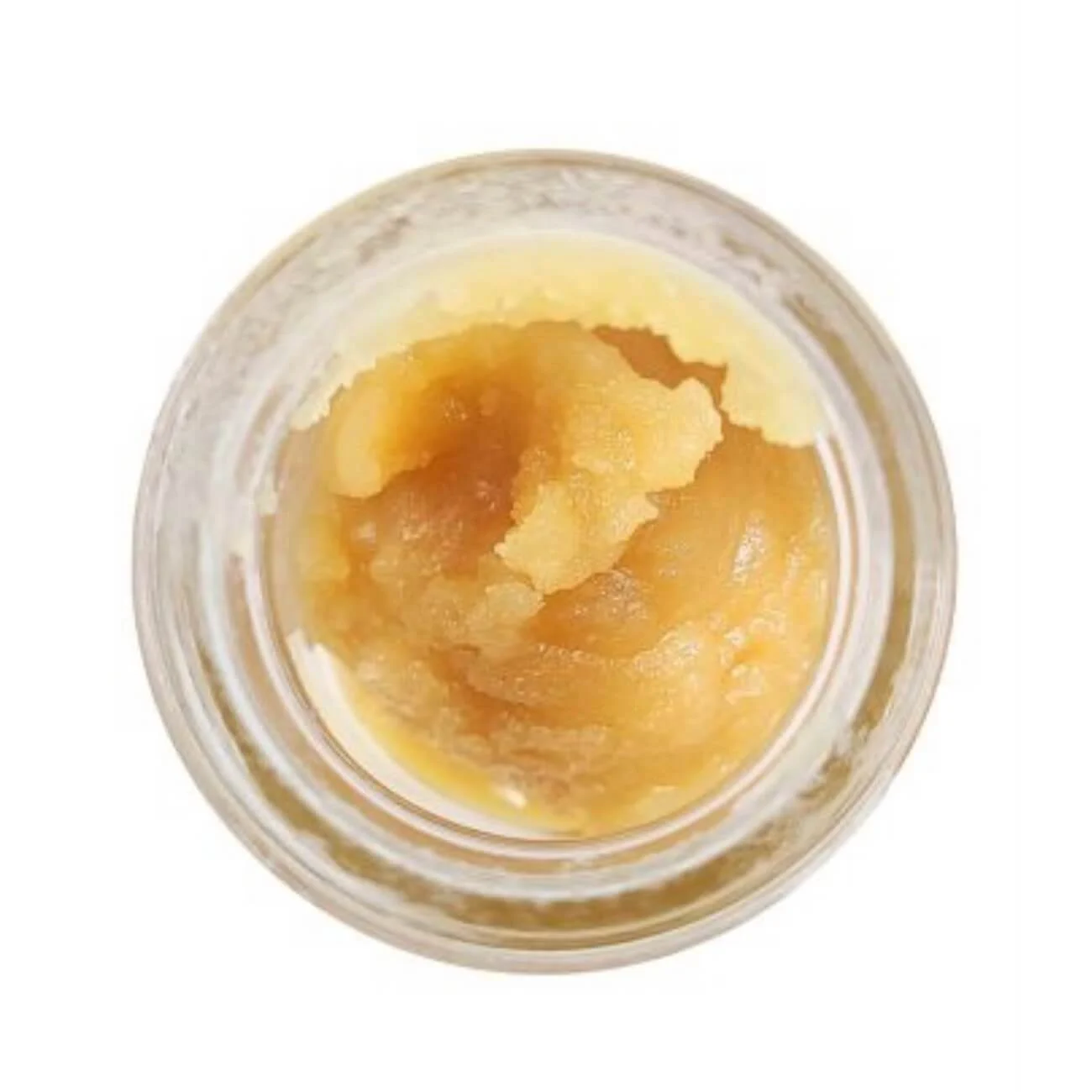
Pink Panties Live Resin is a cannabis concentrate associated with the Pink Panties cultivar.
Pink Panties is currently described by Leafly as an indica with Burmese Kush × Florida Kush backcross genetics. Its reference flower profile is approximately 19% THC and 1% CBG, with caryophyllene listed as the dominant terpene followed by myrcene and limonene. Consumer reports most frequently describe aroused, relaxed and sleepy experiences.
These are consumer-reported strain characteristics, not guaranteed medical effects.
Live resin is also different from ordinary cannabis flower. A concentrate can contain a substantially different cannabinoid concentration, so Pink Panties flower potency should never simply be copied onto a Pink Panties Live Resin description.
For a specific product, useful information includes:
- total THC and THCA;
- CBD and other cannabinoids;
- terpene profile;
- batch number;
- laboratory testing;
- producer information;
- contaminant screening.
For more cannabis concentrate education, see Cannabistopgrade Cannabis Concentrates and Dabbing Guide, explore Cannabistopgrade Hash and Concentrates, and visit Cannabistopgrade.com.
Pink Panties Live Resin Quick Facts
| Topic | Educational overview |
|---|---|
| Product | Pink Panties Live Resin |
| General strain classification | Indica |
| Documented lineage | Burmese Kush × Florida Kush backcross |
| Reference flower THC | About 19% |
| Exact live-resin THC | Batch-specific |
| Dominant terpene | Caryophyllene |
| Common consumer reports | Aroused, relaxed, sleepy |
| Dagga | Common southern African term for cannabis |
| Ganja | Common term for cannabis/marijuana |
| THC | Main intoxicating cannabinoid |
| Long-term effects | Depend strongly on frequency, age, potency and individual factors |
What Weed Can Do to Your Body
The question “what weed can do to your body” covers several biological systems.
Cannabis contains cannabinoids that interact with receptors throughout the brain and body. THC is principally responsible for cannabis intoxication.
CDC states that cannabis can affect the brain, heart, lungs, mental health, coordination and other aspects of health. The magnitude of those effects can vary depending on THC concentration, frequency of use, age, method of administration and individual susceptibility.
Potential short-term effects can include:
- altered perception;
- impaired short-term memory;
- slower reaction time;
- impaired coordination;
- changes in attention;
- changes in appetite;
- increased heart rate;
- anxiety or paranoia in some people.
Cannabis does not affect everyone identically.
A person using a lower-THC flower product may experience something very different from someone exposed to a highly concentrated THC extract.
What Does Weed Do to Your Body?
A useful way to understand what does weed do to your body is to look at individual systems.
Brain
Cannabis directly affects brain functions involved in:
- memory;
- attention;
- learning;
- decision-making;
- coordination;
- emotion;
- reaction time.
CDC reports that recent cannabis use can immediately affect thinking, attention, memory, movement, coordination and perception of time.
This is why cannabis intoxication can interfere with driving and other tasks that require rapid judgment.
Heart and Circulation
Cannabis can temporarily increase heart rate and raise blood pressure immediately after use.
CDC notes that research is continuing into possible relationships between cannabis use and cardiovascular outcomes such as heart disease and stroke.
The evidence should be interpreted carefully because many cardiovascular studies involve people who smoked cannabis, making it difficult to separate cannabinoid effects from smoke exposure.
Lungs
Smoking cannabis introduces combustion products into the respiratory system.
CDC states that smoked cannabis can damage lung tissue and small blood vessels and that cannabis smoke contains many of the same toxins, irritants and carcinogens found in tobacco smoke.
Smoking cannabis is associated with:
- coughing;
- increased mucus;
- bronchitis symptoms;
- airway irritation.
More research is still needed to define the relationship between cannabis smoking and diseases such as lung cancer and COPD.
What Does Dagga Do to Your Body?
Dagga is a term commonly used for cannabis, particularly in southern Africa.
It does not refer to a completely different drug.
Therefore, the answer to “what does dagga do to your body?” is broadly the same as the answer for marijuana or cannabis.
THC-containing dagga can affect:
- thinking;
- memory;
- reaction time;
- coordination;
- perception;
- mood;
- heart rate.
The risks depend partly on how much THC is consumed and how frequently cannabis is used.
A low-potency cannabis flower and a highly concentrated product such as live resin are not equivalent exposures.
This matters for Pink Panties Live Resin, because concentrates can potentially deliver substantially more THC than ordinary flower.
CDC notes that some concentrates, including products called extracts, wax, shatter, budder and live resin, can contain high concentrations of THC.
Is Marijuana Bad for You?
Marijuana is not risk-free, but “is marijuana bad for you?” is too broad to answer properly with only yes or no.
Risk differs according to:
- age;
- THC concentration;
- frequency of use;
- method of consumption;
- pregnancy status;
- cardiovascular or respiratory health;
- mental-health vulnerability;
- simultaneous alcohol or drug use.
CDC states that the fact cannabis is legal for medical or adult use in some states does not mean it is harmless.
Some important risk categories include:
Impairment
Cannabis can reduce reaction time, coordination, attention and decision-making.
Lung Exposure
Smoking cannabis introduces harmful combustion products into the lungs.
Cannabis Use Disorder
Some people develop difficulty controlling their cannabis consumption.
Mental Health Effects
Cannabis can cause anxiety, paranoia and disorientation in some people.
Cardiovascular Effects
Cannabis can temporarily increase heart rate and blood pressure.
Developing Brain
Adolescents and young adults have additional concerns because brain development continues into the mid-20s.
Long-Term Effects on Cannabis Users
The search phrase long term effects on cannabis usually means long-term effects of repeated cannabis use.
Research is still developing, and not every association proves direct causation.
However, several areas deserve attention.
Cannabis Use Disorder
CDC estimates that approximately 3 in 10 people who report cannabis use may have cannabis use disorder.
Risk increases among people who start younger or use cannabis more frequently.
Possible signs include:
- trying unsuccessfully to stop;
- craving cannabis;
- continuing despite problems;
- giving up activities to use cannabis;
- needing increasingly strong products to achieve similar effects.
CDC also notes that high-THC products may be associated with more severe cannabis-use-disorder symptoms.
Memory, Attention and Learning
Heavy or frequent cannabis use can affect memory, attention and learning.
CDC says heavy daily or near-daily use can impair these functions, and effects may persist for a week or longer after the last use.
The developing adolescent brain appears especially vulnerable.
Respiratory Symptoms
Regular smoking can contribute to chronic cough, increased mucus and bronchitis-type symptoms.
CDC reports that these symptoms often improve after cannabis smoking stops.
Mental Health Associations
Cannabis use is associated with increased risk of psychosis and schizophrenia, with stronger associations among people who begin earlier and use cannabis more frequently.
Cannabis has also been associated with depression, social anxiety and suicidal thoughts or behavior, although scientists continue to investigate the nature and direction of these relationships.
It is more accurate to say associated with rather than claiming cannabis directly causes every condition.
Negative Effects of Marijuanas
The phrase negative effects of marijuanas refers to potential adverse effects of cannabis use.
Short-term negative effects can include:
- anxiety;
- paranoia;
- disorientation;
- impaired memory;
- impaired coordination;
- slower reactions;
- dry mouth;
- increased heart rate.
With high THC exposure, some people may experience more intense anxiety, confusion or psychotic symptoms.
CDC notes that products containing very high concentrations of THC can have stronger intoxicating effects and increase the likelihood of overconsumption.
This is particularly relevant to concentrate products.
Pink Panties Live Resin and High-Potency THC
A product being called Pink Panties Live Resin does not establish one fixed THC percentage.
Live resin is a concentrate format.
Some cannabis concentrates can contain substantially greater THC concentrations than flower, which means their effects and risks should not be inferred from Pink Panties’ roughly 19% reference flower profile.
CDC specifically identifies live resin among concentrate categories capable of delivering high concentrations of THC.
Therefore:
Pink Panties flower THC ≠ Pink Panties Live Resin THC.
Always use the laboratory result for the actual concentrate batch.
Smoking Ganja
Smoking ganja means smoking cannabis.
When cannabis burns, a person is exposed both to cannabinoids and to substances created through combustion.
This makes the health effects of smoking ganja different from the effects of THC alone.
CDC reports that cannabis smoke contains many of the same types of toxins and carcinogenic chemicals found in tobacco smoke.
Common smoking formats include:
- joints;
- pipes;
- bowls;
- bongs;
- blunts.
Changing the smoking device does not eliminate combustion exposure.
Secondhand Ganja Smoke
Secondhand cannabis smoke is also relevant.
CDC states that secondhand cannabis smoke contains many of the same toxic and cancer-causing chemicals as tobacco smoke and can also contain THC.
People exposed to enough secondhand cannabis smoke can experience psychoactive effects under some conditions.
Children are an especially important concern because their developing brains may be more vulnerable to THC exposure.
Therefore, the potential health impact of smoking cannabis is not necessarily limited to the person smoking.
Cannabis and Mental Health
Cannabis can cause:
- anxiety;
- paranoia;
- disorientation.
For some individuals, stronger psychological effects can occur.
CDC reports that cannabis use is associated with psychosis and schizophrenia and that this association is stronger among people who begin at younger ages or use cannabis more frequently.
However, these relationships are complex.
Genetics, frequency, THC potency, age of first use and underlying mental-health vulnerability can all influence risk.
A strain name such as Pink Panties cannot predict whether an individual person will experience anxiety, relaxation or another psychological response.
Pink Panties Effects
Leafly’s current Pink Panties profile most frequently reports:
Aroused
Relaxed
Sleepy.
Its three leading flavor descriptions are:
Rose
Lavender
Flowery.
The currently reported major terpenes include:
Caryophyllene
Myrcene
Limonene.
Some consumers also report dry mouth, headache and dry eyes as negative experiences.
These reports should not be interpreted as evidence that Pink Panties Live Resin treats anxiety, insomnia, PTSD, sexual dysfunction or another health condition.
Leafly itself identifies the information as user-reported and not a substitute for medical advice.
Pink Panties Flower vs. Live Resin
| Feature | Pink Panties Flower | Pink Panties Live Resin |
|---|---|---|
| Product type | Dried cannabis flower | Cannabis concentrate |
| Classification | Indica | Concentrated Pink Panties product |
| Reference THC | About 19% | Must be batch tested |
| Dominant terpene | Caryophyllene | May differ by batch/process |
| Potency | Variable | Often more concentrated |
| Consumer reports | Relaxed, sleepy, aroused | Cannot be assumed identical |
| Health effects guaranteed? | No | No |
| Laboratory testing important? | Yes | Yes |
For additional information about concentrated cannabis products, see Cannabistopgrade’s concentrate education guide.
Is Weed Always Dangerous?
Not every person experiences the same level of risk.
For example, risks can differ substantially between:
- occasional and daily use;
- lower-THC and highly concentrated products;
- adults and adolescents;
- smoking and non-combustion methods;
- people with and without certain health vulnerabilities.
That does not mean cannabis is harmless.
The more accurate statement is:
Cannabis has documented short- and long-term risks, but the magnitude of those risks varies according to exposure, age, product potency, consumption method and individual susceptibility.
Frequently Asked Questions
1. What is Pink Panties Live Resin?
Pink Panties Live Resin is a concentrated cannabis product associated with the Pink Panties cultivar. Leafly currently identifies Pink Panties as Burmese Kush × a Florida Kush backcross and classifies it as indica. Exact live-resin potency must come from the individual product’s laboratory test.
2. What does weed do to your body?
Cannabis can affect the brain, heart, lungs, coordination and mental health. Short-term effects can include altered perception, impaired memory and reaction time, increased heart rate and anxiety or paranoia in some people.
3. What does dagga do to your body?
Dagga is another term for cannabis. Its effects therefore depend primarily on the cannabinoids consumed, especially THC, as well as potency, frequency and method of use.
4. What are the long-term effects of cannabis?
Potential long-term concerns include cannabis use disorder, persistent effects on memory and learning with heavy use, respiratory problems from smoking and associations with psychosis or other mental-health outcomes in susceptible populations.
5. Is marijuana bad for you?
Cannabis is not risk-free. The degree of harm varies according to age, frequency, THC concentration, method of use and individual health factors. Highly concentrated THC products may produce stronger effects and greater risk of overconsumption.
Authoritative Outbound Links
CDC – Cannabis and Brain Health
| Quantity | 1/8 oz(3.5g), 1/4 oz (7g), 1/2 oz (14g), 1 oz (28g) |
|---|
Be the first to review “Pink Panties Live Resin”
Related products
Buy THC Extracts Online
Buy THC Extracts Online
Buy THC Extracts Online
Buy THC Extracts Online
Buy THC Extracts Online
Buy THC Extracts Online
Buy THC Extracts Online
Buy THC Extracts Online
Reviews
There are no reviews yet.