
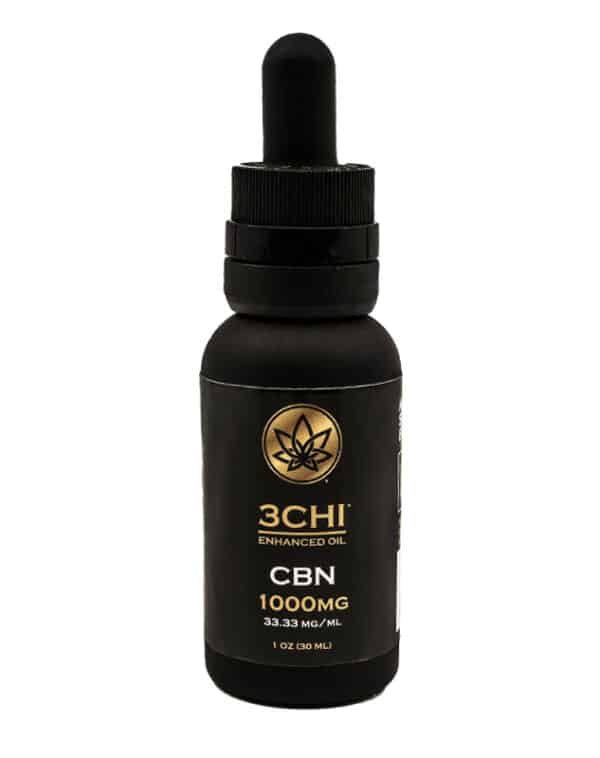
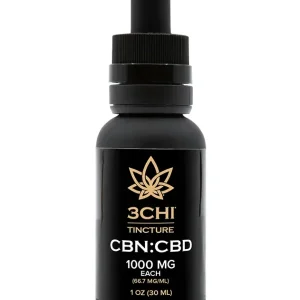
CBN Oil – Broad Spectrum is a hemp-derived cannabinoid tincture currently offered by 3CHI. Unlike a THC-dominant cannabis flower or intoxicating delta-8 tincture, this product is formulated primarily around CBN, or cannabinol, together with CBD, CBC and other minor cannabinoids.
3CHI currently lists the product as a 30 mL broad-spectrum CBN oil containing 1,000 mg CBN, equivalent to approximately 33.3 mg CBN per mL. Its listed ingredients are hemp extract, medium-chain triglycerides and vitamin E. The manufacturer says the formula contains CBD, CBC and other minor cannabinoids and is the same broad-spectrum formulation previously sold under an older version of the Comfortably Numb name.
| Product detail | Current information |
|---|---|
| Product | CBN Oil – Broad Spectrum |
| Brand | 3CHI |
| Bottle size | 30 mL / 1 oz |
| CBN | 1,000 mg total |
| Approximate CBN concentration | 33.3 mg/mL |
| Other cannabinoids | CBD, CBC and other minor cannabinoids |
| Carrier | MCT oil |
| Product type | Broad-spectrum hemp extract |
| Primary cannabinoid | CBN |
| THC status | Check the current batch COA rather than assuming |
| FDA-approved medicine? | No |
The distinction between broad spectrum, full spectrum and isolated cannabinoids is important. A broad-spectrum product usually aims to retain multiple cannabinoids while reducing or removing measurable THC, whereas a full-spectrum extract can retain a wider cannabinoid profile that may include THC. Exact composition should always be confirmed through the current product’s Certificate of Analysis.
For further cannabis education, explore Cannabistopgrade Cannabis Education, Cannabistopgrade Hash and Concentrates and Cannabistopgrade Cannabis Concentrates and Dabbing.
What Is CBN?
CBN, or cannabinol, is one of the numerous cannabinoids associated with Cannabis sativa.
CBN is chemically different from delta-9 THC, CBD and CBG. Cannabis chemistry is also dynamic: peer-reviewed research describes how THCA can convert to THC through decarboxylation and how THC can subsequently degrade toward CBN over time.
This does not mean every CBN product is simply “old THC.” Commercial cannabinoid products may use specifically prepared and purified extracts.
FDA documentation recognizes CBN alongside THC and CBD among cannabinoids found in cannabis.
CBN is often marketed in products associated with nighttime relaxation, but consumer marketing should not be treated as proof that CBN cures insomnia or another medical condition. Research into many minor cannabinoids remains considerably less developed than research into THC and CBD.
Is Broad-Spectrum CBN Oil Intoxicating?
A broad-spectrum CBN oil is generally formulated differently from a THC-dominant cannabis product.
3CHI’s current page describes its CBN Oil – Broad Spectrum as a low-potency product centered on CBN, CBD, CBC and related cannabinoids. The manufacturer also acknowledges that people can respond differently to CBN and that some consumers report mild intoxicating effects while others do not.
That variation means it is better to avoid categorical statements such as:
“CBN can never impair you.”
Likewise, a product marketed as broad spectrum should not automatically be assumed to contain absolutely zero THC without confirming its batch-specific analytical report.
What Does “Top Shelf Cannabinoids” Mean?
The phrase top shelf cannabinoids is mostly marketing language rather than a scientific or government-defined grade.
Cannabinoids themselves are chemical compounds. They do not become “top shelf” in the way that a government agency might officially grade an agricultural commodity.
A better way to judge cannabinoid-product quality is through measurable indicators.
| Quality factor | Stronger evidence | Weak evidence |
|---|---|---|
| Cannabinoid identity | Laboratory-confirmed | Marketing name only |
| Potency | Batch-specific COA | Large number on packaging |
| THC content | Specifically measured | “THC-free” with no report |
| Heavy metals | Tested | Not mentioned |
| Pesticides | Tested | Not mentioned |
| Residual solvents | Tested where relevant | Not disclosed |
| Batch number | Product matches report | Generic COA |
| Laboratory | Clearly identified | Anonymous test |
| Claims | Cautious and specific | “Cures everything” |
FDA emphasizes that cannabis contains more than 80 biologically active compounds and warns that cannabinoid products marketed outside approved drug pathways can present quality and labeling concerns.
So top shelf cannabinoids should mean transparent chemistry and credible manufacturing—not simply expensive packaging.
Top Shelf Strains
Top shelf strains is another commercial expression without one universal technical definition.
In dispensary language, “top shelf” often refers to cannabis flower marketed as especially desirable because of factors such as appearance, aroma, genetics, cultivation, trimming, freshness or cannabinoid and terpene profile.
But there is no federal cannabis grade called Top Shelf.
A useful assessment considers:
Genetics and cultivar identity. Is the strain actually what the label claims?
Freshness. Old, overly dry flower can lose aromatic quality regardless of genetics.
Trichome condition. Cannabis resin glands contain cannabinoids and terpenes.
Laboratory results. THC percentage alone does not define overall quality.
Contaminant screening. A visually attractive flower can still have unwanted contaminants.
Curing and storage. Poor post-harvest handling can undermine otherwise good cannabis.
Therefore, a 30%-THC flower is not automatically more “top shelf” than a well-grown 20%-THC cultivar.
Top Shelf Does Not Mean Highest THC
Cannabis quality is multidimensional.
Two flower batches could look like this:
| Batch | THC | Other considerations |
|---|---|---|
| Flower A | 31% | Old, poorly stored, limited aroma |
| Flower B | 22% | Fresh, well cured, strong terpene profile |
Potency is just one variable.
This is particularly important for SEO pages because cannabis searches often equate highest THC with best, when those are not identical concepts.
Tree of Weed: What Does the Phrase Mean?
Tree of weed is an informal expression for a cannabis plant.
Cannabis is not botanically classified as a tree. It is generally an annual flowering plant belonging to the Cannabaceae family.
FDA describes cannabis as a plant containing more than 80 naturally occurring biologically active compounds, including the well-known cannabinoids THC and CBD.
Depending on genetics and environmental conditions, cannabis plants can become quite large and highly branched, which probably explains expressions such as:
“weed tree”
“tree of weed”
and
“cannabis tree.”
But these are descriptive slang terms rather than separate botanical categories.
Cannabis Trees
Similarly, cannabis trees are not a distinct species of tree.
Plants within Cannabis sativa can vary dramatically in shape, height, branching, leaf morphology and flower structure.
What consumers sometimes call cannabis trees may simply be particularly large cannabis plants.
Different cultivars can also display visibly different growth characteristics, but plant appearance alone cannot reliably determine:
- THC percentage;
- CBD content;
- CBN content;
- strain authenticity;
- indica or sativa effects;
- legal classification.
Chemical testing is needed for cannabinoid composition.
Cannabis Plant vs. Cannabis Product
It is useful to distinguish the plant from processed products:
| Cannabis material | Description |
|---|---|
| Flower | Dried flowering material |
| Hash | Concentrated resin/trichomes |
| Rosin | Mechanically extracted concentrate |
| Oil | Extracted cannabinoid preparation |
| Tincture | Cannabinoids carried in oil or another liquid |
| Edible | Food containing cannabinoids |
| Vape extract | Concentrated formulation designed for vaporization |
| Topical | Product applied to the skin |
CBN Oil – Broad Spectrum belongs in the oil/tincture category rather than the cannabis-flower category.
Different Types of THC
The phrase different types of THC can refer to different molecular forms, isomers and related cannabinoid compounds.
The terminology is frequently confused online.
The most important distinction is that not every cannabinoid with “THC” in the name behaves identically.
Delta-9 THC
Delta-9 THC, formally delta-9-tetrahydrocannabinol, is the primary cannabinoid responsible for the classic intoxicating effects associated with marijuana.
FDA identifies THC as the compound responsible for the marijuana “high.”
When people casually say:
THC
they usually mean delta-9 THC.
Delta-8 THC
Delta-8 THC is an isomer related to delta-9 THC.
CDC states that delta-8 can occur naturally in cannabis in small amounts and can also be produced from CBD. It is psychoactive and can therefore alter perception and produce intoxication. CDC also notes that its health effects are not yet as well understood as those of conventional delta-9 THC.
That makes delta-8 different from non-intoxicating cannabinoids such as CBD.
Delta-10 THC
Delta-10 THC is another THC isomer marketed in some hemp-derived cannabinoid products.
Research on commercial delta-10 products is far less extensive than research on delta-9 THC.
Consumers should therefore be cautious about websites that assign highly specific guaranteed effects such as:
“Delta-10 always gives energy.”
Human responses to cannabinoids are not that predictable.
THCA
THCA, or tetrahydrocannabinolic acid, is technically not simply another intoxicating “type of THC.”
It is the acidic precursor from which delta-9 THC can form.
Peer-reviewed research explains that THCA accumulates in glandular trichomes on cannabis flowers and leaves and can convert to THC through decarboxylation, particularly during heating.
Therefore:
THCA ≠ delta-9 THC
but
THCA can convert into delta-9 THC.
A Simple THC Types Table
| Compound | What it is | Intoxicating? |
|---|---|---|
| Delta-9 THC | Main conventional THC isomer | Yes |
| Delta-8 THC | Closely related THC isomer | Yes |
| Delta-10 THC | Another THC isomer | Potentially |
| THCA | Acidic precursor to delta-9 THC | Not classically intoxicating before conversion |
| CBN | Different cannabinoid, associated partly with THC degradation | Not equivalent to delta-9 THC |
| CBD | Different cannabinoid | Does not produce the classic THC high |
This is why CBN Oil – Broad Spectrum should not be described as simply another form of THC oil.
Types of THC vs. Types of Cannabinoids
These phrases are frequently confused.
THC types refer to forms or isomers related to tetrahydrocannabinol.
Cannabinoids is the larger chemical family.
FDA states that Cannabis sativa contains more than 80 naturally occurring compounds classified as cannabinoids.
Examples include:
THC,
CBD,
CBN,
CBG,
CBC,
and their acidic precursors.
Therefore, CBN is a cannabinoid, but CBN is not a type of THC.
CBD is also a cannabinoid, but CBD is not THC.
That distinction should be maintained throughout educational cannabis content.
Forms of Marijuana
The keyword forms of marijuana can refer to the numerous ways cannabis plant material and extracts are prepared.
Modern regulated cannabis markets commonly contain several broad product categories.
Cannabis Flower
Flower is dried cannabis bud.
Its cannabinoid profile usually contains substantial THCA when the plant is THC-dominant, along with variable concentrations of CBD, CBG and other compounds.
Pre-Rolls
Pre-rolls contain prepared cannabis flower in ready-made paper cones or joints.
Some may contain ordinary flower, while others contain added concentrates.
Hash
Hash concentrates the resin-rich trichomes of cannabis.
Potency can differ substantially from the flower from which the hash originated.
Concentrates
Concentrates include products such as:
wax,
budder,
live resin,
rosin,
shatter,
and various oils.
CDC notes that cannabis concentrates can expose consumers to particularly high concentrations of THC and may carry additional risks.
Edibles
Edibles include gummies, chocolates, baked products and beverages containing cannabinoids.
Their effects differ from inhaled cannabis because cannabinoids are processed through the digestive system.
Tinctures and Oils
Tinctures and oral oils provide cannabinoids in a liquid carrier.
CBN Oil – Broad Spectrum belongs here.
Vape Products
Cannabis vaping products use concentrated cannabinoid formulations designed for vaporization.
Their chemistry varies significantly by product and market.
Topicals
Topicals include lotions, balms and creams containing cannabis-derived compounds.
Not every topical is formulated to produce systemic intoxication.
Marijuana Forms Compared
| Form | Typical measurement | Main characteristic |
|---|---|---|
| Flower | % cannabinoids | Dried plant material |
| Hash | % cannabinoids | Concentrated resin |
| Concentrates | % cannabinoids | Highly concentrated extracts |
| Gummies | mg per piece | Edible |
| Chocolates | mg per serving | Edible |
| Tinctures | mg per mL | Liquid cannabinoid extract |
| Vape products | % or mg | Inhaled concentrate |
| Topicals | mg per container/application | Applied externally |
This makes it easier to understand why numbers cannot always be compared directly.
For example:
25% THC flower
and
25 mg THC tincture
do not mean the same thing.
Broad Spectrum vs. Full Spectrum vs. Isolate
These terms are particularly relevant to CBN Oil – Broad Spectrum.
Broad Spectrum
Broad-spectrum products generally contain multiple cannabinoids while attempting to minimize or remove THC.
The exact profile still depends on the product.
Full Spectrum
Full-spectrum extracts aim to retain a wider mixture of naturally occurring cannabis compounds and may include measurable THC.
Isolate
An isolate is a highly purified individual cannabinoid.
Examples include:
CBD isolate
or
CBN isolate.
A product marketed as isolate should therefore have a narrower cannabinoid profile than a broad-spectrum tincture.
Comparison
| Extract type | Multiple cannabinoids | THC possible? | Example |
|---|---|---|---|
| Isolate | Usually one primary cannabinoid | Product-dependent / usually minimized | CBN isolate |
| Broad spectrum | Yes | Often minimized or non-detectable, verify COA | CBN Oil – Broad Spectrum |
| Full spectrum | Yes | Often yes | Full-spectrum cannabis oil |
Marketing terminology alone is not enough. The current COA remains the most reliable way to understand a specific batch.
Is CBN the Same as CBD?
No.
CBN and CBD are different cannabinoids.
CBD, or cannabidiol, has received considerably more scientific attention than CBN.
FDA notes that it has approved only one prescription CBD medicine for particular seizure disorders and warns against assuming that ordinary retail CBD products are approved treatments for other conditions.
The same principle applies even more strongly to CBN: claims that CBN products definitively treat insomnia, pain, anxiety or another medical condition require appropriate clinical evidence.
Does CBN Make You Sleep?
CBN is heavily marketed around sleep and nighttime relaxation, but consumer anecdotes are not equivalent to strong clinical proof.
3CHI’s current product page itself describes its sleep-related positioning as based largely on anecdotal reports and acknowledges that formal supporting research is limited.
A more accurate statement is:
CBN is commonly marketed in nighttime cannabinoid products, but research is not strong enough to guarantee a sleep benefit for every user.
This phrasing keeps the page useful without turning an emerging cannabinoid into an unproven medical treatment.
Is CBN Oil a Marijuana Product?
Not necessarily.
CBN can be obtained from hemp-derived cannabinoid material as well as marijuana-derived cannabis.
The current 3CHI CBN Oil – Broad Spectrum is marketed as a hemp extract.
The legal distinction between hemp and marijuana is therefore not simply based on the presence of CBN.
Cannabinoid composition and applicable law matter.
Why Laboratory Testing Matters for CBN Oil
For a cannabinoid tincture, useful laboratory testing can answer several important questions at once.
It can determine whether the product contains the advertised amount of CBN, whether THC is actually non-detectable or present at some concentration, whether additional cannabinoids such as CBD or CBC are present, and whether screening has found concerning levels of contaminants.
FDA has warned that cannabinoid products have sometimes contained cannabinoid amounts inconsistent with their labels and that products may also present risks involving contaminants such as pesticides, heavy metals or THC.
That makes laboratory transparency more meaningful than a “top shelf” badge.
Frequently Asked Questions
1. What is CBN Oil – Broad Spectrum?
CBN Oil – Broad Spectrum is a 3CHI hemp-derived tincture containing CBN together with CBD, CBC and other minor cannabinoids. The current 30 mL, 1,000 mg formulation provides approximately 33.3 mg CBN per mL.
2. What are top shelf cannabinoids?
“Top shelf cannabinoids” is not an official scientific grade. Higher-quality cannabinoid products are better evaluated through batch testing, accurate potency, contaminant screening, manufacturing transparency and realistic claims.
3. Is a cannabis tree actually a tree?
No. “Cannabis tree,” “weed tree” and “tree of weed” are informal expressions for large cannabis plants. Cannabis sativa is a flowering plant rather than a botanical tree.
4. What are the main different types of THC?
Commonly discussed forms include delta-9 THC, delta-8 THC and delta-10 THC. THCA is closely related but is technically the acidic precursor that can convert into delta-9 THC when heated. Delta-8 is psychoactive, while research into several less-common THC isomers remains limited.
5. What are the major forms of marijuana?
Common forms include dried flower, pre-rolls, hash, concentrates, vape products, edibles, tinctures/oils and topicals. Each format has different cannabinoid concentrations and routes of exposure, so potency figures should not be compared without considering the product type.
Authoritative Outbound Resources
CDC – Cannabis Frequently Asked Questions
Be the first to review “CBN Oil – Broad Spectrum”
Related products
Cannabis Tincture
Hash
Cannabis Tincture
Buy THC Extracts Online
Buy THC Extracts Online
Cannabis Tincture
Hash
Cannabis Tincture
Reviews
There are no reviews yet.